In 2021 Ako Aotearoa launched the New Zealand Dyslexia-Friendly Quality Mark (DFQM) for tertiary education organisations. Little did Ako Aotearoa know how successful it would be. The DFQM has since been achieved by twenty-five organisations across Aotearoa New Zealand and led to increased awareness and understanding of dyslexia, improving support for dyslexic learners and raising learner success.
Ako Aotearoa is building on this success with a new report that scopes the development of a Neurodivergent-Friendly Quality Mark (NFQM) for the workplace. The NFQM aims to raise awareness of neurodiversity in workplaces across Aotearoa and ensure better support for neurodivergent staff.
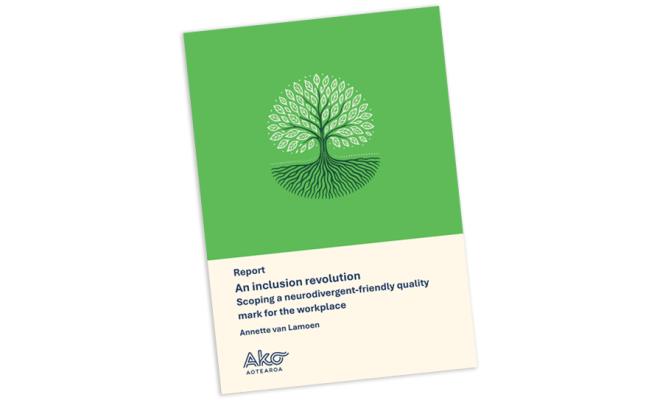
The report, An Inclusion Revolution: Scoping a Neurodivergent-Friendly Quality Mark for the Workplace, investigates how the NFQM can help workplaces become more inclusive and supportive of neurodivergent staff. It identifies barriers, highlights benefits, and provides recommendations for developing the Quality Mark. It also includes examples of inclusive workplace practices that organisations can implement.
The researcher of this report, Annette van Lamoen, also conducted surveys and consultation with stakeholder groups and neurodivergent people to identify the need for, and interest in, a NFQM, including the challenges that can exist for neurodivergent people in the workplace. Results from the consultation saw outstanding responses, with 95% of respondents agreeing that there is a need for a NFQM in Aotearoa New Zealand, and 91% of respondents expressing interest in registering for a NFQM if it were to be developed. The majority of the respondents labelled ‘a lack of neurodiversity awareness’ as one of the main challenges in the workplace.
Manako Principal Advisor, Vicky Beckwith has emphasised the importance of collaborating with neurodivergent people: “The report is values-based and ethically considered, with the voices of neurodivergent people sharing their own neurodivergent experiences. We aimed to learn from their lived experiences so that we could provide relevant, accurate and timely research that can support both neurodivergent ākonga (learners) and staff.”
The report is freely available to download through the Ako Aotearoa Knowledge Centre.