
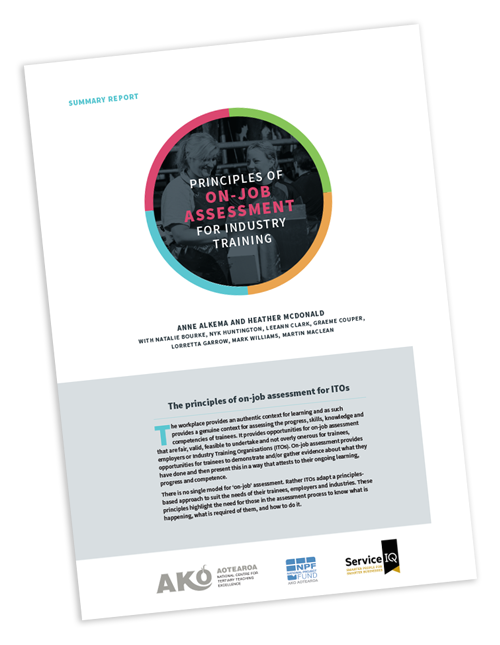
While there is no single model for ‘on-job’ assessment, these reports identify four key ‘Principles of on-job assessment for industry training’ that organisations can use to suit the needs of their trainees, employers and industries.
They also include reflective questions that organisations can use to guide professional conversations about on-job assessment.
The four organisational case studies provide specific examples of the assessment processes and practices that each organisation uses to meet the needs and demands of the specific industry, workplace and trainee involved.
Resource download:
Report | Principles of On-Job Assessment for Industry Training (PDF, 1Mb)
Summary report | Principles of On-Job Assessment for Industry Training (PDF, 3Mb)
Case study | Principles of On-Job Assessment for Industry Training – Practice Example 1 – BCITO (PDF, 600Kb)
Case study | Principles of On-Job Assessment for Industry Training – Practice Example 2 – The Skills Organisation (PDF, 300Kb)
Case study | Principles of On-Job Assessment for Industry Training – Practice Example 3 – ServiceIQ (PDF, 500Kb)
Case study | Principles of On-Job Assessment for Industry Training – Practice Example 4 – Competenz (PDF, 750Kb)
Background:
A project, completed in 2016, that reviewed assessment practices used by industry training organisations (ITOs) to identify models of good practice. This guide builds on Vaughan and Cameron’s (2010) principles and practices for on-job assessment work in 2012.
A collaboration of five ITOs, including ServiceIQ, BCITO, Primary ITO, The Skills Organisation and Competenz.
Report prepared for ServiceIQ and Ako Aotearoa by Anne Alkema and Heather McDonald, Heathrose Research Ltd.
Co-funded by the Ako Aotearoa National Project Fund (NPF)