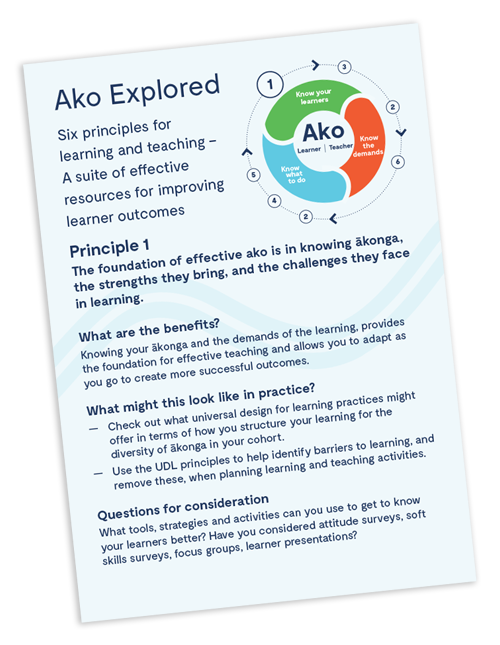
Six principles for enhancing learner outcomes in tertiary education
Ako Explored outlines six universal, evidence-based learning and teaching principles and related practices to enhance positive learner outcomes in the Aotearoa tertiary education sector.
This report outlines principles and practices designed to enhance teaching and leadership in tertiary education, serving as a versatile resource for educators, teams, professional developers, advisors, and tertiary education institutions.
A set of ‘coffee cards’ – one for each principle can be used by teaching teams or kaiako (educators) to challenge and extend their practice.
The principles can be contextualised in a wide range of learning and teaching settings.
BCITO | Te Pūkenga workplace learning advisors held a workshop to discuss the ways in which their existing practice aligns with Ako Explored principles. They found many synergies which reaffirmed their practice, although their context requires a learning approach quite different to class-based learning and teaching.
BCITO | Te Pūkenga workplace learning advisers consider briefly how the Ako Explored principles relate to their practice.
Unitec | Te Pūkenga Academic Advisors outline some ways in which they would use Ako Explored or encourage others to use the principles, practices, or questions.
Unitec | Te Pūkenga Academic Advisors talk about the roles of knowing, being, and doing as part of the learning process and how this can be considered in how learning is structured.
Unitec | Te Pūkenga Academic Advisors consider the ways in which relationships can be established and nurtured through the effective use of digital technologies.
Ako overview
Dr Marcia Leenen-Young’s teaching practice is wrapped around an intimate understanding of Ako (learning and teaching) and the key roles both kaiako (educators) and ākonga (learners) play in the learning and teaching process.
Associate Professor Diane Ruwhiu weaves her teaching practice the learning process around Ako (learning and teaching). She sees this as the core from which the other principles arise.
Principle 1 | Know your learners
The foundation of effective ako (learning and teaching) is in knowing ākonga (learners), the strengths they bring, and the challenges they face in learning.
While Associate Professor Christian Schott notes the criticality of experience as part of the learning process, his starting point is a deep understanding of his ākonga (learners) and their diverse backgrounds and life experiences.
Teaching a demanding topic with a very diverse cohort of students encourages Dr Cami Sawyer to understand her students, what they bring, and the challenges they face. This is the platform on which she builds a connectionist approach to teaching.
Principle 2 | Know what to do
Knowing and using targeted and relevant practices to achieve successful outcomes with ākonga (learners), will strengthen and improve ako (learning and teaching).
In redeveloping courses, David Cox’s strengths are in an intimate understanding of the content and knowing how to adapt his teaching to engage learners and enhance their ability to be successful in the course and beyond.
Associate Professor Kathryn MacCullum utilises a wide range of strategies to engage learners, but at the core of her teaching is the ability to choose the right suite of practices to engage learners and enhance their success.
Principle 3 | Relationships
Ako (learning and teaching) requires positive interpersonal relationships.
At the heart of Professor Richard Easter’s practice is the unwavering commitment to connections and collaboration, and the importance of people in the learning process in the face of intellectually challenging content.
Jamie Smiler, who sees himself as a Māori educator, embeds relationships with ākonga (learners) at the heart of his practice.
Principle 4 | Experience
A focus on experience, and the opportunity to reflect on it, complements and strengthens ako (learning and teaching).
Professor Carolyn Gates exemplifies the importance of weaving experience meaningfully into teaching and remaining intimately connected to the practice environment.
Using a broad array of inclusive pedagogies, Professor Hazel Tucker addresses very complex issues by maximising the experiences her diverse students bring to learning.
Principle 5 | Constructive alignment
Ako (learning and teaching) is enhanced when there is clear alignment between intended learning outcomes, learning and teaching activities, and assessment.
Dr Richard Lobb bases his interactive style of teaching on a keen understanding of how the learning outcomes, learning activities and assessments align to enhance learning and success.
Dr Nick Munn teaches primarily online but does so in a way that is engaging and accessible to learners. He ensures that the teaching and learning activities are creatively connected to the learning outcomes of the course and the subsequent assessments, ensuring relevance and connectedness.
Principle 6 | High expectations
Shared high expectations and challenging tasks are motivations for growth and development.
Dr Brendon Dunphy expressly states that he aims to challenge students but does so in a way that supports ākonga (learners) and sustains learning in the long term.
Professor Andy Martin sees challenge and high expectations as a key component of teaching and learning. He encourages his ākonga (learners) to strive to achieve high standards that set them up for academic and career success.
Background:
These resources were created for Ako Aotearoa in 2023 by Linda Keesing-Styles.
They include evidence-based learning and teaching strategies derived from literature and practice to support education and work-based learning organisations to determine priority practices that enhance learner success and outcomes.
They can also guide kaiako (educators) to reflect and continuously improve practice through a series of indicative practices and questions for consideration.