
An equitable and outcome-focused approach in Aotearoa New Zealand
As a scoping study, this project outlines the current landscape, focusing on the challenges and opportunities AI presents for institutions such as Private Training Establishments (PTEs), Institutes of Technology and Polytechnics (ITPs), and universities.
This project has led to the creation of 3 guides.
Resource download:
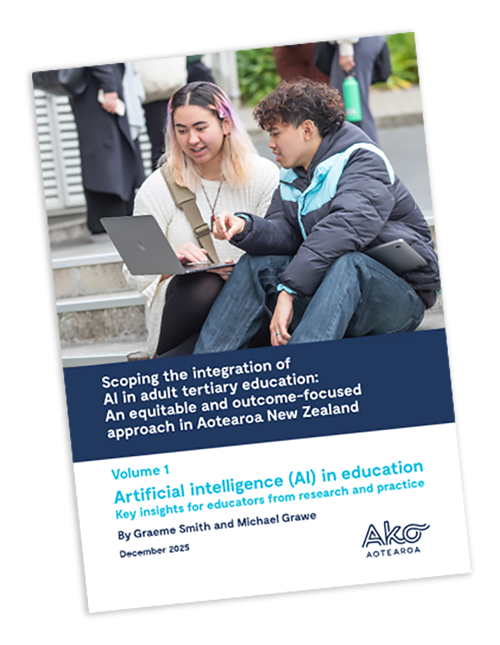
Volume 1 – Artificial intelligence (AI) in education
Volume 1 offers an in-depth exploration of artificial intelligence’s (AI) evolving role in education, with a focus on Aotearoa New Zealand’s diverse tertiary sector. These insights reveal both the opportunities and challenges of integrating AI into tertiary education settings.
Download volume 1 (PDF, 800Kb)
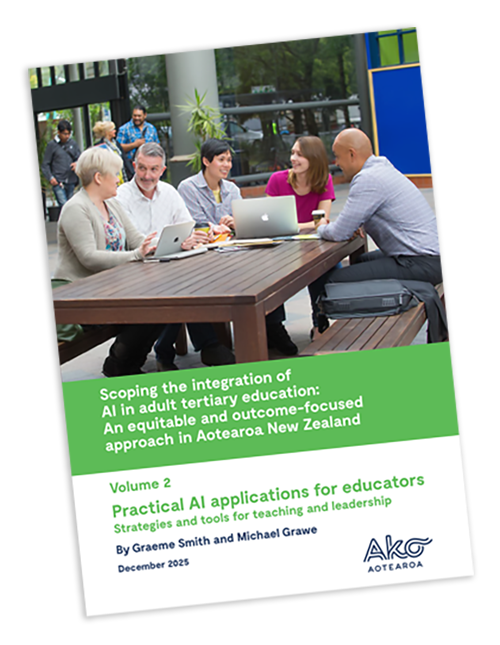
Volume 2 – Practical AI applications for educators
Volume 2 equips educators, leaders, and policymakers with practical strategies for integrating AI into teaching and administration. Educators will find tools, approaches, and step-by-step guidance to support the effective and ethical use of AI in classrooms and beyond.
Download Volume 2 (PDF, 2Mb)
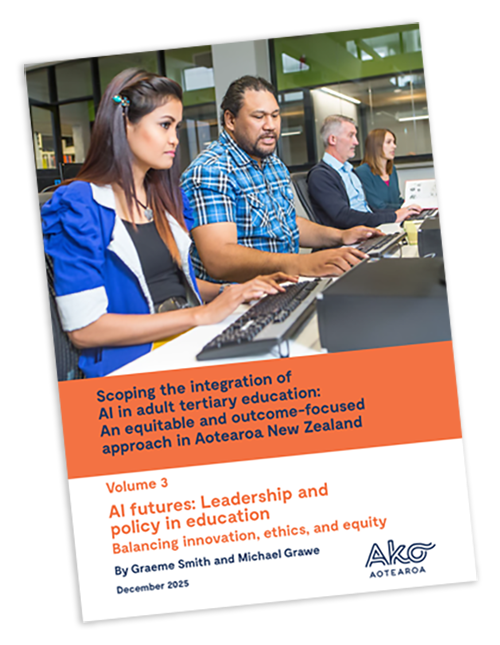
Volume 3 – Leadership and policy in education
Volume 3 shifts the focus to leadership and systemic change, this volume aims to equip education leaders with the tools to develop inclusive policies, design responsible AI frameworks, and address equity challenges in the evolving educational landscape.
Download Volume 3 (PDF, 1Mb)
Background:
As AI continues to reshape education, its successful integration hinges on thoughtful planning, ethical frameworks, and a commitment to inclusivity. While AI offers transformative potential, its benefits must be equitably distributed, ensuring that underserved communities are not left behind. Educational institutions have a responsibility to embed cultural responsiveness into AI tools and practices, particularly in diverse settings like Aotearoa New Zealand.
This project, completed in 2025, aimed to build educator, and organisational capability with using AI tools.
Resources prepared by Graeme Smith and Michael Grawe.
Co funded by the Ako Aotearoa Research and Innovation Agenda (AARIA)