
Research shows texts read by the trades students are as demanding as university-level academic texts.
The report aims to describe the trades-specific language used in the automotive technology, carpentry, fabrication and plumbing trades, as well as how this language is taught and learned at institutes of technology and polytechnics in New Zealand.
There is also a guide resource for organisations who want to see where they are at in terms of embedding, and wish to support their staff to develop embedding capability. It includes insights into literacy development in the trades, models and resources for capability development and strategies and resources for tutors.
Download the report:
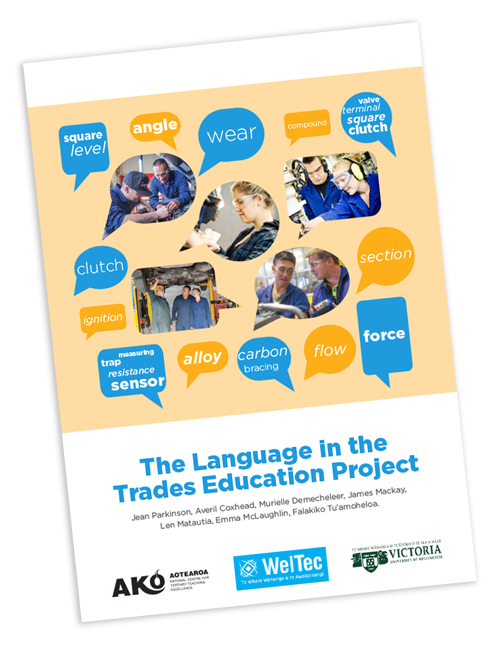
Report | The language in the trades education 2017 (PDF, 4.2Mb)
Guide | Working around the words: Unpacking language learning in vocational training (PDF, 2Mb)
Case study | Building Writing Skills In Trades Training: The Case of Carpentry (PDF, 2Mb)
Poster | Working around the words (PDF 2Mb)
Supporting videos
Tutors from a range of trades talk about the ways that they get learners to use the language of the trade and the way this helps to build understanding.
Tutors explain how simply drawing attention to trade specific language as part of the teaching process can learners to build their trade related vocabulary.
Trades tutors explain the role that modelling pays in supporting the development of trades related language with some ideas about how to do this in practice.
Ideas to set up before being face to face with the learners are shared from tutors who have had success setting up simple resources.
Creating a learning environment where the language of the trade is used as it would be on the job is discussed by tutors who use this technique.
Tutors discuss the strategies they use to support learners to understand the more challenging elements of trade specific language.
This tutor explains how he uses the first language of ESOL learners as a strength when supporting them to understand the language of the trade.
Background:
A three-and-a-half-year project exploring the vocabulary, genres and linguistic features of trades language. A collaboration between Victoria University of Wellington and WelTec.
Reports produced by Jean Parkinson, Averil Coxhead, Murielle Demecheleer, James Mackay, Len Matautia, Emma McLaughlin and Falakiko Tu’amoheloa.
Co-funded by the Ako Aotearoa National Project Fund (NPF)