
Translating scientific results, conclusions and recommendations into language easily understood by non-experts is a critical skill for scientists and science learners.
These reports document the development and evaluation of a suite of scenarios that can be used as real-time role-plays that develop communication skills.
Through these role-plays, learners can gain experience in realistic and challenging situations where they need to rapidly respond in an uncertain environment, and effectively communicate with a range of stakeholders.
Resource download:
Full report | Improving Science Communication through Scenario-based Role-plays (PDF, 3Mb)
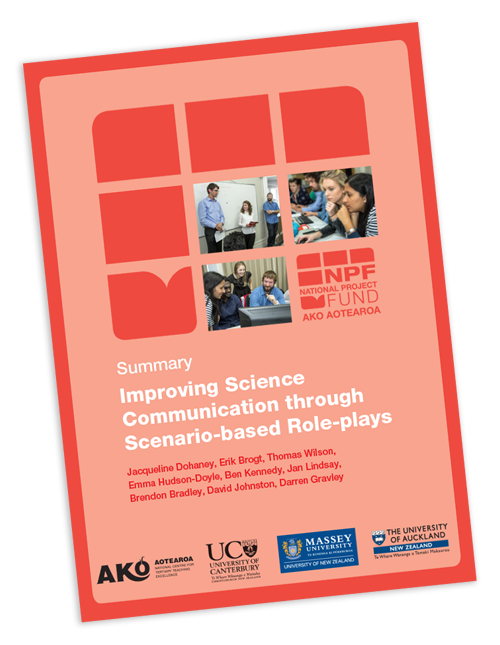
Summary report | Improving Science Communication through Scenario-based Role-plays (PDF, 550Kb)
Project update | Improving Science Communication through Scenario-based Role-plays (PDF, 1.1Mb)
Background:
A project, completed in 2016, to help scientists and science learners learn how to translate scientific results, conclusions and recommendations into language easily understood by non-experts.
A collaboration involving the University of Canterbury, University of Otago, Nga Pae o te Maramatanga, Massey University Joint Centre for Disaster Research, Mercalli Consulting and GNS Science Joint Centre for Disaster Research.
Reports prepared by Jacqueline Dohaney, Erik Brogt, Thomas Wilson, Emma Hudson-Doyle, Ben Kennedy, Jan Lindsay, Brendon Bradley, David Johnston, Darren Gravley.
Co-funded by the Ako Aotearoa National Project Fund (NPF)