A cross-disciplinary comparison of the approach to developing ‘work ready plus’ graduates

There are growing social and economic demands for graduates who can navigate the
uncertainty and complexity of rapidly transforming employment contexts.

Built on recent, international studies on graduate employability, and utilizing the Work Ready Plus Graduate Capability Framework, this report explored ways to develop key graduate capability items that are most relevant to graduate employability across five disciplines in a New Zealand tertiary education institution.

Download the report:
Background:

A two-year research project, completed in 2020, examining the employability of graduates within five programmes of study, including the New Zealand Certificate in Construction Trade Skills (Level 3); the Diploma in Early Childhood Teaching (Level 5-6); the Bachelor of Creative Technologies (Level 5-7); the Graduate Diploma in Health studies (Level 7); and the Master in Management (Level 9).

Research report prepared by Qilong Zhang.


Co-funded by the Ako Aotearoa Regional Hub Project Fund (RHPF)
Posted in Curriculum | Leave a comment

Digital literacy training creates new education and employment opportunities for learners

This report, and accompanying videos, illustrates how digital literacy supports second-chance learners’ progress into education and employment.

Download the report:

Supporting videos:

These videos describes the training completed by learners on the Computers in Homes programme.

Background:

A project, completed in 2011, to provide a digital literacy training programme that supports second chance learners’ progress into higher education and employment.

Report prepared by Barbara Craig – Victoria University of Wellington.


Co-funded by the Ako Aotearoa Regional Hub Project Fund (RHPF)
Posted in Using technology in education | Leave a comment

Discipline specific e-Training for trades tutors

Integrating theory with practice using e-Technology

It is recognised that e-learning, in its variety of forms, provides learners with more choices and contributes to the development of skills, competencies and employability.

This report offers suggestions for the development of a discipline specific e-training model for trades tutors that could be applied to any trades discipline.

Download the report:

Background:

A project, completed in 2012, to develop a discipline specific e-training model that can be applied to any trades discipline. A collaboration of Waikato Institute of Technology and the Hairdressing Industry Training Organisation.

Research report prepared by Julia Bruce. 


Co-funded by the Ako Aotearoa Regional Hub Project Fund (RHPF)
Posted in Trades training | Leave a comment

Giving feedback on doctoral writing: A guide for supervisors and advisors

This report, guide for supervisors, and accompanying quick-reference poster draws upon research and advice from experienced supervisors and academic advisors to offer practical advice on how to give useful feedback on doctoral thesis writing.

Good supervision is key to higher degree research students’ successful completion: a commitment to provide ongoing subject-specific research guidance and oversee production of the written thesis.

Resource download:

Background:

A project, completed in 2016, to evaluate good practice, identify critical success factors or good doctoral writing feedback. A collaboration involving University of Auckland, Victoria University of Wellington and Tai Poutini Polytechnic.

Resources prepared by Susan Carter & Deborah Laurs, Lisa Chant, Rawinia Higgins, Jen Martin, Teresia Teaiwa and ’Ema Wolfgramm-Foliaki.


Co-funded by the Ako Aotearoa Regional Hub Project Fund (RHPF)
Posted in Research methodologies | Leave a comment

Guidelines for developing and using e-assessments with vocational learners

These reports introduce a series of guidelines which can be used as a framework to support the development, implementation and evaluation of e-assessments for learning within vocational education.

Download the report:

Background:

An 18-month project commissioned by the New Zealand Qualifications Authority and Ako Aotearoa to produce guidelines for tutors who develop and use e‑assessments with vocational learners. A collaboration involving Ara Institute of Canterbury (Ara), Nelson-Marlborough Institute of Technology (NMIT), Te Tapuae o Rēhua and Unitec Institute of Technology (Unitec).

Reports produced by Dr. Selena Chan, Steve Chapman, Keith Power, Cheryl Stokes (Ara Institute of Canterbury) , James Gropp, Aaron Lyster (Nelson-Marlborough Institute of Technology), Kym Hamilton (Te Tapuae o Rehua) and Lee Baglow, Christopher Lovegrove, Kamuka Pati, Alan Warburton (Unitec Institute of Technology).


Co-funded by the Ako Aotearoa National Project Fund (NPF)

Posted in Assessment | Leave a comment

Teaching practice experiences of year one early childhood student teachers in a field-based teacher education programme

This report examines teaching practice narratives from stage one early childhood (ECE) student teachers based on their experiences in a field-based teacher education programme.

While based in Early Childhood Education, the recommendations may be of use for supporting those involved in any field-based teacher education.

Download the report:

Background:

A project completed in 2009, undertaken by Te Tari Puna Ora a Aotearoa/New Zealand Childcare Association, that aimed to identify how effective the field-based teacher education model is in the application of theory in practice.

Research report prepared by Caterina Murphy and Jenny Butcher.


Co-funded by the Ako Aotearoa Regional Hub Project Fund (RHPF)
Posted in Workplace learning | Leave a comment

Finding out if increasing student well-being leads to greater academic success

This report details the impact student participation in a well-being improvement programme has on students’ well-being and on the academic success of first-year tertiary students studying at a distance.

Download the report:

Background:

A project completed in 2012, undertaken by the Open Polytechnic, to discover how well-being impacts on the academic success of first-year tertiary students studying at a distance. Specifically, it asked if participation in a well-being improvement program (The Tuesday Program) had an impact on students’ well-being and final grades.

Research report prepared by Catherine Ross, John Bathurst and Aaron Jarden.


Co-funded by the Ako Aotearoa Regional Hub Project Fund (RHPF)
Posted in Student engagement | Leave a comment

Embedding employability in the curriculum

University graduates need to be equipped for an uncertain and rapidly changing world and for changes in the nature of work.

This report details an efficient means of embedding ‘future-ready’ capabilities in advanced and research-informed university courses.

It include a pedagogical framework to guide learning designers and teachers who are embedding employability within degree programmes.

Download the report:

Background:

A two-year research project, completed in 2020, to discover, trial and share effective and efficient ways of embedding employability in the curriculum. A collaboration between the University of Auckland, University of Otago and the New Zealand Association of Graduate Employers.

Research report produced by Susan Geertshuis and Narissa Lewis.


Posted in Curriculum | Leave a comment

Employability and professional development:

Counselling students’ perceptions of counsellor education and beyond

This report investigated how different elements of the counsellor education and professional development workshops prepared participants for future work.

It offers recommendations for how counsellor development programme content can be made more relevant to the requirements of private practice.

Download the report:

Background:

A project completed in 2009, undertaken by Massey University, to examine the extent to which students who had completed a postgraduate distance counsellor education programme were prepared for: continuing development as reflective practitioners; professional employment; and gaining professional membership and appropriate progression in the guidance and counselling field.

Research report prepared by Jeannie Wright and Brent Gardiner.


Co-funded by the Ako Aotearoa Regional Hub Project Fund (RHPF)
Posted in Curriculum | Leave a comment

Empowering students’ futures: Learners with dyslexia, dyspraxia, and other learning disorders

This report examines Y’s Words, a programme shown to enhance literacy and numeracy among students with learning disorders such as dyslexia, dyspraxia and dyscalculia.

Download the report:

Background:

A project, completed by Christchurch YMCA Education Centre in 2008, to develop a good practice guide to enhance literacy and numeracy among students with learning disorders.

Research report prepared by Valerie Weir.


Co-funded by the Ako Aotearoa Good Practice Publication Grants scheme (GPPG)

Posted in Neurodiversity | Leave a comment

Enabling students to become life-ready, study-ready and work-ready in Te Tai Tokerau, Northland

This report, and accompanying poster, present key findings and discussion around efforts to enable learners in Te Tai Tokerau, Northland to be life-ready, study-ready and work-ready, with a recognition of the interconnectedness between these categories.

Resource download:

Background:

A project, completed in 2017, to design regional solutions to address barriers to learners completing their study and moving into work. A collaboration between Te Matarau Trust and NorthTec.

Report prepared by Philip Alexander-Crawford, Mark Ewen, Cath Fraser & Rachael Dennis.


Co-funded by the Ako Aotearoa Regional Hub Project Fund (RHPF)
Posted in Educational transitions | Leave a comment

Encouraging person-centred care through an experiential education programme

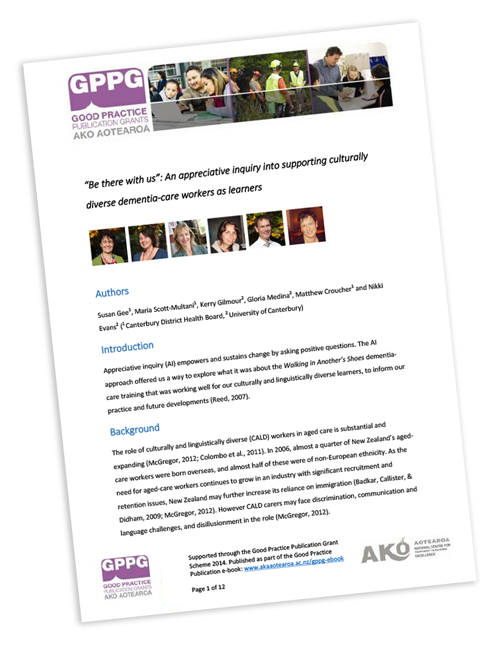
Walking in Another’s Shoes

This report details the establishment of the ‘Walking in Another’s Shoes’ training programme, for dementia care workers offered by several New Zealand District Health Boards.

It combines workshops with one-on-one workplace facilitation to nurture reflective, professional carers who can respond in creative person-centred ways.

Download the report:

Background:

A project completed in 2010, undertaken by the Canterbury District Health Board, to provide a systematic education programme for residential care workers to enhance person-centred dementia care.

Report prepared by Susan Gee, Maria Scott and Matthew Croucher. 


Co-funded by the Ako Aotearoa Good Practice Publication Grants scheme (GPPG)

Posted in Workplace learning | Leave a comment

Engaging construction apprentices in the online environment

This report details the experiences of Building and Construction Industry Training Organisation (BCITO) apprentices after the 2021 introduction of a Learning Management System (LMS) called MyBCITO.

It offers some insights for increasing understanding of the digital capacity and ongoing digital needs of apprentices in the construction industry.

While the report focusses on the building and construction industry, the information will be of use in informing those in other trades training and beyond, as to how best support and maintain quality experiences for those engaging in technology-enabled education and training

Download the report:

Background:

This project, completed in 2023, investigated the online learning experiences of Te Pūkenga-BCITO apprentices, focusing on understanding the influence of technology, barriers, and facilitators to digital learning, the correlation between low literacy/numeracy skills and digital literacy, and proposing enhancements for a digital environment to optimise support for workplace learning.

Research report prepared by Dr Janet McHardy.


Co-funded by the Ako Aotearoa Research and Innovation Agenda (AARIA)

Posted in Online learning | Leave a comment

Engaging learners effectively in science, technology and engineering

The pathway from secondary to university education

These reports offer guidelines for how science educators can improve student engagement in the study of science at university. They offer suggestions for pedagogical ‘best practice’ for science education in the first year at university, and improving the transition from the school learning environment to that of university.

Download the report:

Background:

A two-year research project, completed in 2011, to understand how university students become or remain engaged in science during their transition from school to university.

Research reports prepared by Tim J Parkinson, Helen Hughes, Dianne H Gardner, Gordon T Suddaby, Marg Gilling and Bill R MacIntyre. 


Co-funded by the Ako Aotearoa National Project Fund (NPF)

Posted in Student engagement | Leave a comment

Engaging first year university students in discipline-specific discourse through online writing projects

This report suggests design guidelines for incorporating e-learning strategies when designing for the development of discipline specific‐literacy that build upon student’s existing digital literacy skills.

They can be considered, regardless of discipline, when planning to use students’ existing digital skills for improving their discipline‐specific discourse.

Download the report:

Background:

A project completed in 2012, undertaken by The University of Auckland, to determine whether and how the existing digital literacy skills of General Education students could be utilised in order to develop new discipline-specific literacy.

Research report prepared by Nancy November and Karen Day. 


Co-funded by the Ako Aotearoa Regional Hub Project Fund (RHPF)
Posted in Online learning | Leave a comment

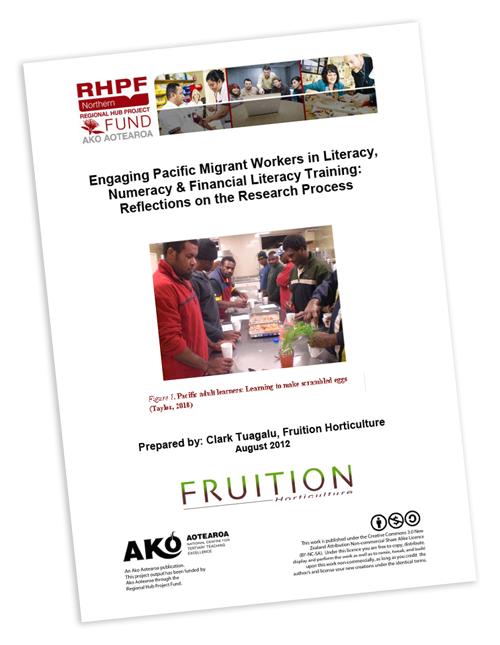
Engaging Pacific learners in literacy, numeracy and financial literacy

This report identifies specific learning and teaching strategies that promote and support Pacific learner engagement for improved learning and achievement in workplace literacy and numeracy programmes.

Download the report:

Background:

A project, completed in 2012, to assist literacy and numeracy providers understand how to better engage learners from various Pacific Island countries in literacy, numeracy and financial literacy training. A collaboration of Fruition Horticulture, McGirr Associates and University of Waikato.

Research report prepared by Clark Tuagalu.


Co-funded by the Ako Aotearoa Regional Hub Project Fund (RHPF)
Posted in Pacific learner success | Leave a comment

Engaging teachers and learners through service-learning

This report focuses on the practice of using service-learning (connecting academic content with service in the community) in two courses at the University of Canterbury and its proven and potential positive effects on student engagement.

Download the report:

Background:

Report produced in 2011 by Billy O’Steen, Lane Perry, Pete Cammock, Simon Kingham, Eric Pawson, Rob Stowell and Dave Perry from University of Canterbury


Co-funded by the Ako Aotearoa Good Practice Publication Grants scheme (GPPG)

Posted in Student engagement | Leave a comment

Enhancing learning and confidence for Māori through community participation

This report describes how embedding community activities into curriculum has resulted in enhanced learning and employability of Māori learners.

Download the report:

Background:

This innovative teaching practice successfully allows students to achieve positive changes in their behaviour and attitude while learning and gaining skills in work environments.

Report prepared by Sharlane Pene and Marvynne Ashley, Gracelands Insight Learning.


Co-funded by the Ako Aotearoa Good Practice Publication Grants scheme (GPPG)

Posted in Adult and community education | Leave a comment

Enrolment assessment tool

This report documents the development and evaluation of a quick Enrolment Assessment Tool for guiding the suitable qualification level for migrant dairy farm workers who are undertaking formal industry training (trainees).

While the report focusses on the dairy industry, the findings may be of use to any industry that utilises migrant workers, or those involved with supporting people with English as a second language in their transition to work or training.

Download the report:

Background:

A project, completed in 2011, to develop and trial a quick diagnostic placement tool that Agriculture ITO Training Advisors can use on-farm to assess Non-English Speaking Background (NESB) dairy farm workers who are undertaking formal industry training. A collaboration of English Language Partners, Agribusiness Training Ltd and Agriculture Industry Training Organisation.

Research report prepared by Charlotte Heather and Dorothy Thwaite.


Co-funded by the Ako Aotearoa Regional Hub Project Fund (RHPF)
Posted in Language, Literacy and Numeracy (LLN) | Leave a comment

Evaluating a strengths-based learner engagement programme

This report investigates use of a strengths-based learning and engagement programme called My Voice. It include findings from both student and tutor perspectives.

Learner engagement is crucial to success in educational programmes. However, actually engaging students in learning is a constant challenge for tertiary providers.

Download the report:

Background:

A project to evaluate the outcomes of a strength-based course called My Voice. A collaboration involving Trade and Commerce Ltd, BERYL Consultants, Te Wānanga o Aotearoa and Salvation Army Employment Plus.

Research report produced by Mike Hay and Colin Campbell. 


Co-funded by the Ako Aotearoa National Project Fund (NPF)

Posted in Student engagement | Leave a comment

Establishing Communities of Practice

A pedagogy support mechanism for teaching teams in the New Zealand PTE environment

This report investigated the use of a Community of Practice (CoP) as a professional development tool for PTE tutors.

The findings will be of use to organisations intending to implement CoPs as a teacher development initiative.

Download the report:

Background:

A one-year project, completed in 2017, to determine the effectiveness of a Community of Practice (CoP) as a mechanism for professional development of Youth Guarantee (YG) tutors in the Private Training Establishment (PTE) context. A collaboration of G&H Training Limited, The College of Future Learning NZ (FutureCol) and Workforce Development Limited.

Research report prepared by Anne Greenhalgh and Lesley Petersen.


Co-funded by the Ako Aotearoa Regional Hub Project Fund (RHPF)
Posted in Professional learning | Leave a comment

Evaluating the quality of workplace learning for student nurses in hospital settings

This report analyses whether the Clinical Learning Environment, Supervision, and Nurse Teacher (CLES+T) survey is a valid tool for assessing nursing students’ perception of the quality of their learning in hospital settings in New Zealand.

Download the report:

Background:

n New Zealand, the education of registered nurses is a three year Bachelor of Nursing Degree which includes “a minimum of 1100 practice hours”. Of these practice hours, some are to include hospital based workplace settings as distinct from community workplace settings.

The CLES+T survey is a tool for assessing students’ perception of the quality of their learning in community settings.

Completed in 2012, this project was a collaboration of Christchurch Polytechnic Institute of Technology and Turku University of Applied Sciences, Turku, Finland.

Report prepared by Deborah Sims, Paul Watson, Philippa Seaton, Rose Whittle, Isabel Jamieson, Mikko Saarikoski and Jane Mountier.


Co-funded by the Ako Aotearoa Regional Hub Project Fund (RHPF)
Posted in Industry specific resources | Leave a comment

Evaluating the quality of workplace learning for nursing students in community settings

This report analyses whether the Clinical Learning Environment, Supervision, and Nurse Teacher (CLES+T) survey is a valid tool for assessing nursing students’ perception of the quality of their learning in community settings in New Zealand.

Download the report:

Background:

In New Zealand, the education of registered nurses is a three year Bachelor of Nursing Degree which includes “a minimum of 1100 practice hours”. Of these practice hours, some are to include community based workplace settings as distinct from hospital workplace settings.

The CLES+T survey is a tool for assessing students’ perception of the quality of their learning in community settings.

Completed in 2010, this project was a collaboration of Christchurch Polytechnic Institute of Technology and Turku University of Applied Sciences, Turku, Finland.

Report prepared by Deborah Sims, Paul Watson, Philippa Seaton, Rose Whittle, Isabel Jamieson, Mikko Saarikoski and Jane Mountier.


Co-funded by the Ako Aotearoa Regional Hub Project Fund (RHPF)
Posted in Industry specific resources | Leave a comment

Evaluating the effectiveness of immersive learning in nurse education

This report details how nursing students responded to the introduction of clinical simulations in teaching and how effective these were in the context of a newly-developed immersive learning approach. 

Download the report:

Background:

A project completed in 2015, undertaken by Otago Polytechnic, to evaluate the effectiveness of using a technology-enhanced, integrated, immersive, teaching approach to clinical practice, in order to improve learner outcomes within nursing education.

A research report prepared by Liz Ditzel, Raewyn Lesa and Karole Hogarth. 


Co-funded by the Ako Aotearoa Regional Hub Project Fund (RHPF)
Posted in Curriculum | Leave a comment

Focusing on strengths for challenging youth

This report describes a five-step model that has been used with learners who have typically failed mainstream schooling.

The model involves: fun support, challenge support, personal development, higher learning and empowerment. This model can be applied to a wide range of educational settings, and has been shown to enhance learner motivation and self-management.

Download the report:

Background:

Report produced in 2009 by John Hannam from the YMCA Education Centre.


Co-funded by the Ako Aotearoa Good Practice Publication Grants scheme (GPPG)

Posted in Student engagement | Leave a comment

First year health students using CD-ROM based interactive case studies

This report documents a trial of two scenario-based interactive learning resources to gauge their effects on the learning of health science students at Massey University.

The findings may be of use for those thinking of developing multimedia, scenario-based resources to be used by students.

Download the report:

Background:

A project, completed in 2012, that aimed to develop a new scenario-based learning tool to encourage active student participation and learning. A collaboration of Massey University and Charles Darwin University.

Research report prepared by Jim Clarke, Michelle McCulley, Isabelle Lys, Terry Stewart and John Milne.


Co-funded by the Ako Aotearoa Regional Hub Project Fund (RHPF)
Posted in Curriculum | Leave a comment

Feedback and feedforward: assessment for advanced learning in an online environment

In this video, Mandia Mentis describes how the use of online (Moodle) tools in a postgraduate blended learning programme enhanced assessment for learning for students.

Video:

Background:

Created in 2011, this digital video/multimedia presentation shows how new technologies afford different best practice approaches to teaching, learning and assessment.

Using screenshots and voiceovers, the presentation will illustrate how the use of online (Moodle) tools in a postgraduate blended learning programme enhance assessment for learning for students.


Co-funded by the Ako Aotearoa Good Practice Publication Grants scheme (GPPG)

Posted in Assessment | Leave a comment

Exercise & sport science as a rigorous science education

A guide for teachers of the discipline

This report presents high-level reflections on the Exercise & Sport Science programme, those who teach it; and the overall capacity to deliver a rigorous science education. It also includes a gap-analysis and explores how the gaps can be closed.

Download the report:

Background:

A project completed in 2010, undertaken by Massey University, to guide tertiary teachers of Exercise & Sport Science in ways that could improve the rigour of Exercise & Sport Science as a scientific discipline and lead to better learning outcomes for undergraduates.

Research report prepared by Jonathan Hughes and Helen Hughes.


Co-funded by the Ako Aotearoa Regional Hub Project Fund (RHPF)
Posted in Curriculum | Leave a comment

An evaluation of an innovative simulation programme for mental health workers

This report details an evaluation of the ‘Hearing Voices’ programme, an innovative simulation programme for mental health workers which uses sound recordings to train mental health workers through a simulation of what it is like to hear distressing voices.

Download the report:

Background:

A project completed in 2012, undertaken by Keepwell Limited, to establish the most effective experiential approach to teaching and learning about working with people who hear distressing voices.

Research report prepared by Arana Pearson.


Co-funded by the Ako Aotearoa Regional Hub Project Fund (RHPF)
Posted in Industry specific resources | Leave a comment

Filling the knowledge gap for the NDBA Level 5

Administrative professionals hold a wide range of qualifications, however many of these qualifications do not specifically relate to the business administration work people are doing.

The report highlights steps independent workplace assessors and ITPs can take together to fill the knowledge gaps for administrative professionals who undertake the National Diploma in Business Administration Level 5 (NDBA L5) in their workplace.

Linking theoretical learning with workplace assessment opportunities for a NDBA L5 ensures that already held skills and newly acquired knowledge go hand in hand with the work carried out every day by administrative professionals in their workplace environment.

Download the report:

Background:

A project, completed in 2012, to identify the knowledge gaps which occur between the work administrative professionals undertake in their place of work and the requirements of the National Diploma in Business Administration Level 5 (NDBA L5). A collaboration of Waiariki Institute of Technology and Enderby Associates Limited.

Research report prepared by Vivienne Kermode and Eth Lloyd.


Co-funded by the Ako Aotearoa Regional Hub Project Fund (RHPF)
Posted in Workplace learning | Leave a comment