Bridging to tertiary study

A support resource for academic writing in English for Māori students

This report and accompanying resources were created to provide support for Māori students, particularly those involved in study at first degree level, who need to develop skills in writing assignments in English in a range of academic subjects.

Resource download:

Background:

A two-month project, completed in 2016 at The University of Waikato, to trial and evaluate a tailor-made series of academic writing units could support the English writing skills of Māori students entering tertiary study and/or of Māori students who were already enrolled in tertiary study but experiencing low levels of success.

Resources prepared by Diane Johnson and Sophie Nock. 


Co-funded by the Ako Aotearoa Regional Hub Project Fund (RHPF)
Posted in Māori learner success | Leave a comment

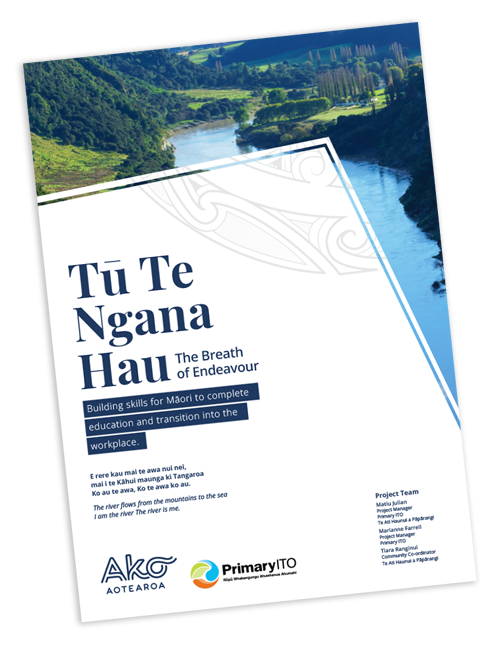
Tū Te Ngana Hau – Breath of endeavour

This report and supporting videos detail a community-driven programme focused on building skills for Māori to complete education and transition into the workplace.

The vision of this project was to grow the capacity and capability of local people to drive this kaupapa for themselves and create meaningful education pathways to find or create employment opportunities.

Download the report:

Supporting videos:

Background:

A two-year project completed in 2017, this research followed a community-driven project that aimed to create further education and training opportunities for tribal members of the iwi/tribe of Te Ati Haunui a Pāpārangi from the marae villages on the Whanganui river.

Tū Te Ngana Hau (The Breath of Endeavour) is a concept that embraces the life force of a remote community, providing a bespoke foundational programme to create pathways that will lead to further education and training. Best described as an action research project, the setting of this pilot is the Whanganui awa (river) community.

Research report prepared by Matiu Julian – Tiara Ranginui – Community Co-ordinator, Te Ati Haunui a Pāpārangi and Marianne Farrell – Primary ITO.


Co-funded by the Ako Aotearoa National Project Fund (NPF)

Posted in Māori learner success | Leave a comment

Teaching occupational therapy students how to integrate evidence for better clinical outcomes

This report investigated the skills and attitudes that are essential for new occupational therapy graduates to be confident and effective evidence-based practitioners.

It has developed a model that identifies five components that inform decision-making to provide a comprehensive guideline for teaching Evidence-Based Practice.

Download the report:

Background:

Critiquing research is the most studied aspect of learning how to be evidence-based, however therapists do not spend a lot of time looking for and critiquing research.

This 18-month project, completed in 2019 at Otago Polytechnic, aimed to better prepare occupational therapy students to transition from an academic environment to the realities of evidence-based practice.

Research report prepared by Dr Linda Robertson, Helen Jeffrey, Kim Reay and Dr Angela Benfield.


Co-funded by the Ako Aotearoa Regional Hub Project Fund (RHPF)
Posted in Curriculum | Leave a comment

Best practice in supervisor feedback to thesis writers

This report shares what supervisors and research students in New Zealand universities identified as best practice in providing feedback to thesis writers.

Download the report:

Background:

An 18-month project to investigate what supervisors and research students in New Zealand universities identified as best practice in providing feedback to thesis writers. A collaboration of AUT University and University of Auckland.

Research report prepared by John Bitchener, Helen Basturkmen, Martin East and Heather Meyer.


Co-funded by the Ako Aotearoa National Project Fund (NPF)

Posted in Research methodologies | Leave a comment

A virtual reality tool for teaching library design

This report documents the development and evaluation of a virtual reality (VR) teaching tool that can be used to teach library design.

Download the report:

Supporting video:

This video shows what the end-user can see on screen when using the VR Library design tool.

Background:

A project, completed in 2019, to develop a virtual reality tool for teaching library design. A collaboration of Victoria University of Wellington and The Open Polytechnic.

Report prepared in by Philip Calvert. 


Co-funded by the Ako Aotearoa Regional Hub Project Fund (RHPF)
Posted in Online learning | Leave a comment

Using authentic spoken texts in socio-pragmatic focused instruction

A survey of teacher practices and perspectives

This report investigates ESOL teachers’ use of authentic spoken texts with learners at different proficiency levels. 

Download the report:

Background:

A project, completed in 2009, to discover to what extent teachers had access to suitable authentic materials to teach the important norms of pragmatics (socio-culturally appropriate use of language) in situations relevant to the personal and academic or employment lives of their students. A collaboration of AUT University and University of Auckland.

Report prepared by Heather Denny and Helen Basturkmen.


Co-funded by the Ako Aotearoa Regional Hub Project Fund (RHPF)
Posted in Language, Literacy and Numeracy (LLN) | Leave a comment

A training programme for deaf tutors

This report documents the development of a Deaf Cultural Awareness and NZSL teaching training programme that teaches about Deaf identity, culture and language with the goal of overcoming at least three most common barriers: access to accommodations, attitudinal barriers, level of social integration, and ease of communication (including NZSL).

Download the report:

Background:

A one-year project, completed in 2020 by Merge NZ with support from the New Zealand Sign Language Teachers Association (NZSLTA), to develop a training programme for tertiary staff to enhance the provision of support services for deaf/hard of hearing students.

Report prepared by Victoria Lessing, Jaime Brown and Susie Ovens.


Co-funded by the Ako Aotearoa Regional Hub Project Fund (RHPF)
Posted in Accessibility | Leave a comment

Assessment of industry-based learning:

A self-assessed approach to learning

This report describes how industry-based learning (IBL) has been effectively assessed in a Bachelor of Business programme.

Download the report:

Background:

Report prepared in in 2010 by Diana Ayling, Dave Hodges, and Prue Cruickshank – Unitec New Zealand.


Co-funded by the Ako Aotearoa Good Practice Publication Grants scheme (GPPG)

Posted in Workplace learning | Leave a comment

Assessing Hauora Māori in medical students in clinical settings

A project to develop effective assessment methods, tools and staff development processes that can be used to assess Māori health competencies in clinical settings.

Cultural competence assessment is relevant to many vocational training programmes. While this project focused on clinical assessment of Hauora Māori in medical students, findings are likely to be very relevant to the assessment of cultural competence and equity in other forms of workplace training.

Download the report:

Background:

It is important that health professional education programmes in Aotearoa New Zealand contribute to improving Māori health and promote reduction and elimination of health inequities.

This University of Auckland project, completed in 2013, aimed to develop effective assessment methods that can be used to assess Māori health competencies in clinical settings.

Reports prepared by Rhys Jones, Phillippa Poole, Mark Barrow, Papaarangi Reid, Sue Crengle, Jamie Hosking and Boaz Shulruf.


Co-funded by the Ako Aotearoa National Project Fund (NPF)

Posted in Māori learner success | Leave a comment

Assessing the effectiveness of a flipped classroom in foundation engineering

This report details a pilot study of a flipped classroom approach with a cohort of first year engineering students at the Department of Mechanical Engineering at the University of Canterbury.

Download the report:

Background:

A project, completed in 2017 at the University of Canterbury, to investigate engineering students’ impressions of the flipped classroom approach and their ongoing academic achievement in follow-on courses.

Report prepared by Paul Docherty, Wendy Fox-Turnbull and Pinelopi Zaka.


Co-funded by the Ako Aotearoa Regional Hub Project Fund (RHPF)
Posted in Curriculum | Leave a comment

Art at risk

These resources provide a set of research resources and practical information for teachers working with digital images.

The Teacher’s Resource and the accompanying set of posters can be used to guide students through the decisions that need to be made when using digital images, and provide a set of case studies that include a record of real classroom situations and the decisions that were made regarding the risk of copyright infringement, understandings of appropriate ethical behaviours, and our critical and social contexts in New Zealand Aotearoa.

Part Two: Background Research documents, analyses, evaluates, considers and recommends methods for engaging with digital images whilst paying careful attention to the movements towards open source and creative commons approaches to digital media.

Resource download:

Background:

A project completed in 2011, undertaken by Otago Polytechnic, to investigate the use of the digital image and the associated delivery of software and copyright information in the tertiary classroom.

Resources prepared by Susan Ballard and Pamela McKinley.


Co-funded by the Ako Aotearoa Regional Hub Project Fund (RHPF)
Posted in Curriculum | Leave a comment

The good teaching project

This project aimed to discover students’ ideas of what good teaching and effective learning are in university settings. 

The findings share both attributes and actions that students saw as characterising ‘good teachers’.

This report offers recommendations for university teachers, suggesting some principles that are likely to make teachers more effective when working with students, alongside recommendations for university students to aid them to recognise their role in the teaching-learning partnership.

Download the report:

Background:

A one-year project, completed in 2017 at the University of Otago, to explore high achieving university students’ conceptions of ‘good teaching’ and ‘effective learning’ in university lecture and tutorial settings.

Research report prepared by Vivienne Anderson, Ana Rangi, Esmay Eteuati, Rob Wass, Clinton Golding, and Rafaela Rabello.


Co-funded by the Ako Aotearoa Regional Hub Project Fund (RHPF)
Posted in Curriculum | Leave a comment

Kia Matatau ki te Reo: Factors influencing the development of proficiency in te reo Māori with adult learners

This report examines the success factors that enhance Māori adults learning Māori as a second language, identifies how to best support adults learning te reo, and also inform efforts to revitalise the Māori language in Aotearoa.

Download the report:

Background:

A thesis, completed in 2013, by Matiu Rātima from University of Waikato, to investigate the factors that help or hinder adult Māori second language learners to become proficient speakers of te reo Māori.


Co-funded by the Ako Aotearoa National Project Fund (NPF)

Posted in Māori learner success | Leave a comment

The added value of Work-Integrated Learning

Work-Integrated Learning (WIL) acts as a bridge for the student between the academic present and their professional future. It aims to merge theoretical knowledge gained in academic studies with workplace experiences by developing relevant professional skills in preparation for future career opportunities

This report examines the legacy impact of the Work-Integrated Learning (WIL) programme through interview with WIL graduates that are now WIL workplace supervisors.

The findings contain suggestions that may enhance WIL supervision, student experiences and outcomes.

Download the report:

Background:

A one-year project, comleted in 2019, to examine the legacy impact of the Work-Integrated Learning (WIL) programme first as a student and later as a WIL supervisor. A collaboration of Massey University, Auckland University of Technology, University of Waikato and New Zealand Council for Educational Research (NZCER).

Rreport prepared by Andy Martin, Malcolm Rees, Jenny Fleming, Karsten Zegwaard and Karen Vaughan.


Co-funded by the Ako Aotearoa Regional Hub Project Fund (RHPF)
Posted in Workplace learning | Leave a comment

Te Toka Herenga Waka: Increasing Māori learner success at WITT

This report explores reasons behind the significant number of Māori student withdrawals in 2017 at the Western Institute of Technology at Taranaki (WITT).

It identifies strategies and approaches that can be used to enhance Māori student participation and achievement in a WITT context.

Download the report:

Background:

A two-year project, completed in 2019, from Western Institute of Technology Taranaki that explores reasons that lead to Māori student withdrawal, as a basis for enhancing the effectiveness of tertiary teaching and support services for Māori at WITT.

Research report prepared by Ken Taiapa and Diana Fergusson.


Co-funded by the Ako Aotearoa Regional Hub Project Fund (RHPF)
Posted in Māori learner success | Leave a comment

Te Kāwai Kūmara

This report evaluates the development and synchronous delivery of a postgraduate programme in te reo Māori across multiple sites. 

It provides valuable insight into the way new technologies foster collaboration, and yielded learnings about the challenges and benefits of multi-party collaboration in programme design and delivery.

Download the report:

Background:

A two-year project, completed in 2014, to build the research capability and capacity of Māori learners by supporting them through advanced digital technologies including smart boards and video-conferencing.

A collaboration of AUT University, Victoria University of Wellington, Te Wānanga o Aotearoa, Te Ātaarangi National Trust and Christchurch Polytechnic Institute of Technology (now Ara Institute of Canterbury).

Rsearch report prepared by Tānia Ka’ai. 


Co-funded by the Ako Aotearoa National Project Fund (NPF)

Posted in Māori learner success | Leave a comment

Developing and implementing an evaluation process for organisational capability in technology enhanced programme development

This report documents a study to better understand sector-wide capability in technology enhanced learning. It provided a diverse group of education sector organisations with a mechanism to benchmark themselves against a rubric of relevant indicators.

It also identifies opportunities for building organisational capability for the development of technology enhanced learning that will make the biggest impact to learners.

Download the report:

Background:

A two-year project, completed in 2018, to develop and implement an evaluation process for organisational capability in technology enhanced programme development in Tertiary Education Organisations.

A collaboration of Ako Aotearoa and Synapsys. Participating Tertiary Education Organisations (TEOs) were CareerForce, The Skills Organisation Inc., Literacy Aotearoa, NorthTec, Otago Polytechnic, Taratahi Institute of Agriculture, Wellington Institute of Technology (Weltec) and Whitireia New Zealand.

Research report prepared for Ako Aotearoa by Synapsys.


Co-funded by the Ako Aotearoa National Project Fund (NPF)

Posted in Online learning | Leave a comment

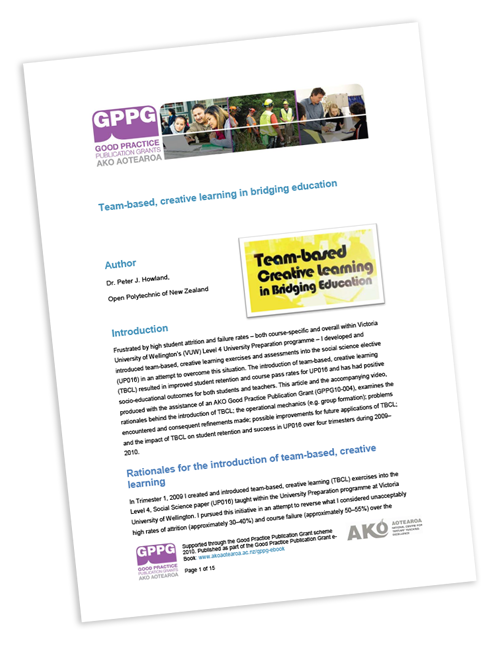
Team-based, creative learning in bridging education

This report outlines Dr Peter Howland’s process to develop and introduce team-based, creative learning exercises and assessments into the social science elective (UP016) in an attempt to improve student retention and course pass rates.

Download the report:

Supporting video:

Background:

Report completed in 2010 by Dr Peter Howland from the Open Polytechnic.


Co-funded by the Ako Aotearoa Good Practice Publication Grants scheme (GPPG)

Posted in Educational transitions | Leave a comment

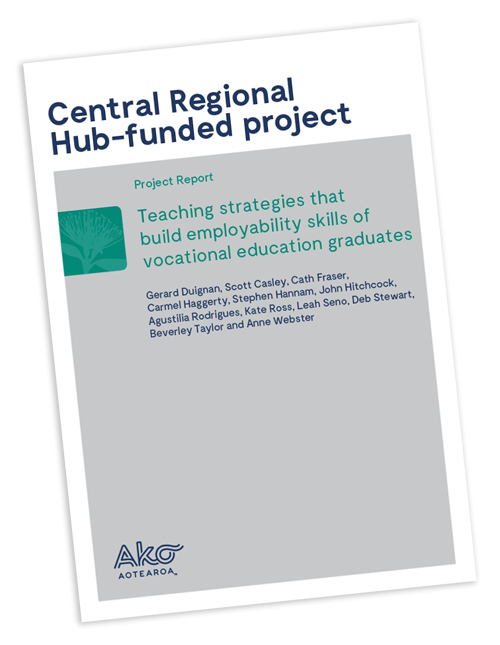
Identifying authentic teaching strategies that build employability skills

This report shares ten employability capabilities and a range of practical, proven approaches for teachers to prepare learners for the challenges of the workplace.

The Guidelines have been designed for use by teachers of vocation-based programmes, especially those including work experience, work placement or internships.

They are accessible and practical, for teachers to interpret easily and apply in their own context.

Visit the Teaching Employability Skills project website for further tips.

Download the report:

Background:

This collaborative project, completed in 2019, involved seven Institutes of Technology and Polytechnics (ITPs) produced a toolkit of ideas and strategies to assist teachers in vocational education in embedding employability skills into their teaching practices.

Report prepared by Gerard Duignan, Scott Casley, Cath Fraser, Carmel Haggerty, Stephen Hannam, John Hitchcock, Agustilia Rodrigues, Kate Ross, Leah Seno, Deb Stewart, Beverley Taylor and Anne Webster.


Co-funded by the Ako Aotearoa Regional Hub Project Fund (RHPF)
Posted in Curriculum | Leave a comment

Teaching, assessing and modelling appropriate performance-appraisal behaviours

This report describes how engaging Human Resource Management learners in a performance-appraisal initiative supports them to develop work-ready skills.

The performance appraisal initiative is designed to fully immerse students in the performance appraisal development, implementation, and feedback processes. It uses multiple learning opportunities including real-world examples of a workplace practice to enhance work readiness.

Download the report:

Background:

This initiative was undertaken in 2012 by the third-year undergraduate Human Resource Management course, which is offered in the Department of Strategy and Human Resource Management at The University of Waikato in Hamilton.

Report prepared by Dr Linda Twiname and Dr Trudy Harris.


Co-funded by the Ako Aotearoa Good Practice Publication Grants scheme (GPPG)

Posted in Assessment | Leave a comment

Sustained improvements in teaching and learning in engineering education

This report details the scoping and development of a proactive support strategy and recommendations to sustain and optimise the quality of teaching and learning in engineering degree programmes in New Zealand.

The project identified that there was a community of practice of over 80 engineering academics. The activities and resulting networking stimulated and contributed to a wide range innovative pedagogical interventions and opportunities for inter-institutional collaboration.

Download the report:

Background:

An 18-month project, completed in 2013, to bring together engineering education leaders from New Zealand engineering degree-granting institutions to scope and develop a strategy to support sustained improvements in engineering teaching and learning. A collaboration of University of Waikato, University of Auckland, Manukau Institute of Technology and Otago Polytechnic.

Research report prepared by Janis Swan and Elizabeth Godfrey.


Co-funded by the Ako Aotearoa National Project Fund (NPF)

Posted in Curriculum | Leave a comment

Teaching practicum in 21st century New Zealand

This report identifies factors which contribute to successful learning on practicum, including structures and processes which maximise the learning experiences of student teachers during practicum

It offers recommendations that may be of use to those involved in teacher practicum experiences.

Download the report:

Background:

A project, completed in 2011, to examine the learning experience of student teachers and their mentors during practicum to enable the development of models for practicum appropriate for 21st century New Zealand teacher education programmes. A collaboration of Victoria University of Wellington and Massey University.

Research report prepared by Louise Starkey and Peter Rawlins.


Co-funded by the Ako Aotearoa Regional Hub Project Fund (RHPF)
Posted in Curriculum | Leave a comment

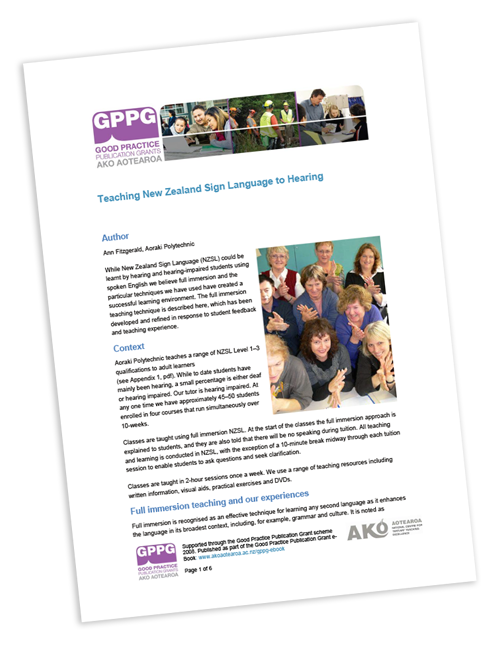
Teaching New Zealand Sign Language to hearing learners

This report explains the benefits of teaching New Zealand Sign Language to both hearing and hearing impaired students using full immersion teaching.

Download the report:

Background:

In this project, completed in 2008, Aoraki Polytechnic tutors developed and refined the full immersion teaching technique for teaching New Zealand Sign Language (NZSL). This was done in response to student feedback and teaching experience. 

Report prepared by Ann Fitzgerald.


Co-funded by the Ako Aotearoa Good Practice Publication Grants scheme (GPPG)

Posted in Accessibility | Leave a comment

Teaching for numeracy and mathematics transfer in tertiary science

This report identifies teaching and learning strategies for successful transfer of numeracy and mathematical skills and knowledge across contexts with potential for use in the sciences.

It includes a good practice guide for effective numeracy transfer from one cognitive domain (e.g. mathematics) to another (e.g. science).

Download the report:

Background:

A project, completed in 2014 by the University of Canterbury, to identify and implement pedagogical strategies designed to facilitate the transfer of numeracy and mathematical skills and knowledge to science disciplines.

Research report prepared by Erik Brogt, Annie Soutter, Sarah Masters, and Wendy Lawson.


Co-funded by the Ako Aotearoa Regional Hub Project Fund (RHPF)
Posted in Curriculum | Leave a comment

Teaching and learning circles: A framework for enhancing teaching culture and practice

This report shares the findings of an investigation into using Teaching and Learning Circles (TLC) to enhance teaching practice and culture in Higher Education. It aimed to provide a peer observation of teaching framework that can be implemented at any tertiary institution seeking to enhance teaching practice and foster improved teaching culture.

The Resource kit provides information about the purpose and proposed process of Teaching and Learning Circles and includes some handy forms to guide educators through the process of establishing a Teaching and Learning Circle in their organisation.

Resource download:

Background:

This one-year University of Otago project, completed in 2019, investigated using Teaching and Learning Circles (TLC) to enhance teaching practice and culture in Higher Education. The Teaching and Learning Circles is a voluntary, non-evaluative, reciprocal peer observation of teaching with an emphasis on collegial dialogue and self-reflection.

Report prepared by Dr Tracy Rogers, Dr Rob Wass, Dr Julie Timmermans and Professor Clinton Golding.


Co-funded by the Ako Aotearoa Regional Hub Project Fund (RHPF)
Posted in Professional learning | Leave a comment

Teaching and Learning Circles

Developing reflective practice and enhancing teaching culture

This report describes the successful implementation of a Teaching and Learning Circles (TLCs) process at one New Zealand university. Evidence is shared of the impact of TLCs on collegiality, confidence and competence among participants. 

The accompanying resource pack provides an introduction to Teaching and Learning Circles and some resources to help educators get started organising their own Teaching and Learning Circle.

Resource download:

Background:

Teaching and Learning Circles (TLCs) are a facilitated peer observation of teaching and a professional development opportunity for tertiary teachers. 

The main aim of the project, completed in 2020, was to explore the influence of a peer observation of teaching initiative, the ‘Teaching and Learning Circles’ (TLCs), on teaching culture/s and student learning.

This work builds on the Ako Aotearoa co-funded project Teaching and Learning Circles: A framework for enhancing teaching culture and practice

Report prepared by Dr Kathryn Sutherland, Dr Irina Elgort and Dr Emma Tennent.


Co-funded by the Ako Aotearoa Regional Hub Project Fund (RHPF)
Posted in Professional learning | Leave a comment

Developing pedagogy for exercise science in tertiary physical education programmes in the Aotearoa New Zealand context

This report surveyed the existing exercise science curriculum content for physical education/teacher education (PETE) students to develop practical recommendations that will assist tertiary institutions and their staff in the development of pedagogies suitable for the enhancement of learning in the exercise sciences.

Download the report:

Background:

A project completed in 2010, undertaken by University of Canterbury, to enhance tertiary exercise science pedagogy for physical education teacher education.

Research report prepared by Nick Draper, Ian Culpan and Susannah Stevens.


Co-funded by the Ako Aotearoa Regional Hub Project Fund (RHPF)
Posted in Curriculum | Leave a comment

Developing research supervision skills

Supervising students undertaking research projects, dissertations or theses at all levels from pre-degree to doctorates is a significant part of the work of tertiary educators, and the relationship between supervisor and student has been shown to be a critical factor in the retention of students.

The report explores practices in research supervision education across a range of different New Zealand tertiary institutions. It include practical recommendations to assist tertiary institutions and their staff in developing effective research supervision training.

Download the report:

Background:

A project completed in 2008, undertaken by University of Canterbury, to investigate current practices in research supervision education, with regard to students undertaking research projects, at a variety of qualification levels across a range of different tertiary institutions within the Aotearoa New Zealand context.

Research report prepared by Jean Rath.


Co-funded by the Ako Aotearoa Regional Hub Project Fund (RHPF)
Posted in Research methodologies | Leave a comment

Developing the usefulness of reflective practice for professional development from within eLearning

This report describes the process of developing and reviewing the effectiveness of undertaking reflective practice activities within an eLearning environment. 

Reflective writing is one way nurses describe, discuss, and critically analyse their practice to demonstrate evidence of continuing competency within a portfolio. By integrating an online resource, nurses can access at different times when their ward work is not so busy.

The report may be of use to organisations looking to provide reflective practice activities in an accessible way.

Download the report:

Background:

This study, completed in 2010, was to assess the effectiveness of the eLearning activity in a health education environment for a cohort of graduate nurses. These results could then be used for the further refinement of the eLearning site and the development of the next year’s course.

Report prepared by Anne Stevens and Robyn Boladeras, Bay of Plenty District Health Board.


Co-funded by the Ako Aotearoa Good Practice Publication Grants scheme (GPPG)

Posted in Online learning | Leave a comment

Developing the skills of Māori farm employees in Te Tai Tokerau / Northland

This report details an investigation into the workplace literacy (WPL) skills of Māori farm employees from five isolated pastoral farms in Northland. 

It offers recommendations for interventions that could improve workplace literacy training for Māori farm employees working on dispersed pastoral farms in isolated rural areas.

While the report focusses on agriculture, the suggestions may be of use for building workplace literacy in other industries.

Download the report:

Background:

A project, completed in 2012, to assess the workplace literacy (WPL) skills of Māori farm employees in Northland. The project was undertaken by Venture Group Ltd, in collaboration with the Agriculture ITO (AgITO); and with encouragement and some input from the Te Tai Tokerau office of Te Puni Kokiri (TPK) and the Retirement Commission.

Research report prepared by Neil Shaw, Gill Minogue and Jill Hartles.


Co-funded by the Ako Aotearoa Regional Hub Project Fund (RHPF)
Posted in Language, Literacy and Numeracy (LLN) | Leave a comment