Taikākā | Optimising Māori academic achievement in a Māori-medium initial teacher education

This report details the development and evaluation of an evidence-based academic and cognitive skills programme for Māori students.

The accompanying teaching strategies resource presents some exemplars presented as ‘lesson plans’, intended for teachers to customise for their own courses and classes.

Resource download:
Background:

A four-and-a-half-year project, completed in 2018, that aimed to develop an evidence-based academic and cognitive skills programme for Māori initial teacher education students, underpinned by a kaupapa Māori framework. The programme adapted elements of the AVID (Advancement via Individual Determination) academic advancement programme to the New Zealand context.

A collaboration of University of Waikato and University of Auckland.

Report prepared by Jenny Lee-Morgan and Maia Hetaraka.


Co-funded by the Ako Aotearoa National Project Fund (NPF)
Posted in Māori learner success | Leave a comment

Project-based learning in visual arts and design:

What makes it work?

This report documents the redevelopment of a Bachelor of Visual Arts and Design (BVAD) course into a project-based learning programme and identifes the factors that ‘make project-based learning work’ in the context of arts and design education.

The findings may be of use for other education organisations who are considering developing project-based curriculum, particularly in the field of arts and design.

Download the report:

Background:

A project completed in 2014, undertaken by Eastern Institute of Technology, to redevelop a traditional arts and design degree into a 21st century project-based learning programme. 

Report prepared by Suzette Major and Elly Govers. 


Co-funded by the Ako Aotearoa Regional Hub Project Fund (RHPF)

Posted in Curriculum | Leave a comment

Enriching tutor-student engagement and enhancing student learning autonomy

Puanga Te Matapae Oranga

This report documents the development and evaluation of Puanga Te Matapae Oranga – a professional development toolkit of reflective tools and strategies that support tutors in self-reflection and provide mechanisms to encourage collective reflection, sharing of teaching practices, and learning from each other.

Download the report:

Background:

A project, completed in 2019 at Workforce Development Ltd, to develop and trial tools that provide tutors with strategies that support their pedagogical practice, encourage them to analyse their cultural lens, and prompt critical, ongoing reflection, as an individual and in a collective capacity.

This project builds on a project which identified Key tutor practices that
positively correlate with successful completion for Māori students within a PTE
environment
.

Report prepared by Anne Greenhalgh and Lesley Peterson.


Co-funded by the Ako Aotearoa Regional Hub Project Fund (RHPF)

Posted in Professional learning | Leave a comment

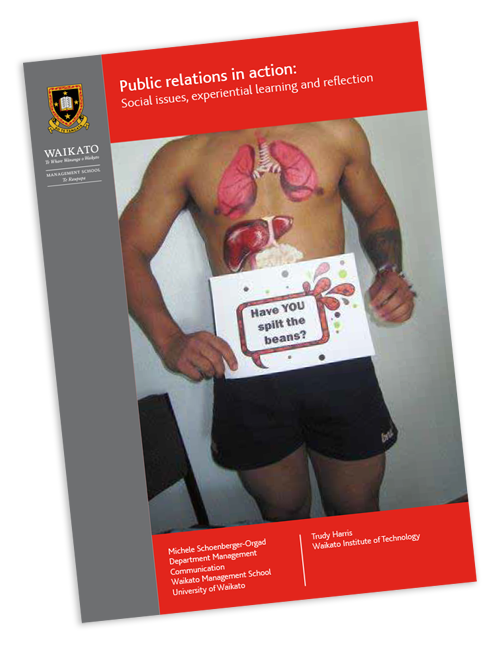
Public relations in action: Social issues, experiential learning and reflection

This report details a pilot study to provide public relations students with an authentic learning experience of working with a real-world client.

Download the report:

Background:

A project, completed in 2013, to provide students with an authentic learning experience of working with a real-world client, collaborating with others in an agency, developing client relationships and to build their own networks with industry professionals within the field of public relations.

A collaboration of University of Waikato and Waikato Institute of Technology.

Report prepared by Michèle Schoenberger-Orgad and Trudy Harris.


Co-funded by the Ako Aotearoa Good Practice Publication Grants scheme (GPPG)

Posted in Curriculum | Leave a comment

Putting the story on screen: Digitally supported reading for adult learners

This report documents the development and evaluation of a Digitally Supported Literacy (DSL) resource for adult literacy learners using digital media to create an on-screen reading experience with embedded learning support.

The findings may be of use to other Language, Literacy and Numeracy (LLN) providers looking to create a digital or online resource for adult learners.

Download the report:

Background:

The project, completed in 2012, to create a learning resource for adult literacy learners using digital media with embedded learning support.

A collaboration of Adult Learning Support Nelson Inc (ALS) and the University of Waikato.

Report prepared by Susan Bruce, Brendyn Montgomery, Jan Blythe, David Whitehead and Caroline Budge.


Co-funded by the Ako Aotearoa Regional Hub Project Fund (RHPF)

Posted in Language, Literacy and Numeracy (LLN) | Leave a comment

Enhancing generic thinking skills of tertiary STEM students through puzzle-based learning

This report presents findings from a year-long project assessing the effectiveness of integrating puzzles, paradoxes, and sophisms (PPS) into the curriculum to improve critical thinking skills among science, technology, engineering and mathematics (STEM) students at the tertiary level.

An accompanying resource offers a curated collection of puzzles, paradoxes, and sophisms tailored to foster critical thinking.

Resource download:

Background:

A one-year project, completed in 2017, to evaluate the impact of the regular use of puzzles, paradoxes and sophisms (PPS) as a pedagogical strategy for enhancing generic thinking skills of tertiary STEM students.

A collaboration of Auckland University of Technology and University of Auckland.

Report prepared by Sergiy Klymchuk, Mike Thomas, Sergei Gulyaev and Tanya Evans.


Co-funded by the Ako Aotearoa Regional Hub Project Fund (RHPF)

Posted in Curriculum | Leave a comment

Quantext: For rapid analysis of student responses to short answer questions

This report details a pilot study which aimed to develop and evaluate Quantext in authentic tertiary education contexts.

Download the report:

Background:

A two-year study, completed in 2020 by McDonald and Moskal Ltd to implement and evaluate the new text analysis tool, Quantext, in real classroom settings.

Quantext supports the rapid analysis of short-form student writing, for example, responses to short-answer questions or mini essays. It allows teachers to aggregate and summarise trends or patterns in student writing, monitor writing development and potentially trace conceptual understanding back to source in teaching resources and lecture content.

Report prepared by Jenny McDonald, Adon Moskal, Cathy Gunn and Irina Elgort.


Co-funded by the Ako Aotearoa Regional Hub Project Fund (RHPF)

Posted in Assessment | Leave a comment

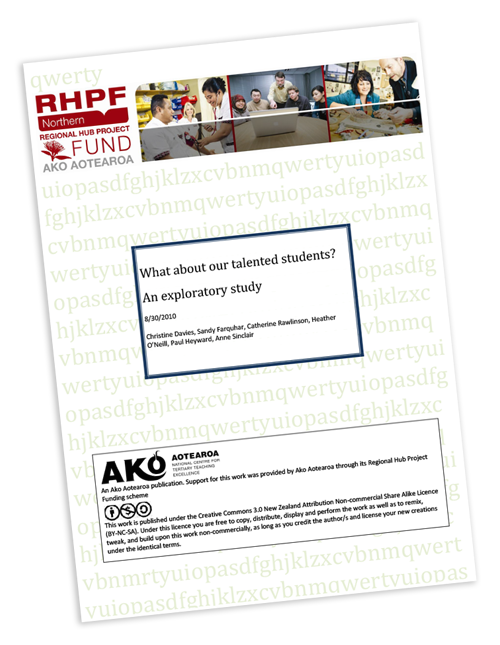
What about our talented students? An exploratory study

This report investigates the provision for talented students. It covers how ‘talented’ students were defined, how talented students were identified, opportunities for talented students that supported their learning, and issues for talented students.

Download the report:

Background:

A project completed in 2010, undertaken by The University of Auckland, to investigate the current provision for talented students across four faculties, within one tertiary institution in Aotearoa-New Zealand.

Report prepared by Christine Davies, Sandy Farquhar, Catherine Rawlinson, Heather O’Neill, Paul Heyward and Anne Sinclair.


Co-funded by the Ako Aotearoa Regional Hub Project Fund (RHPF)

Posted in Curriculum | Leave a comment

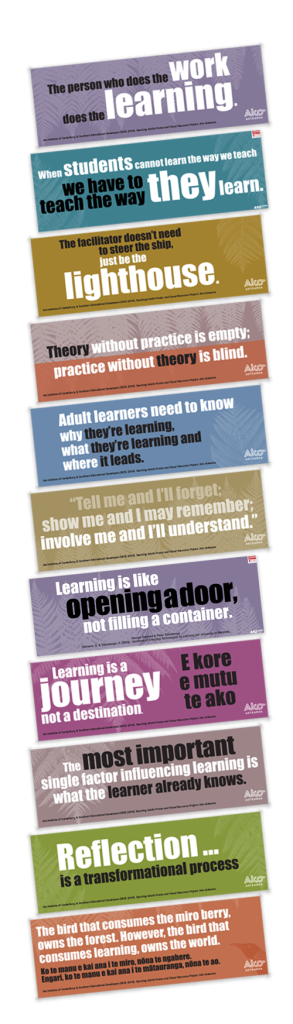
Teaching adults poster and visual resource project

A set of posters designed to support adult learning online or in tertiary classrooms, focusing on integrating elements of local culture and effective teaching principles.

Resource download:

Background:

A project, completed in 2010, to produce a set of posters and electronic aids for teachers of adult educators in Aotearoa New Zealand, along with supporting information to explain their design and content.

A collaborative project undertaken by Christchurch Polytechnic Institute of Technology and members of the Southern Educational Developers (SED) in South Island Institutes of Technology and Polytechnics (ITPs).


Co-funded by the Ako Aotearoa Regional Hub Project Fund (RHPF)

Posted in Adult and community education | Leave a comment

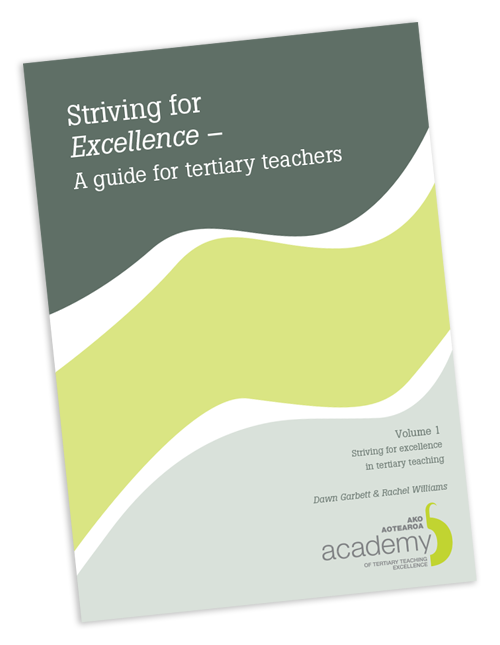
Striving for Excellence: A guide for tertiary teachers

These guides presents insights gathered from recipients of the Tertiary Teaching Excellence Awards about what tertiary teaching excellence is, what drives excellent tertiary teachers and how they achieve what they do.

Resource download:

Background:

A project, completed in 2013, to develop a guide for tertiary teachers from the growing body of good practice material from those teachers recognised nationally in the Tertiary Teaching Excellence Awards.

A collaboration of Ako Aotearoa Academy of Tertiary Teaching Excellence, The University of Auckland and Victoria University of Wellington.

Reports prepared by Dawn Garbett and Rachel Williams.


Posted in Strategic leadership and change | Leave a comment

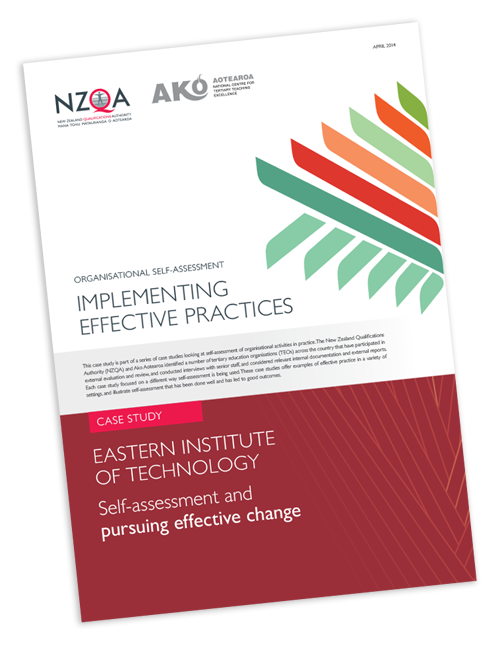
Self–assessment case studies

A series of case studies from New Zealand Tertiary organisations looking at self-assessment of organisational activities in practice.

The case studies are designed to:

  • help other tertiary education organisations reflect on their own experiences and approaches and build or maintain an effective culture of self-assessment
  • provide insights into the way management and staff use self-assessment to improve their educational practice and performance.

Resource download:

Background:

A project, led by NZQA and Ako Aotearoa in 2014, to develop a set of five case studies that describe a range of tertiary education organisations’ experiences with implementing self-assessment.

Case studies developed by Building and Construction Industry Training Organisation, Otago Polytechnic, People Potential, Tūranga Ararua and Eastern Institute of Technology.

Reports prepared by Natalie Bourke.


Posted in Assessment | Leave a comment

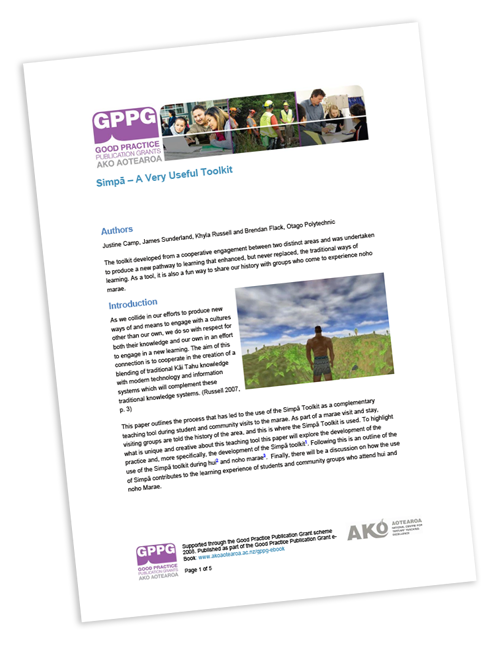
Simpā – A very useful toolkit

This report outlines the process that has led to the use of the Simpā Toolkit as a complementary teaching tool during student and community visits to the marae.

Simpā, is a toolkit that merges Māori history and computer gaming technology as a way of teaching Māori history in an interactive and interesting way.

Download the report:

Background:

A project, completed in 2010 at Otago Polytechnic, to create a blending of traditional knowledge with modern technology and information systems to produce new ways to engage with Māori culture.

Report prepared by Justine Camp, James Sunderland, Khyla Russell and Brendan Flack.


Co-funded by the Ako Aotearoa Good Practice Publication Grants scheme (GPPG)

Posted in Māori learner success | Leave a comment

SET for work, SET for life, Te Tai Tokerau

This report, and accompanying resources, offer ‘best practice’ guidelines for improving Secondary-Tertiary transitions for students across the New Zealand Vocational Education and Training (VET) system.

Resource download:

Background:

This project, completed in 2019, analysed and reflected on the effectiveness of the SET for Life operational framework, with the goal of developing good practice guidelines to inform and enable change in the connection between the world of work and the world of learning.

SET for Life is a skills, employment and training programme run by The Skills Organisation. It involved the design and trial of a suite of interventions to improve transitions for secondary school learners, pre-trade ITP (Institutes of Technology and Polytechnics) students and ITO (Industry Training Organisation) trainees.

A collaboration between The Skills Organisation, Primary ITO, NorthTec and Te Matarau Education Trust in Te Tai Tokerau.

Resources prepared by Nigel Studdart, Ken Eastwood and Sarah Renni.


Co-funded by the Ako Aotearoa National Project Fund (NPF)
Posted in Educational transitions | Leave a comment

Digging for Māori values at Te Tai o Poutini Polytechnic

Mā pango mā whero ka oti te mahi

This report details the findings of a study into the benefits of Māori frameworks on the retention and completion rates of Māori students within Tai Poutini Polytechnic’s Digger Schools.

Download the report:

Background:

A project completed in 2015, undertaken by Tai Poutini Polytechnic, that aimed to investigate whether the higher Māori participation and completion rates at the Digger Schools may be due to high alignment with Māori values.

Report prepared by Tonga Karena and Christine Fenton. 


Co-funded by the Ako Aotearoa Regional Hub Project Fund (RHPF)

Posted in Māori learner success | Leave a comment

Seeing the bigger picture through context-based learning

This report describes context-based learning (CBL) and the learner benefits associated with the practice, including capability building, increased creativity and skills of critical analysis as a professional.

The process of CBL involves students being provided with a scenario, and undertaking a student-led process of hypothesising, which ultimately results in the development of the students’ own learning needs.

Download the report:

Background:

A project, completed in 2010 at Whitireia Community Polytechnic, to investigate the benefits of a context-based learning approach.

Report produced by Wendy Trimmer, Kay Laracy and Michele Love-Gray.


Co-funded by the Ako Aotearoa Good Practice Publication Grants scheme (GPPG)

Posted in Curriculum | Leave a comment

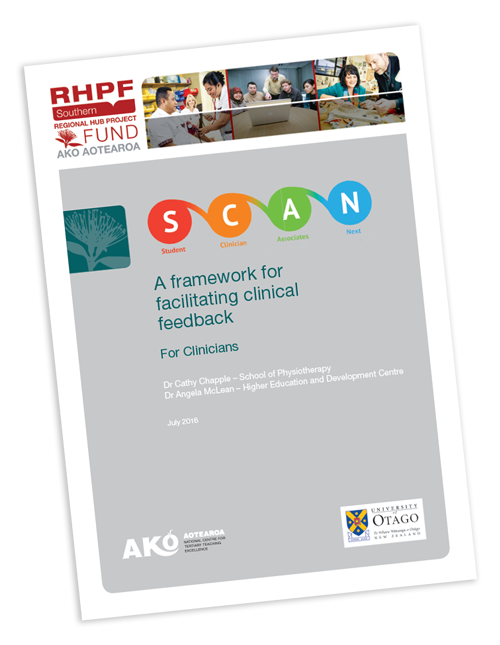
SCAN: A Framework for facilitating clinical feedback

These guides introduce the SCAN framework for providing feedback to health students on clinical practice activities in a frequent, informal and efficient way.

The accompanying discussion points document provides prompt questions / discussion points for SCAN video clip resources.

Resource download:

Supporting videos:

These video resources illustrate a clinical scenario where feedback is taking place between a student and a clinical supervisor.

Background:

A two-year project completed in 2016, undertaken by University of Otago, to develop a framework for engaging in feedback where the process was clear, expectations explicit, student contribution was emphasised and there was a feed forward mechanism to improve future practice or learning.

Resources prepared by Cathy Chapple and Angela McLean.


Co-funded by the Ako Aotearoa Regional Hub Project Fund (RHPF)

Posted in Industry specific resources | Leave a comment

Review of the effectiveness of educational tools for teaching telehealth care

This report investigates the available pedagogical and professional development models for teaching Telehealth to healthcare workers. It offers recommendations that can be used as guidelines for teaching Telehealth care.

Telehealth is broadly defined as the delivery of health-related services at a distance.

Many of the findings of this review may also be of interest to professionals beyond the health professions, particularly those in fields in which new information and communications technologies are increasingly impacting on practice.

Download the report:

Background:

A project, completed in 2010, that aimed to create a comprehensive, review-based evidence base of most effective and efficient pedagogical tools for education health care providers on how to best deliver Telehealth.

A collaboration of University of Canterbury and Christchurch Polytechnic Institute of Technology.

Report prepared by Arindam Basu, Philippa Seaton, Ray Kirk, Elizabeth Hanley, Dale Sheehan, Billy O‘Steen and Mary Allan.


Co-funded by the Ako Aotearoa Regional Hub Project Fund (RHPF)

Posted in Industry specific resources | Leave a comment

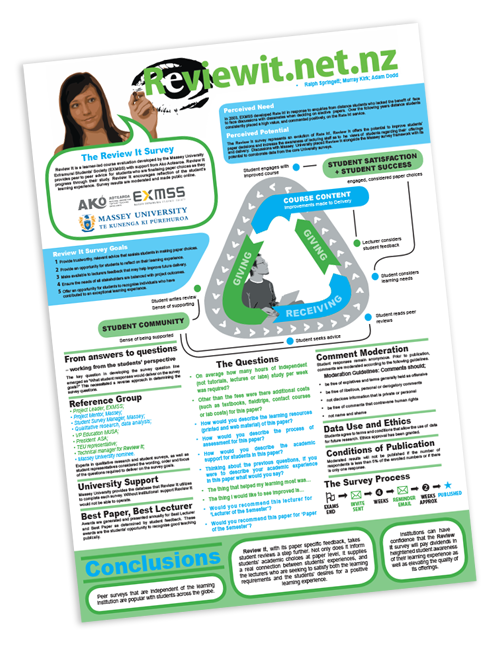
Review it!

This poster introduces ReviewIt, a website that provided peer to peer advice for students who are finalising paper choices as they progress through their study.

While the website may no longer be active the poster may still be of use to those hoping to create a method for students to share/rate their study experiences.

Resource download:

Poster | Review it! (PDF, 600Kb)

Background:

An 18-month project, undertaken by Massey University Extramural Students’ Society (EXMSS) in 2011, to develop a student survey (Review It), that builds upon a previous survey Rate it, enabling students to share their experiences of Massey University courses with other students.

Poster developed by Ralph Springett, Gordon Suddaby, Murray Kirk and Adam Dodd.


Co-funded by the Ako Aotearoa Regional Hub Project Fund (RHPF)

Posted in Student engagement | Leave a comment

Satellite Programmes: Barriers and enablers for student success

This report examines the development and implementation of a Health Care Assistance (HCA) programmes delivered at satellite locations across the central North Island by Bay of Plenty Polytechnic.

A set of guidelines for scoping successful satellite programmes have been developed from the findings which may be used to assist the development of satellite programmes by other Institutes of Technology and Polytechnics (ITPs) and Private training establishments (PTEs) who serve multiple communities.

Download the report:

Background:

A project, completed in 2016 at Bay of Plenty Polytechnic (BoPP), to examine the development and implementation of BoPP’s Health Care Assistance (HCA) programmes delivered at satellite programmes across the central North Island.

Report prepared by Heather Watt and Rachel Gardiner.


Co-funded by the Ako Aotearoa Regional Hub Project Fund (RHPF)

Posted in Student engagement | Leave a comment

Rethinking assessment for the science modules in the first year nursing programme

This report documents the evaluation of an innovative assessment tool that was developed to provide evidence that students were developing science-informed competence for nursing.

Download the report:

Background:

A project, completed in 2011, that aimed to enhance the validity and reliability of assessment outcomes for nursing students in their first-year science programme.

A collaboration of Waikato Institute of Technology, Manukau Institute of Technology and New Zealand Council for Educational Research.

Report prepared by Gudrun Dannenfeldt, Jane Stewart, Angela Stewart, Kevin Stewart, Victor Fester, Jackie McHaffie, Pam Williams, and Rose Hipkins.


Co-funded by the Ako Aotearoa Regional Hub Project Fund (RHPF)

Posted in Assessment | Leave a comment

An upgraded earthquake design tool for architecture and civil engineering teachers and students

This report documents the design and evaluation of updates to the RESIST software to include earthquake code changes, and enhance its effectiveness as a design and teaching tool for Architecture and Civil Engineering Teachers and Students.

Download the report:

Background:

A project, completed in 2014, to update the RESIST software and make it accessible to all teachers and students.

RESIST is a computer software that facilitates preliminary designs of buildings against wind and earthquake loads. For over 20 years various versions of RESIST have empowered architecture students to design structures for their design projects.

A collaboration of Victoria University of Wellington, University of Canterbury and Unitec Institute of Technology.

Report prepared by Andrew Charleson.


Co-funded by the Ako Aotearoa Regional Hub Project Fund (RHPF)

Posted in Industry specific resources | Leave a comment

Reflective practice strategies for clinical psychology students

Understanding and managing personal responses in professional roles

This report documents an investigation of the effectiveness of a teaching and learning approach to assist clinical psychology students develop an understanding of how to manage countertransference (CT) using reflective practice skills.

Research demonstrates that the experience of countertransference – or emotional responses to clients that can result in problematic therapist behaviours – can be one of the most challenging aspects of working therapeutically.

The accompanying Reflective Practice Guide – Understanding and Managing Countertransference – was developed to accompany the recommendations found in the report.

Resource download:

Background:

This project, completed in 2016, investigated the reflective practice skills of clinical psychology students who work with consumers in mental health and forensic settings.

A collaboration involving six New Zealand tertiary institutions, led by the University of Auckland.

Report prepared by Claire Cartwright, Nigel George and Sue Cowie.


Co-funded by the Ako Aotearoa Regional Hub Project Fund (RHPF)

Posted in Industry specific resources | Leave a comment

Reflective practice project

A professional development/support model for all teachers

This report documents the development and evaluation of the Reflective Practice Project – an eight week professional development programme in which teachers are supported in their reflective practice by a teaching mentor. The model uses pre-designed meeting templates to prompt the teacher’s reflective practice, and to monitor the teaching mentors input.

Supporting documentation for implementing this model is included in the accompanying management guide for those looking to adapt or implement a similar programme for their organisation.

Resource download:

Background:

A project completed in 2012, undertaken by the International College of Camille, to develop a mentored professional development programme.

Report prepared by Michelle Clarke.


Co-funded by the Ako Aotearoa Regional Hub Project Fund (RHPF)

Posted in Professional learning | Leave a comment

Redesigning the design crit

This report documents an investigation to test the validity of new design crit types to improve learner outcomes.

Traditionally the design crit is a key part of design and architectural education. It involves students publicly presenting their design projects in front of critics, usually from academia and design practice.

Download the report:

Background:

A project completed in 2011, undertaken by Victoria University of Wellington, to validate the use of the experimental crits as viable alternatives to the Traditional Crit in the context of architectural and design education.

Report prepared by Christine McCarthy.


Co-funded by the Ako Aotearoa Regional Hub Project Fund (RHPF)

Posted in Curriculum | Leave a comment

Reflective experiential learning

This report details the design and evaluation of using the Active Video Watching (AVW-Space) system in order to improve students’ presentation skills.

AVW-Space is a controlled video-watching environment designed for self-study that
resembles informal learning with popular social environments, such as YouTube.

An instructor manual has also been prepared to help educators with their use of AVW-Space software. 

Resource download:

Background:

A one-year project, completed in 2017, that investigated supporting mechanisms for active video watching in order to improve students’ presentation skills. A collaboration of University of Canterbury, University of Leeds and The University of Adelaide.

Report prepared by Antonija Mitrovic and Moffat Mathews.


Co-funded by the Ako Aotearoa Regional Hub Project Fund (RHPF)

Posted in Online learning | Leave a comment

Supporting engagement during Active Video Watching with personalised nudges

This report introduces improvements to the AVW-Space platform, with intelligent support for writing comments, in the form of interactive visualizations and personalized nudges, to help increase students’ presentation skills.

AVW-Space is a controlled video-watching environment designed for self-study that
resembles informal learning with popular social environments, such as YouTube.

An instructor manual has also been prepared to help educators plan with their use of AVW-Space v2.0. 

Resource download:

Background:

A one-year project, completed in 2019 at the University of Canterbury and University of Otago, that builds on previous findings of a 2017 Ako Aotearoa funded project that investigated using Active Video Watching to Teach Presentation Skills.

Report prepared by Antonija Mitrovic.


Co-funded by the Ako Aotearoa Regional Hub Project Fund (RHPF)

Posted in Online learning | Leave a comment

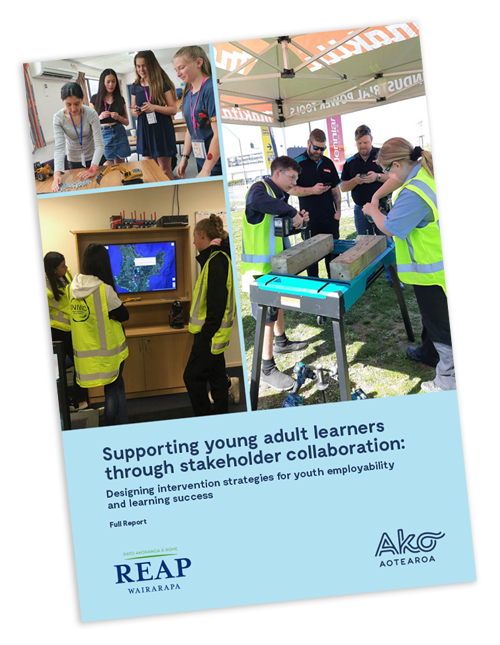
Supporting young learners through stakeholder collaboration

This report details a study to determine effective interventions that foster employability skills and support young learners to pathway into future education, training and/or employment.

The accompanying guide outlines tips and tools for creating a youth-friendly workplace and support young people to become successful, contributing employees.

Resource download:

Background:

This project, completed in 2021 at REAP Wairarapa, that aimed to evaluate an existing programme (L2W) that teaches young people soft skills which are recognised as core employability skills, and investigate how other key stakeholders invested in young peoples’ learning and employment success can collaborate and build their capabilities to achieve this outcome. A key focus was to consider how employers can be supported in providing youth-friendly workplaces. 

Report prepared by Peter McNeur, Tracey Shepherd, Maria McKenzie, Kylie Brady, Shirley Johnson, and Lesley Petersen.


Co-funded by the Ako Aotearoa Regional Hub Project Fund (RHPF)

Posted in Adult and community education | Leave a comment

Supporting workers from non-English speaking backgrounds in agriculture industry training

Migrant workers not from English speaking backgrounds (NESB) are at a disadvantage in their initial work and training, although they are literate in their own language. This can put their productivity, safety and employment relations at risk.

This report documents the development and evaluation of two tools to support migrant farm workers from non-English speaking backgrounds who are undertaking formal industry training in New zealand.

While the report focusses on trainees in the diary industry, the findings will be of use for any industry training people from non-English speaking backgrounds.

Download the report:

Background:

A project, completed in 2011, to develop, trial and evaluate tools to support migrant dairy farm workers from non-English speaking backgrounds who are undertaking formal industry training (trainees).

A collaboration of Agribusiness Training, English Language Partners and the Agriculture Industry Training Organisation.

Report prepared by Charlotte Heather and Dorothy Thwaite.


Co-funded by the Ako Aotearoa Regional Hub Project Fund (RHPF)

Posted in Workplace learning | Leave a comment

Survey of literature relating to tertiary teacher development and qualifications

These reports detail a 2009 literature review focusing on teachers’ informal experiential workplace learning about teaching and how to teach, and about formal courses for balanced professional education.

Download the report:

Background:

A project completed in 2009, undertaken by Whitireia Community Polytechnic, to carry out a comprehensive review of the literature on teachers’ informal experiential workplace learning about teaching and how to teach, and on research into aspects of formal courses and qualifications for tertiary teachers.

Reports prepared by Alison Viscovic.


Posted in Professional learning | Leave a comment

Taking Stock – Tertiary practitioner education training and support

A 2010 stock-take of the qualifications, and formal and informal support, available to new tertiary teachers in New Zealand.

Download the report:

Background:

A project completed in 2010, commissioned by Ako Aotearoa and undertaken by Projects International, that aimed to identify which tertiary teaching qualifications are being offered, and to identify organisational policies and practices in place for supporting new tertiary teaching staff.

Report prepared by Martin Eadie, Chris Knol and Brigid Thorns. 


Posted in Strategic leadership and change | Leave a comment