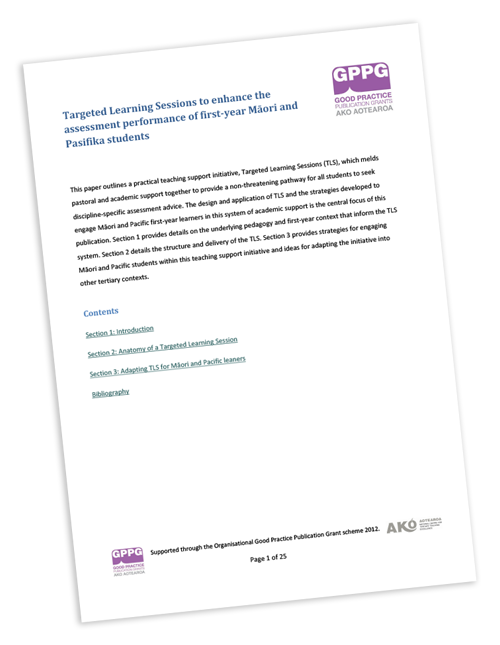
Targeted Learning Sessions (TLS) melds pastoral and academic support together to provide a non-threatening pathway for all students to seek discipline-specific assessment advice.
This report is a good practice guide outlining the design and application of Targeted Learning Sessions and strategies developed to engage Māori and Pacific first-year learners in this system of academic support.
A project, completed in 2014 at the University of Auckland, to design Targeted Learning Sessions (TLS) with strategies developed to engage Māori and Pacific first-year learners.
Co-funded by the Ako Aotearoa Good Practice Publication Grants scheme (GPPG)
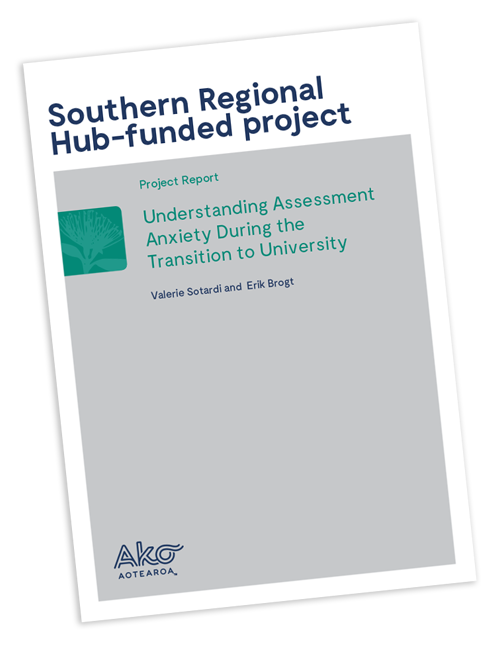
This report offers valuable insights into the first-year students’ challenges and experiences, examining their anxieties during their initial coursework and prior encounters with assessment-related stress.
The accompanying guides offer strategies for educators to support and guide first-year university students in managing assessment anxiety effectively, and tips to assist students understand assessment anxiety and provides strategies to help them manage this.
A two-year project, completed in 2018 at the University of Canterbury, to understand the assessment-related anxieties which first-year students in Aotearoa New Zealand may experience.
Resources prepared by Dr Valerie Sotardi and Erik Brogt.
Co-funded by the Ako Aotearoa Regional Hub Project Fund (RHPF)
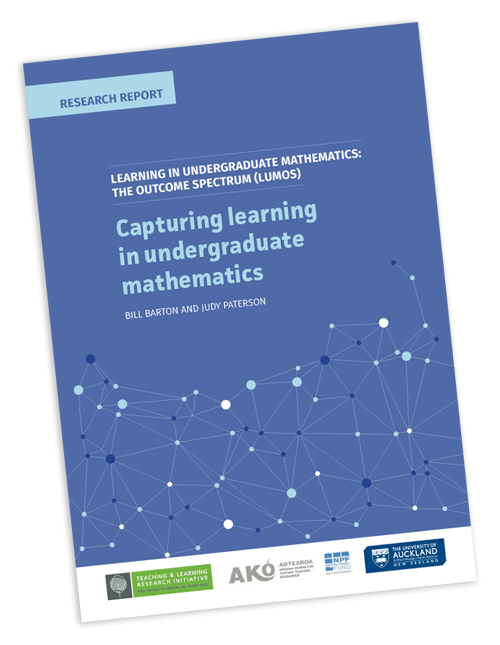
A five-year project to improve the tertiary education outcomes for mathematics learners led by the University of Auckland in collaboration with the University of Canterbury, Victoria University of Wellington and an international reference group of experts.
Report prepared by Bill Barton and Judy Paterson.
Co-funded by the Ako Aotearoa National Project Fund (NPF)
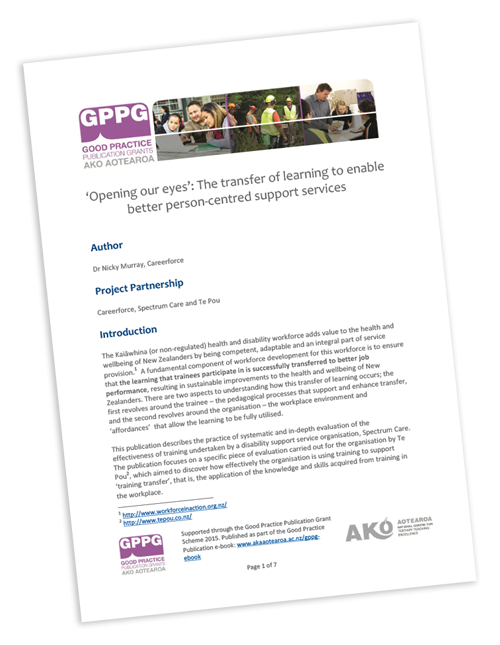
This report details an in-depth evaluation of the effectiveness of training undertaken by a disability support service organisation, and the application of the knowledge and skills acquired from training back in the workplace.
It contains recommendations to help organisations understand and reflect on the value and effectiveness of the training that they offer. The model could also be extended to other sectors or industries where workplace learning is predominant.
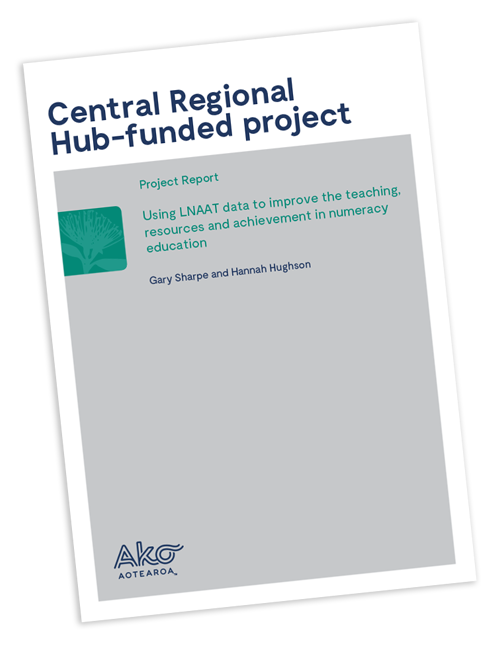
This report documents an investigation to identify numeracy deficit in tertiary learners using data within the Literacy and Numeracy Assessment Tool (LNAAT).
It identifies common areas of numeracy skill deficit for learners and offers recommendations for interventions that can support learners numeracy development in those areas.
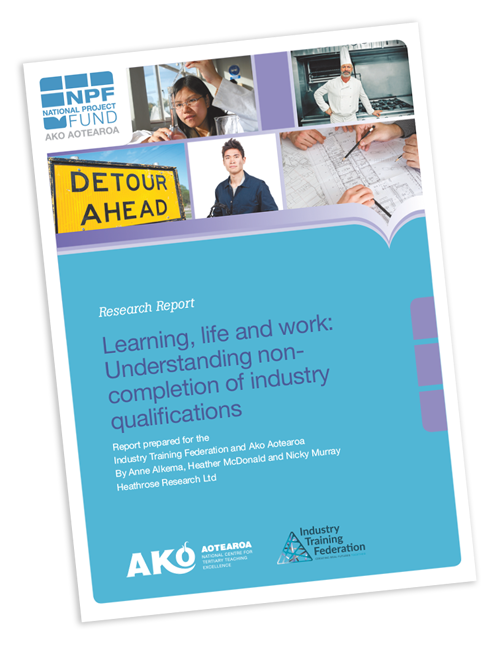
These reports explores the reasons apprentices and industry trainees did not completing their industry training qualifications, capturing the voices of non-completing trainees and apprentices to inform the narratives on qualification completion in industry training.
It offers recommendations for potentially effective interventions to increase the qualification completion rates in industry training.
A six-month project, completed in 2016, that aimed to identify the factors associated with the qualification non-completion of level 3 and 4 apprentices and industry trainees.
A collaboration between the Industry Training Federation (ITF) and 12 industry training organisations (ITO).
Report prepared for the Industry Training Federation and Ako Aotearoa by Anne Alkema, Heather McDonald and Nicky Murray, Heathrose Research Ltd.
Co-funded by the Ako Aotearoa National Project Fund (NPF)
This report details a study to enhance levels of pastoral and academic support for migrant students studying humanities and arts subjects.
The accompanying good practice guide indicates a series of critical transition points in the career track of migrant students at which timely practical assistance might assuage the effects of the conditions under which many such students learn.
A project completed in 2010, undertaken by Massey University, to enhance levels of pastoral support for migrant students studying humanities and arts subjects, engage migrant communities regarding their learning needs, and develop responsiveness to the learning needs of migrant students.
Resources prepared by Warwick Tie, Peter Lineham, Judy Hunter and Ann Dupuis.
Co-funded by the Ako Aotearoa Regional Hub Project Fund (RHPF)
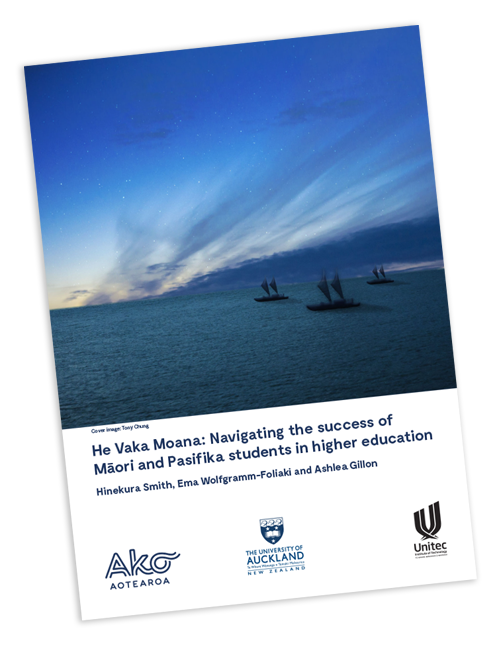
This report describes the development of He Vaka Moana, a sustainable, interdisciplinary fellowship for teaching, learning, assessment and research.
A strengths-based project framed by Oceanic principles and methodologies, He Vaka Moana aims to support educators to develop and advance Māori and Pasifika learners’ success.
A two year long project, completed in 2021, that used an Oceanic methodology to investigate Māori and Pasifika student success and retention. A collaboration between University of Auckland and UNITEC.
Report prepared by Hinekura Smith, Ema Wolfgramm-Foliaki and Ashlea Gillon.
Co-funded by the Ako Aotearoa National Project Fund (NPF)
This report introduces an evaluation tool to gather feedback from students and multiple stakeholders involved in work-integrated learning (WIL).
This is intended for subject-matter experts, professional training teachers, trade teachers, and those overseeing courses with significant workplace components. It can be valuable for teachers seeking feedback from their students, supervisors responsible for student workplace placements, and even workplace managers facilitating such placements.
Originally developed for assessing teaching practices in psychology internships, it can be adapted for other professional and vocational internship programs engaged in WIL at the tertiary level.
A two-year project, completed in 2023 at Massey University, to develop a tool for evaluating the impact of teaching practice on post-graduate learners undertaking professional psychology internships.
Report prepared by Barbara Kennedy, Michael Philipp, Sara Herkt, and Shanika Yoshini Koreshi.
Co-funded by the Ako Aotearoa Regional Hub Project Fund (RHPF)
This report describes the design and evaluation of a mobile business consulting game that can support contextual learning. The game was designed to provide a learning experience similar to a real world business consulting exercise that can be used by any group of learners using readily available mobile devices.
A project, completed in 2011, to create a mobile business consulting game that can support contextual learning, is freely available and is easy for both teachers and learners to use in any physical environment. A collaboration of Massey University and Auckland University of Technology.
Report prepared by David Parsons and Krassie Petrova.
Co-funded by the Ako Aotearoa Regional Hub Project Fund (RHPF)
This report, and accompanying resource, provide a tool kit for staff wishing to provide professional development for casual teaching staff in the post-compulsory teaching sector.
An 18-month project, completed in 2019 at the University of Otago, to investigate the effectiveness of a teacher development programme through peer observation and mentoring.
Report prepared by Dr Rob Wass, Dr Tracy Rogers, Angela Howell, Dr Catherine Hartung, and Dr Gwynaeth McIntyre.
Co-funded by the Ako Aotearoa Regional Hub Project Fund (RHPF)
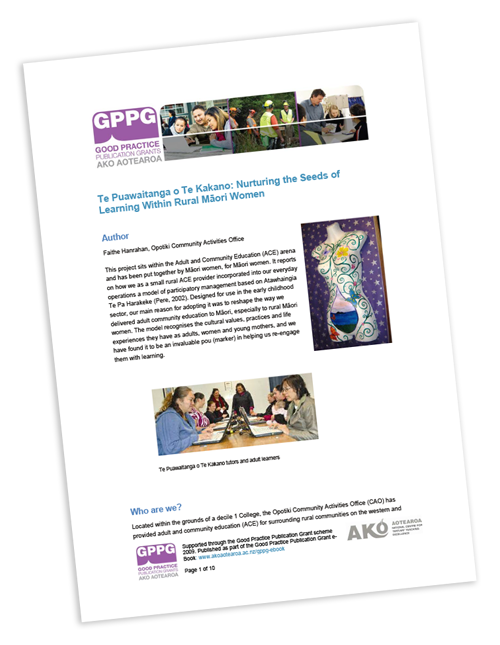
This report describes how the early childhood Māori management/learning model of ‘Atawhaingia Te Pa Harakeke’ has been incorporated into Adult and Community Education practices in order to better meet the learning needs of Māori women.
A project, completed in 2010 at the Opotiki Community Activities Office, to reshape the delivery of adult community education to Māori, especially to rural Māori women.
The model recognises the cultural values, practices and life experiences they have as adults, women and young mothers, to help re-engage them with learning.
Report prepared by Faithe Hanrahan.
Co-funded by the Ako Aotearoa Good Practice Publication Grants scheme (GPPG)
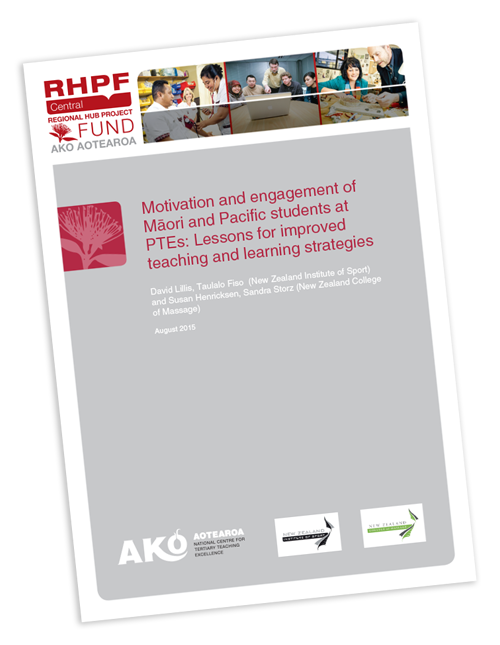
Lessons for improved teaching and learning strategies
This report identifies teaching and learning strategies that will support the creation of learning environments that enhance engagement and motivation for Māori and Pacific learners.
A project, completed in 2015, to enhance understanding of motivation and engagement of Māori and Pasifika PTE students and explore the relationships between motivation, engagement and learning outcomes.
A collaboration of New Zealand Institute of Sport and New Zealand College of Massage.
Rreport prepared by David Lillis, Taulalo Fiso, Susan Henricksen and Sandra Storz.
Co-funded by the Ako Aotearoa Regional Hub Project Fund (RHPF)
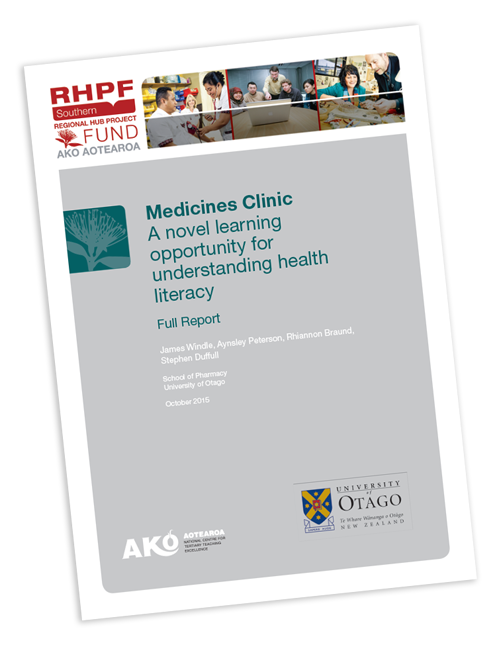
A project completed in 2015, undertaken by the University of Otago’s School of Pharmacy, to develop a pilot of public drop-in community-based Medicines and Health Literacy Clinics (MHLCs) with final-year pharmacy students at the University of Otago.
The project aimed to provide a community based patient-centred placement opportunity for final year students to better understand adult health literacy, and to provide an environment where students and academic pharmacists could interact, while illustrating a new example of activities possible in clinical care settings.
Report prepared by James Windle, Aynsley Peterson, Rhiannon Braund and Stephen Duffull.
Co-funded by the Ako Aotearoa Regional Hub Project Fund (RHPF)
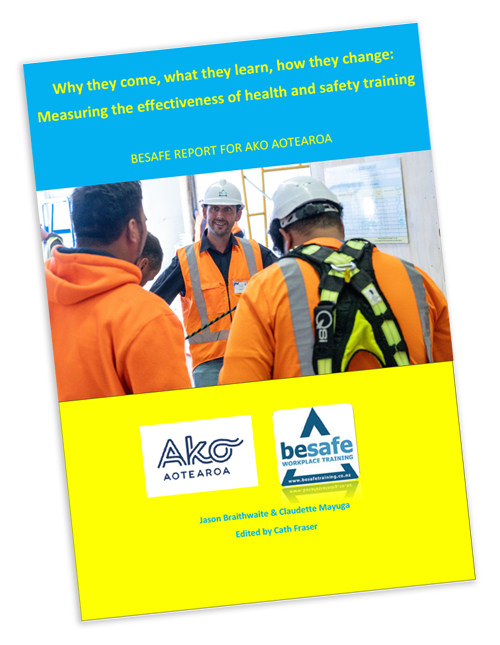
This report presents the findings of a research inquiry to gauge the impact their health and safety courses were having on trainees and the workplaces they returned to.
While focussed on Health and Safety courses, the findings and series of transferable reflections/recommendations will be of use for other training and education providers.
This project, completed in 2020 by Besafe Training, that investigated the effectiveness of workplace health and safety training programmes for industry training providers.
Report prepared by Jason Braithwaite and Claudette Mayuga.
Co-funded by the Ako Aotearoa Regional Hub Project Fund (RHPF)
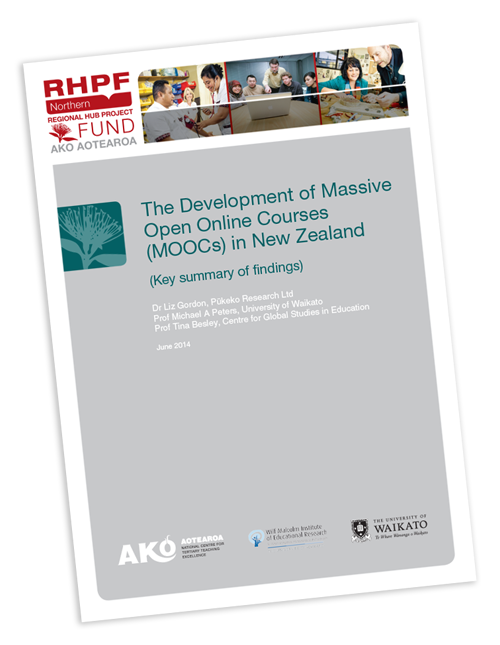
A one-year project, completed in 2014 at the University of Waikato, to report on the state of play of massive open online courses (MOOCs) development in the NZ tertiary education sector.
Report prepared by Liz Gordon, Michael Peters and Tina Besley.
Co-funded by the Ako Aotearoa Regional Hub Project Fund (RHPF)
This report documents an investigation into the effectiveness of an informal, voluntary mentoring programme for Primary Industry Training Organisation (ITO) trainees. It offers suggestions for creating a good practice model which could help improve mentoring relationships.
A project, completed in 2014, ascertain if mentoring support for Primary Industry Training Organisation (ITO) trainees by local community volunteer mentors made a difference to the trainees’ learning experiences and outcomes.
Report produced by Mike Styles, Marianne Farrell and Dr Lesley Petersen.
Co-funded by the Ako Aotearoa Regional Hub Project Fund (RHPF)
Field‐based experience is an integral component of many pre-service professional preparation programmes.
This report offers tips for creating effective mentoring relationships for learners in professional and vocational training areas.
The three accompanying booklets share the common habits for effective mentors, ideas on mentoring for training providers, and tips for learners to make the most of their mentoring experience.
A project, completed in 2012, that investigated ways to develop genuine learning dialogue between practicum mentors/supervisors and their students. A collaboration of Bethlehem Tertiary Institute, WINTEC and New Zealand Tertiary College, with input from private practitioner, Richard Charmley.
Report prepared by Andrew Smith, Marion Sanders, Bev Norsworthy, Suzzanne Barthow, Lynne Miles, Phillip Ozanne, and Cindy Weydema.
Co-funded by the Ako Aotearoa National Project Fund (NPF)
Mathematical maturity is a ubiquitous concept in the mathematical community and is thought to be important to have to be able to develop as a mathematician.
This report documents a study to better define ‘mathematical maturity’ and examine its contribution to the teaching and learning of mathematics.
An 18-month project, completed in 2018 at the University of Canterbury, that aimed to develop pedagogy to help students improve mathematical thinking, reasoning and transfer skills and overall mathematical performance.
Report prepared by Annie Soutter, Maarten McKubre-Jordens and Erik Brogt.
Co-funded by the Ako Aotearoa Regional Hub Project Fund (RHPF)
This video discusses the student-centred learning environment that has been particularly rewarding for Māori students in the Communication Design degree programme at Otago Polytechnic.
Background:
A project completed in 2014, undertaken by Otago Polytechnic, to produce a short film looking at three projects and exploring how cultural bridges are built between students, teachers, Māori advisors and communities.
Video produced by Caroline McCaw, Jon Wilson, Gina Huakau, Justine Camp, Vincent Egan, Thomas Te Whaiti-Henry and Madison Henry-Ryan.
Co-funded by the Ako Aotearoa Good Practice Publication Grants scheme (GPPG)
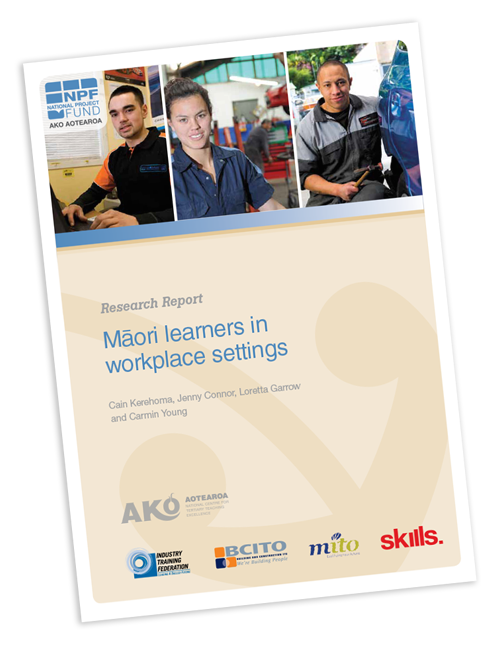
These reports explore the experiences of Māori learners in industry training organisations to understand how to best support Māori learners.
They provides insights into what is distinctive about Māori trainees in New Zealand and how to successfully engage them in learning, alongside a model to support Māori learners in the workplace.
A project, completed 2013, that aimed to help the industry training system become more responsive to the needs of Māori learners.
A collaboration involving Industry Training Federation, Kāhui Tautoko Consulting Ltd, Electrotechnology ITO (ETITO), Building and Construction ITO (BCITO) and the Motor ITO (MITO).
Reports prepared by Cain Kerehoma, Jenny Connor, Loretta Garrow and Carmin Young.
Co-funded by the Ako Aotearoa National Project Fund (NPF)
This report investigates capacity building and career development needs of Māori doctoral students, and presents effective practices that support Māori scholars early in their careers.
The accompanying quick reference guide and postcard series provide tips for supervisors supporting Māori and other indigenous PhD scholars.
A two-year project, completed in 2018, to learn more about the capacity building and career development needs of Māori doctoral students in their early careers. A collaboration between University of Waikato, Ngā Pae o te Māramatanga and Ako Aotearoa.
Report prepared by Associate Professor Leonie Pihama.
Co-funded by the Ako Aotearoa National Project Fund (NPF)
These reports form a complete New Zealand law student profile, detailing the expectations, views and experiences of law students during each year of their law studies and in their first post-law school years.
A project, undertaken by the University of Canterbury between 2014 and 2021, to develop a law student profile.
This longitudinal study consists of a number of phases of a self-selected cohort of students who first enrolled in law papers in 2014 at the Universities of Auckland, Canterbury, and Waikato, and later, Victoria University of Wellington.
Reports prepared by Lynne Taylor, Ursula Cheer, Natalie Baird, John Caldwell and Debra Wilson.
Co-funded by the Ako Aotearoa Regional Hub Project Fund (RHPF)
This report identifies factors to enhance the success of learners studying in post-compulsory education at Levels 1-3 on the National Qualifications Framework.
A two-year project, completed in 2012, that explored how to increase educational attainment for priority tertiary learners. A collaboration between Ako Aotearoa and the priority learners Educational Attainment Working Group (EAWG).
A project, completed in 2012, to explore a socio-cultural approach to mentoring with Māori and Pasifika electrical apprentices. The Skills Organisation commissioned Work and Education Research and Development Services to undertake the project.
Report prepared by Chris Holland.
Co-funded by the Ako Aotearoa Good Practice Publication Grants scheme (GPPG)
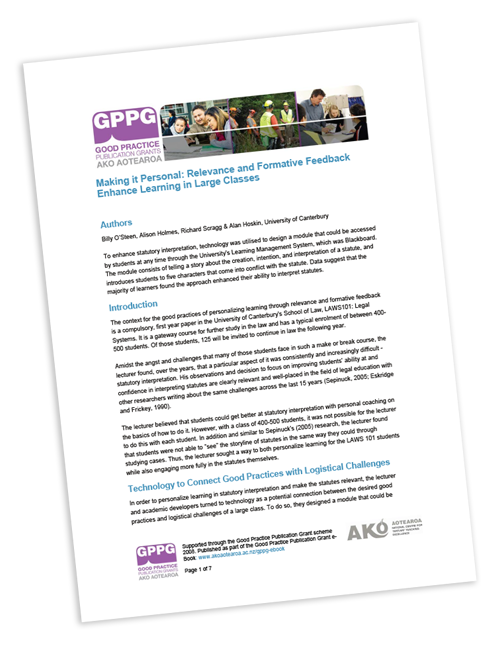
This report documents the design and evaluation of an online learning module to improve students’ ability at and confidence in interpreting legal statutes.
A project, completed in 2010 at the University of Canterbury, to enhance statutory interpretation through designing a learning module, utilising technology, that can be accessed by first year law students at any time through the University’s Learning Management System.
Report prepared by Billy O’Steen, Alison Holmes, Richard Scragg and Alan Hoskin.
Co-funded by the Ako Aotearoa Good Practice Publication Grants scheme (GPPG)
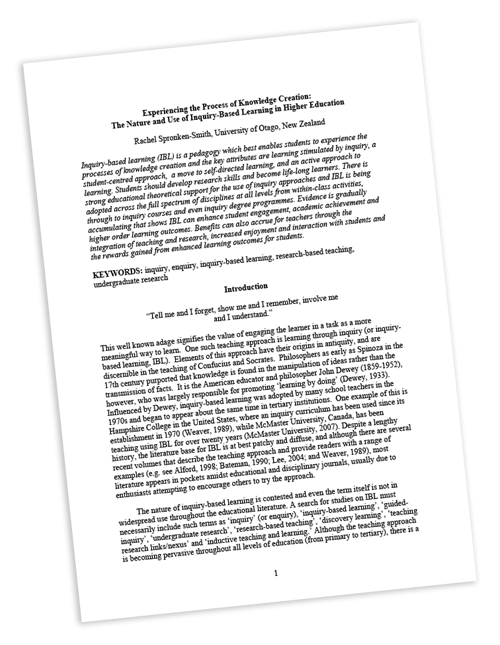
Inquiry-based learning (IBL) is a pedagogy which enables students to experience the processes of knowledge creation. The key attributes are learning stimulated by inquiry, a student-centred approach, a move to self-directed learning, and an active approach to learning.
This report, and accompanying resources, present case study examples of inquiry-based learning at tertiary institutions, and identify the impact of inquiry-based learning on student learning outcomes.
A two-year project, completed in 2008, to identify, explore and share with the tertiary community, a variety of examples of IBL at undergraduate level across a range of faculties and institutions.
Evidence is gradually accumulating that shows IBL can enhance student engagement, academic achievement and higher order learning outcomes. Benefits can also accrue for teachers through the integration of teaching and research, increased enjoyment and interaction with students and the rewards gained from enhanced learning outcomes for students.
A collaboration of University of Otago, University of Canterbury, Christchurch Polytechnic Institute of Technology and Victoria University of Wellington.
Resources prepared by Rachel Spronken-Smith, Rebecca Walker, Billy O’Steen, Julie Batchelor, Helen Matthews and Tom Angelo.
These videos present a series of case studies on the HITO Training Salon Of The Year finalists and describes how hairdressing students are supported in the workplace.
These case studies illustrate key training characteristics, excellence in training and professional training achievements that support and enhance the success and motivation of apprentices. The unique features of each finalist are showcased here with the intention to support other hairdressing employers involved in supporting learners in apprenticeships.
While these videos have been created with the intention of supporting hairdressing students and trainers, the strategies described may be of benefit to a variety of industry training situations.
In this video Training Salon Of The Year finalists explain about what they like about hairdressing and how they learn. They also talk about benefits of hair dressing apprenticeships.
In this video Platform artist Patrick Cameron talks about what it takes to run a successful hair salon.
In this video Training Salon Of The Year finalists talk about the importance of lifelong learning in their practice.
In this video Platform Artist Patrick Cameron talks about the different opportunities in a hair dressing career and the skills that aspiring hairdressers should have.
In this video salon owner Ursula Harris and her apprentices talk about how apprentices get trained in her salon and the benefits of real-life training.
In this video Gabrielle Bundy-Cooke, owner of Spectra hair salon in Palmerston North, explains how she trains her apprentices.
In this video Salon owner/Manager Annemarie Wilkinson and her staff explain how apprentices are trained at their salon.
In this video Diana Beaufort, owner of Reds hair salon, and her staff talk about their training programme for apprentices and what it takes to be a good hair dresser.
In this video Lyndsay Loveridge, owner of HQ Hair By Design, talks about how to run a successful hairdressing salon and how they train their staff. Several of Lyndsay’s apprentices also share what they enjoy about their work.
Background:
The videos were created in 2010 by Erica Cumming from the Hairdressing Industry Training Organisation (HITO).
Co-funded by the Ako Aotearoa Good Practice Publication Grants scheme (GPPG)
These reports, and accompanying quick-reference guide, identify key educational practices that lead to better education outcomes for Māori in tertiary settings.
A project, completed in 2009 at the University of Canterbury, to investigate tauira, exemplars, of success for Māori in tertiary education and identify and share educational practices in tertiary institutions that lead to better education outcomes for Māori.
Resources prepared by Janinka Greenwood and Lynne-Harata Te Aika.
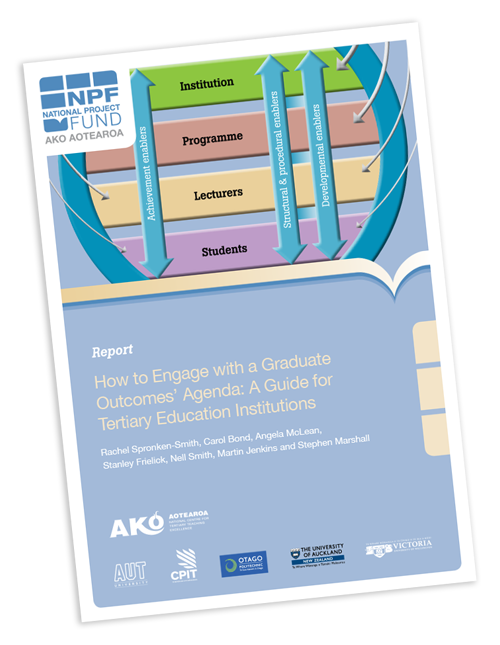
This report presents the findings from a large, multi-institutional project exploring engagement with a graduate outcomes agenda across higher education institutions in Aotearoa, New Zealand
The accompanying guides were designed to provide practical advice for institutions wishing to better engage with a graduate outcomes agenda.
An 18-month project, completed in 2012, to explore policy and practice related to graduate outcomes in higher education institutions in New Zealand.
A collaboration involving University of Otago, University of Sydney, Christchurch Polytechnic Institute of Technology (CPIT), Auckland University of Technology (AUT) and Victoria University of Wellington.
Resources prepared by Rachel Spronken-Smith, Carol Bond, Angela McLean, Stanley Frielick, Nell Smith, Martin Jenkins and Stephen Marshall.
Co-funded by the Ako Aotearoa National Project Fund (NPF)