This report and accompanying case studies detail innovative and effective assessment strategies that teachers use to support effective teaching and learning.
A one-year project, undertaken by Waikato Institute of Technology on behalf of the Ministry of Education, to investigate innovative and effective assessment strategies that teachers use to support effective teaching and learning in a range of New Zealand tertiary education organisations (TEOs).
Reports prepared by Jill Musgrave, Pat Reid, Rosanne Matheson, Jane Stewart, A G Oneroa Stewart, David Mitchell and Surya Pandey.
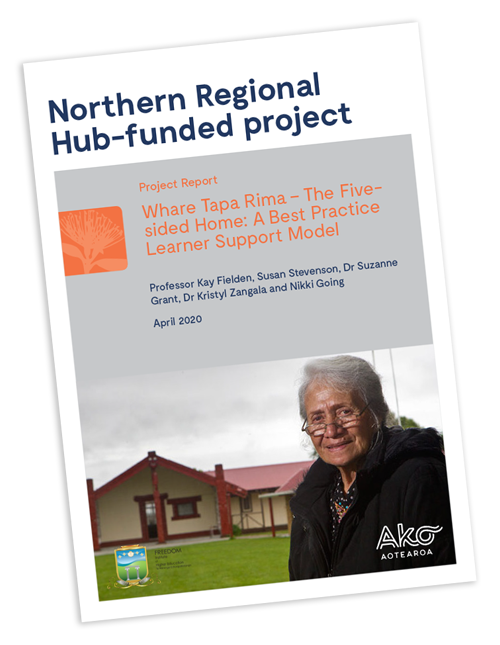
This comprehensive report provides an outline of the Whare Tapa Rima model as well as guidance and support for implementing the model into your practice.
It can assist educators, organisations and educational leaders to implement a holistic learner support programme in their institutions.
A key objective of this video is to support equitable educational outcomes especially in the tertiary and higher education contexts in New Zealand.
Background:
A project by the Freedom Institute of Higher Education that presents a model of learner support that builds on applications of Mason Durie’s Whaiora: Whare Tapa Wha model.
The report was completed in 2020 by Professor Kay Fielden, Susan Stevenson, Dr Suzanne Grant, Dr Kristyl Zangala and Nikki Going.
Co-funded by the Ako Aotearoa Regional Hub Project Fund (RHPF)
The report documents the Cultural Treasures’ Youth Empowerment Programme, which aimed to empower Pasifika students transitioning into tertiary education programmes at the University of Auckland.
The findings may be of use to educators of Pacific learners looking to discover ways to enhance their learners’ cultural pride, increase their self-esteem and build a sense of self-efficacy to support them through their Tertiary education journey.
A project, completed in 2018, to empower Pacific students who are struggling with education, through the use of Pacific taonga/treasures to reignite their passion for learning.
The research was undertaken by the Centre for Pacific Studies at the University of Auckland, with support from the New Foundations Trust and Wesley College.
Report prepared by Tarisi Vunidilo, Betty Loto and Kali Vunidilo.
Co-funded by the Ako Aotearoa Regional Hub Project Fund (RHPF)
Research shows texts read by the trades students are as demanding as university-level academic texts.
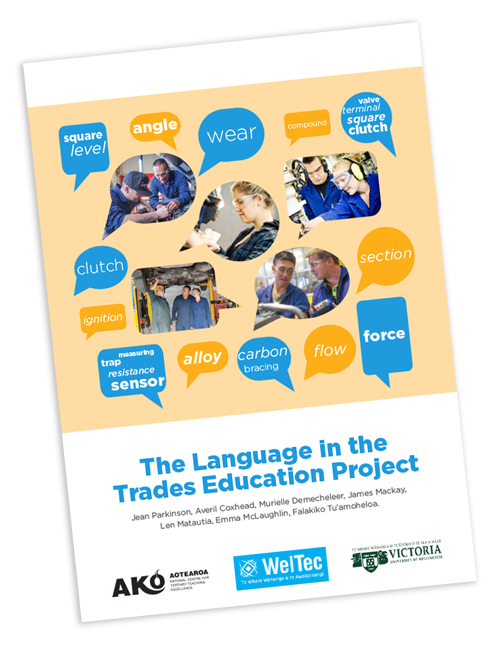
The report aims to describe the trades-specific language used in the automotive technology, carpentry, fabrication and plumbing trades, as well as how this language is taught and learned at institutes of technology and polytechnics in New Zealand.
There is also a guide resource for organisations who want to see where they are at in terms of embedding, and wish to support their staff to develop embedding capability. It includes insights into literacy development in the trades, models and resources for capability development and strategies and resources for tutors.
Tutors from a range of trades talk about the ways that they get learners to use the language of the trade and the way this helps to build understanding.
Tutors explain how simply drawing attention to trade specific language as part of the teaching process can learners to build their trade related vocabulary.
Trades tutors explain the role that modelling pays in supporting the development of trades related language with some ideas about how to do this in practice.
Ideas to set up before being face to face with the learners are shared from tutors who have had success setting up simple resources.
Creating a learning environment where the language of the trade is used as it would be on the job is discussed by tutors who use this technique.
Tutors discuss the strategies they use to support learners to understand the more challenging elements of trade specific language.
This tutor explains how he uses the first language of ESOL learners as a strength when supporting them to understand the language of the trade.
Background:
A three-and-a-half-year project exploring the vocabulary, genres and linguistic features of trades language. A collaboration between Victoria University of Wellington and WelTec.
Reports produced by Jean Parkinson, Averil Coxhead, Murielle Demecheleer, James Mackay, Len Matautia, Emma McLaughlin and Falakiko Tu’amoheloa.
Co-funded by the Ako Aotearoa National Project Fund (NPF)
This report describes the training experiences of 20 adult educators who attended He Mana Ako Training workshops aimed at embedding literacy and numeracy in courses designed for Māori learners.
This report documents the development of a training programme in cooperative learning (CL) for New Zealand tertiary lecturers. The results of the initial trials and pilot programmes for the proposed programme are documented and analysed, and a suggested final programme is presented.
This project was completed in 2011, to develop a training programme in co-operative learning (CL) for New Zealand tertiary lecturers. A collaboration of Wellington Institute of Technology and Whitireia New Zealand.
Reports prepared by Trish Baker and Jill Clark.
Co-funded by the Ako Aotearoa Regional Hub Project Fund (RHPF)
A practical guide to working with tertiary student groups
The Co-operative Learning guide is designed to provide practical suggestions and ideas on how best to incorporate group work into teaching programmes.
The guide includes numerous practical activities – across informal non-assessed and formal assessed cooperative learning classroom activities. A wide range of handy hints and teacher/student comments are included and woven throughout the publication.
The authors have included many suggestions for further reading and resources, and useful forms and templates are shared so that practitioners can adapt them for their own teaching contexts.
A project completed in 2015 to develop a practical guide to Cooperative Learning (CL) designed to support practitioners who want to incorporate more group work with their learners.
The guide was prepared by Jill Clark and Trish Baker.
Co-funded by the Ako Aotearoa Regional Hub Project Fund (RHPF)
An audio-visual resource for students on how to read academic texts
This report, and resources designed for both students and tutors, aims to support tertiary students in overcoming challenges related to academic reading by providing audio-visual resources, downloadable materials, and effective strategies to enhance their reading skills and promote successful study.
Peri says he “doesn’t do reading”. See him use the knowledge and skills he already has to learn to read a textbook.
Your reading history doesn’t need to control your success. There are effective strategies you can learn and use to read academic texts well and grow your intelligence.
The 7-step model for reading nonfiction is explained and demonstrated step by step.
Maria uses her areas of strength to help her get meaning out of texts and combat stress.
Peri shares the tips and strategies he uses to read nonfiction.
Hear about the ways that students benefit from interacting and learning with each other.
Ideas and strategies that tutors can use when introducing students to a new topic.
Learn about Irlen Syndrome which is about sensitivity to light intensity. Many people who have trouble reading have Irlen.
Background:
A project completed in 2012, undertaken by Whitireia New Zealand, to develop audio-visual resources for students wanting to improve their academic reading skills and another audio-visual tool for tutors to understand the reading needs of their students.
Report prepared by Clare Hazledine and Mary Silvester.
Co-funded by the Ako Aotearoa Regional Project Fund (RHPF)
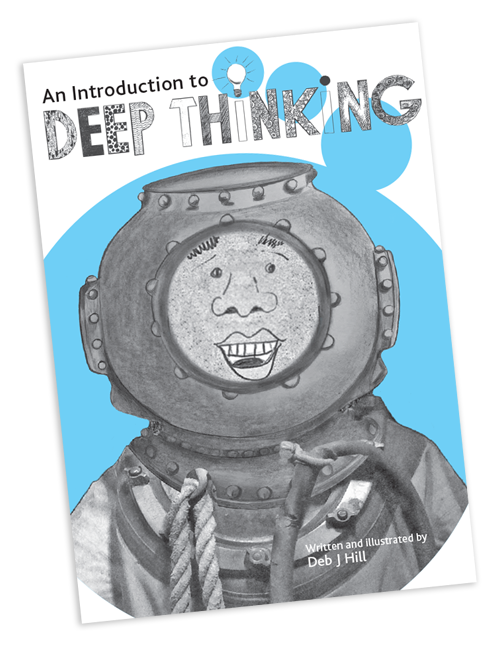
This short graphic resource explains how the inherited language we use limits our thinking in important ways. It encourages readers to interrogate their own life history to reflect on the beliefs and understandings they hold now. Taking a developmental as well as socially and historically situated perspective of “education” is the first step towards challenging these “limiting ideas”.
A project to develop a guide that presents a ‘taxonomy’ of thought in Tertiary Education, illustrating the various ‘types’ and unmasking the limitations of each. A collaboration of Whanganui Learning Centre Trust, Universal College of Learning, Waikato Institute of Technology, and Ocean University of China.
Report prepared by Deb Hill.
Co-funded by the Ako Aotearoa Regional Hub Project Fund (RHPF)
This report and accompanying posters set out guidelines and procedures with which individual Tertiary Education Organisations may provide consistent alternative arrangements in tests and examinations to students with disability/impairment.
Such provisions could help ensure students with disability/impairment have the same opportunity as their peers to achieve learning outcomes.
A project completed in 2015, undertaken by ACHIEVE (The National Post-Secondary Education Disability Network Incorporated), to survey and compare policy and practice of alternative assessment arrangements, to accommodate diverse needs for extra time in examinations and tests for students with impairments, in tertiary education institutions in New Zealand.
Co-funded by the Ako Aotearoa Regional Hub Project Fund (RHPF)
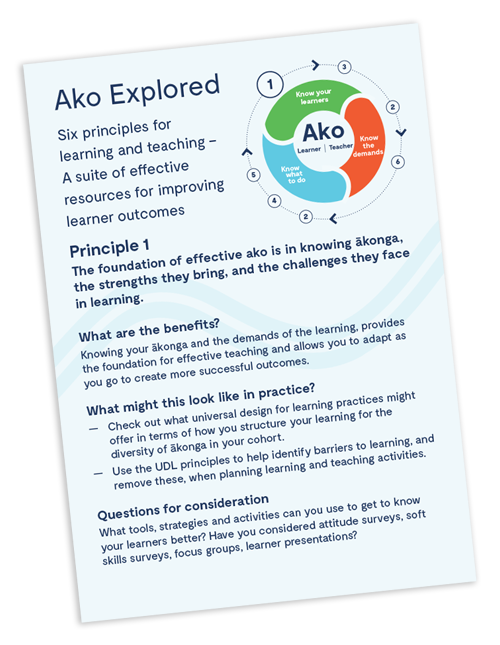
Six principles for enhancing learner outcomes in tertiary education
Ako Explored outlines six universal, evidence-based learning and teaching principles and related practices to enhance positive learner outcomes in the Aotearoa tertiary education sector.
This report outlines principles and practices designed to enhance teaching and leadership in tertiary education, serving as a versatile resource for educators, teams, professional developers, advisors, and tertiary education institutions.
A set of ‘coffee cards’ – one for each principle can be used by teaching teams or kaiako (educators) to challenge and extend their practice.
The principles can be contextualised in a wide range of learning and teaching settings.
BCITO | Te Pūkenga workplace learning advisors held a workshop to discuss the ways in which their existing practice aligns with Ako Explored principles. They found many synergies which reaffirmed their practice, although their context requires a learning approach quite different to class-based learning and teaching.
BCITO | Te Pūkenga workplace learning advisers consider briefly how the Ako Explored principles relate to their practice.
Unitec | Te Pūkenga Academic Advisors outline some ways in which they would use Ako Explored or encourage others to use the principles, practices, or questions.
Unitec | Te Pūkenga Academic Advisors talk about the roles of knowing, being, and doing as part of the learning process and how this can be considered in how learning is structured.
Unitec | Te Pūkenga Academic Advisors consider the ways in which relationships can be established and nurtured through the effective use of digital technologies.
Ako overview
Dr Marcia Leenen-Young’s teaching practice is wrapped around an intimate understanding of Ako (learning and teaching) and the key roles both kaiako (educators) and ākonga (learners) play in the learning and teaching process.
Associate Professor Diane Ruwhiu weaves her teaching practice the learning process around Ako (learning and teaching). She sees this as the core from which the other principles arise.
Principle 1 | Know your learners
The foundation of effective ako (learning and teaching) is in knowing ākonga (learners), the strengths they bring, and the challenges they face in learning.
While Associate Professor Christian Schott notes the criticality of experience as part of the learning process, his starting point is a deep understanding of his ākonga (learners) and their diverse backgrounds and life experiences.
Teaching a demanding topic with a very diverse cohort of students encourages Dr Cami Sawyer to understand her students, what they bring, and the challenges they face. This is the platform on which she builds a connectionist approach to teaching.
Principle 2 | Know what to do
Knowing and using targeted and relevant practices to achieve successful outcomes with ākonga (learners), will strengthen and improve ako (learning and teaching).
In redeveloping courses, David Cox’s strengths are in an intimate understanding of the content and knowing how to adapt his teaching to engage learners and enhance their ability to be successful in the course and beyond.
Associate Professor Kathryn MacCullum utilises a wide range of strategies to engage learners, but at the core of her teaching is the ability to choose the right suite of practices to engage learners and enhance their success.
Principle 3 | Relationships
Ako (learning and teaching) requires positive interpersonal relationships.
At the heart of Professor Richard Easter’s practice is the unwavering commitment to connections and collaboration, and the importance of people in the learning process in the face of intellectually challenging content.
Jamie Smiler, who sees himself as a Māori educator, embeds relationships with ākonga (learners) at the heart of his practice.
Principle 4 | Experience
A focus on experience, and the opportunity to reflect on it, complements and strengthens ako (learning and teaching).
Professor Carolyn Gates exemplifies the importance of weaving experience meaningfully into teaching and remaining intimately connected to the practice environment.
Using a broad array of inclusive pedagogies, Professor Hazel Tucker addresses very complex issues by maximising the experiences her diverse students bring to learning.
Principle 5 | Constructive alignment
Ako (learning and teaching) is enhanced when there is clear alignment between intended learning outcomes, learning and teaching activities, and assessment.
Dr Richard Lobb bases his interactive style of teaching on a keen understanding of how the learning outcomes, learning activities and assessments align to enhance learning and success.
Dr Nick Munn teaches primarily online but does so in a way that is engaging and accessible to learners. He ensures that the teaching and learning activities are creatively connected to the learning outcomes of the course and the subsequent assessments, ensuring relevance and connectedness.
Principle 6 | High expectations
Shared high expectations and challenging tasks are motivations for growth and development.
Dr Brendon Dunphy expressly states that he aims to challenge students but does so in a way that supports ākonga (learners) and sustains learning in the long term.
Professor Andy Martin sees challenge and high expectations as a key component of teaching and learning. He encourages his ākonga (learners) to strive to achieve high standards that set them up for academic and career success.
Background:
These resources were created for Ako Aotearoa in 2023 by Linda Keesing-Styles.
They include evidence-based learning and teaching strategies derived from literature and practice to support education and work-based learning organisations to determine priority practices that enhance learner success and outcomes.
They can also guide kaiako (educators) to reflect and continuously improve practice through a series of indicative practices and questions for consideration.
This resource contains teaching guides and resources to support the provision of Treaty of Waitangi education in the tertiary sector, including 24 Treaty activities.
A project completed in 2011, undertaken by the Auckland Workers’ Educational Association, to support provision of Treaty education in the tertiary sector by making teaching resources easily accessible.
The resource was prepared by Jen Margaret, Christine Herzog and Karena Stephens-Wilson.
Co-funded by the Ako Aotearoa Regional Hub Project Fund (RHPF)
This report explores the effectiveness of an online mentoring space combining kaupapa Māori and peer mentoring principles to provide culturally relevant support for Māori students in distance learning.
A project completed in 2013 by Caroline Rawlings and Karaitiana Wilson from The Open Polytechnic to investigate an online mentoring space that uses the principles of kaupapa Māori alongside the principles of peer mentoring to develop culturally relevant support that not only meets the students learning needs, but their cultural needs as well.
Co-funded by the Ako Aotearoa Regional Hub Project Fund (RHPF)
The Induction pack for trainers resource contains a series of templates designed to assist your work as a trainer and guide the induction of new vocational educators in their first weeks in the role.
The concept is that an organisational trainer or staff developer can use the materials in a series of face-to-face sessions with individuals or small groups of new teachers to assist their transition from industry to the classroom.
The resource is very much a trainer’s starter-kit and is not intended to take the place of a comprehensive adult teaching and learning course or qualification.
These resources were developed by Tonya McNamee from New Zealand Management Academies and Craig Hansen from Lifeway College in 2014.
The aims of the project were to investigate the effectiveness of current induction processes for new teachers from industry and share and develop induction processes and materials that meet the needs of new teachers.
Co-funded by the Ako Aotearoa Regional Hub Project Fund (RHPF).
This report aims to assist tertiary institutions and individuals to strengthen the relationship between student feedback, teaching development and the quality of the student learning experience.
The Summary guide – Closing the loop – outlines the key recommendations for change resulting from the research and introduces the principle, “closing the loop”. A series of questions and actions are presented that support organisations and teaching staff to think about, and enhance their engagement and responses to student evaluations.
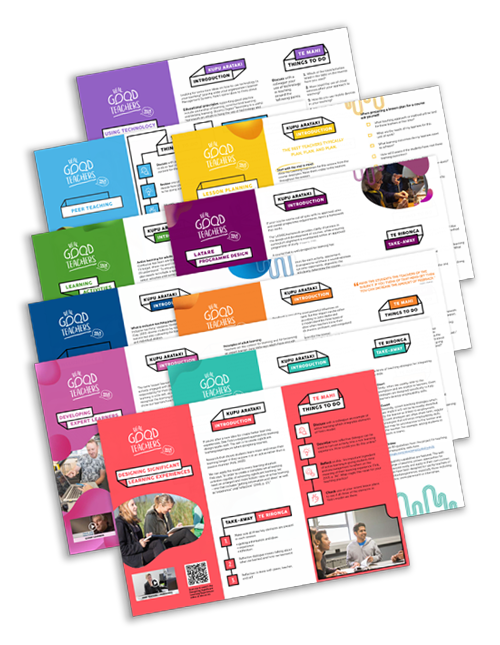
Teaching Employability Skills – Real Good Teacher Guide
Designing Rich Learning Experiences – Real Good Teacher Guide
Background:
The development of the guides was lead by John Hitchcock from Wellington Institute of Technology (WELTEC). The project was a collaboration of Wellington Institute of Technology, Whitireia New Zealand, Eastern Institute of Technology, Nelson Marlborough Institute of Technology, Waikato Institute of Technology, Taratahi Agricultural Training Centre, and Universal College of Learning.
Co-funded by the Ako Aotearoa Regional Hub Project Fund (RHPF).
This report consolidates critical success factors and best practices from a variety of art educational settings for intellectually impaired people into an inclusive teaching methodology.
It provide practical action orientated suggestions for the development of a tertiary art educational methodology and resources for teaching adults with intellectual impairments.
It could be of value to other educators wishing to develop an inclusive tertiary educational methodology.
A project completed in 2011, by Marcel Baaijens from The Learning Connexion, Wellington, to investigate if and how tertiary art education can be made inclusive enabling students with intellectual impairment to study art at a tertiary level.
Co-funded by the Ako Aotearoa Regional Hub Project Fund (RHPF).
A report documenting successful teaching strategies used at Whitireia New Zealand to improve Māori, Pacific and youth learner success.
A supporting resource is aimed at tutors seeking new teaching approaches, serving as both a self-evaluation tool to enhance teaching and learning spaces and offering a selection of useful tips aligned with local, national, and international research, fostering a culture of success.
This project aimed to collate best practice stories and exemplars of successful teaching and learning for Māori, Pacific and youth learners at Whitireia Polytechnic. It aimed to use this information as the basis for establishing a foundation of successful teaching practice across Whitireia.
Co-funded by the Ako Aotearoa Regional Hub Project Fund (RHPF).
Practical ideas and resources for teaching and learning
A report, and series of short guide resources featuring teaching and learning strategies designed to simplify the process of embedding literacy for vocational and foundation tutors.
The project report was completed in 2019 by Aleeshea Reid, Emma McLaughlin and Manaini Cama.
The guides were developed in consultation with a tutor advisory group from a variety of teaching areas across both WelTec and Whitireia, including painting, engineering, hairdressing and business administration. These tutors gave feedback on the practicality of the teaching and learning ideas presented and how easily they could be implemented in their teaching context.
Co-funded by the Ako Aotearoa Regional Hub Project Fund (RHPF).
This report is a how-to guide to help practitioners answer the question: How do I know what I am doing is working and making a difference to my students’ learning?
This is a high-level guide intended to help you start to gather and use data to help determine how well what you are doing is supporting and improving your students’ learning. It is designed to provide some initial advice on how you can gather and use data to reflect on and examine the practices that happen every day in tertiary settings.
The guide shows examples of the types of data you may have available or can collect, and provides suggestions about types of data to collect, how to collect them, and how to think about the evidence you’ve collected. It discusses how you can use the conclusions drawn from the data to find out more about the impact of what you are doing, and then use this information to refine and improve your practice.
the guide does not provide information on how to analyse data. Nor does it discuss in detail specific research methodologies, data analysis, or principles of research design.
A project completed for Ako Aotearoa by Anne Alkema in 2011 to collect evidence of learner benefit and publish a how-to guide to support the reflective practice of tertiary education practitioners.
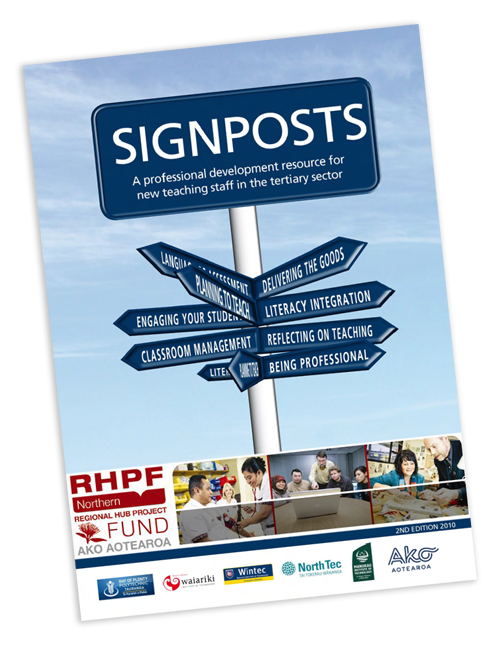
The original Signposts resource was developed in 2008.
An evaluation of the resource was conducted in 2010 led by Judith Honeyfield. The project involved five tertiary institutions, the Bay of Plenty Polytechnic, NorthTec, Waikato Institute of Technology, Manukau Institute of Technology and Waiariki Institute of Technology.
Co-funded by the Ako Aotearoa Regional Hub Project Fund (RHPF).
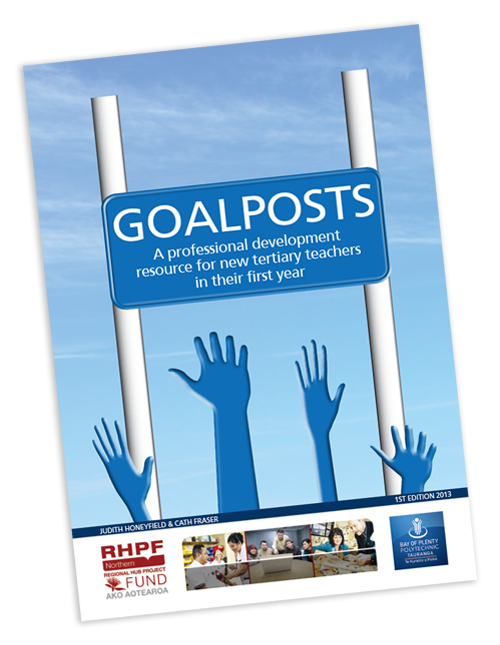
A professional development resource for new tertiary teachers in their first year
A resource designed to assist new tertiary teachers early in their new role, by providing a quick overview of some of the key principles and theories of adult learning.
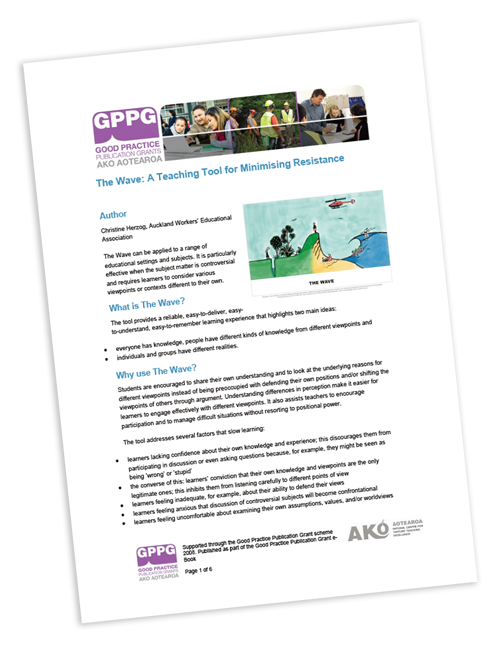
This report introduces ‘The Wave’ as a versatile teaching tool applicable across diverse educational settings and subjects, with a particular focus on its effectiveness in addressing controversial subject matter and encouraging learners to consider multiple viewpoints or contexts different to their own.
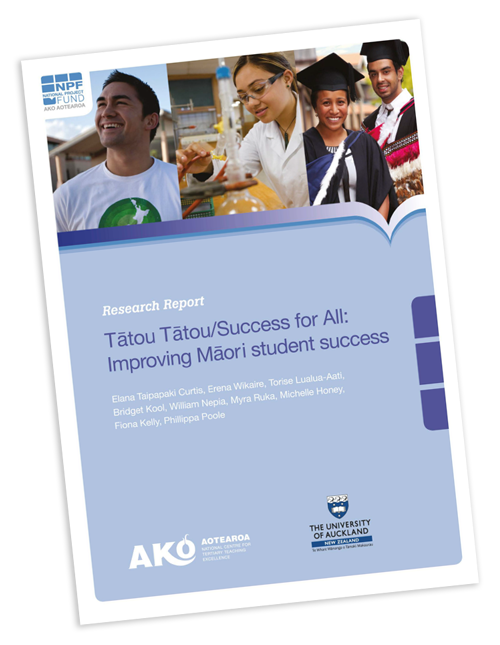
The report was completed in 2012 by project leader Elana Taipapaki Curtis, Erena Wikaire, Torise Lualua-Aati, Bridget Kool, William Nepia, Dr Myra Ruka, Michelle Honey, Fiona Kelly, and Phillippa Poole.
The project aimed to examine the ways in which non-lecture teaching and learning helped or hindered Māori success in degree-level education, and explore what ‘success’ meant in health professional degree-level study from a Māori perspective.
Co-funded by the Ako Aotearoa National Project Fund.
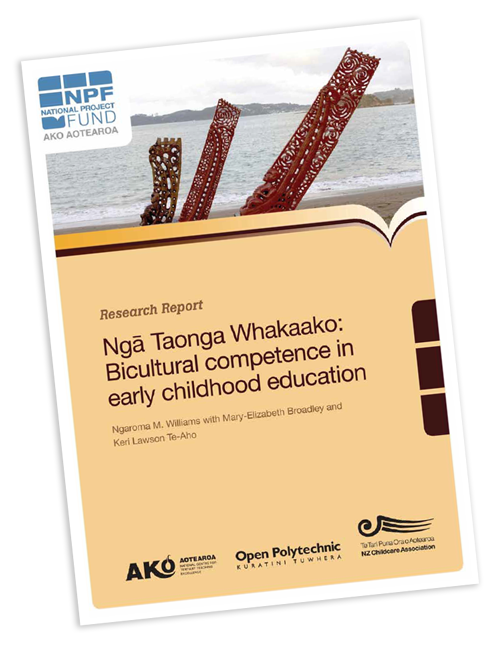
These resources were completed in 2012 by Ngaroma Williams with Mary-Elizabeth Broadley and Keri Lawson-Te Aho.
The project aimed to better understand bicultural competency in early childhood education within New Zealand and to gauge how Māori and non Māori educators perceived the level of bicultural competency within the early childhood education sector.
Additional sets of cultural capability resources were produced by Dr Ngaroma M. Williams et al. to support Kaiako in strengthening their te reo Māori teaching and learning repertoires.
An updated Ngā Taonga Whakaako Tikanga Māori | Theory and Practice (2025), the Ki te hoe | Indigenising Spaces – Preparing teaching spaces in using and teaching te reo Māori (2024) , and Ki Te Hoe: Indigenising Practice (2023) resource sets are available from the University of Canterbury website.
Co-funded by the Ako Aotearoa National Project Fund.
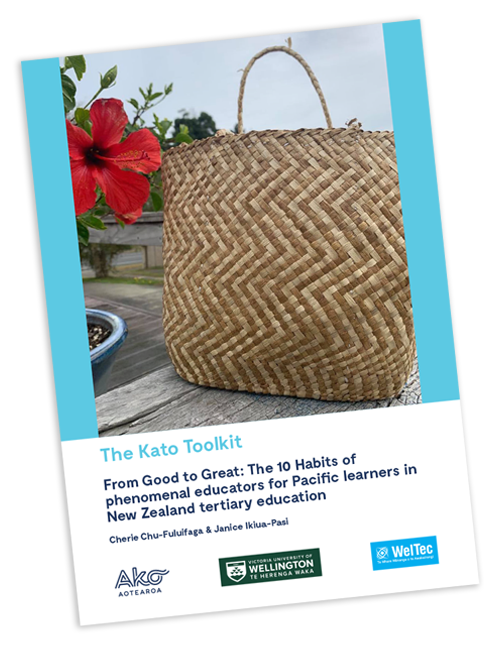
The Kato toolkit was developed to support educators in planning and developing teaching and learning theory and practices for the success and development of Pacific learners.
The 10 habits in the Kato Toolkit can be used in order from one to 10 or they can be used separately depending on what you need for your teaching.
This report was completed in 2021 by Dr Cherie Chu-Fuluifaga and Janice Ikiua-Pasi.
The research aimed to identify, analyse and describe phenomenal educators who have effective teaching and learning practices in place for Pacific learners.
One of the ways the attributes, skills and qualities of phenomenal educators were identified was from student feedback, when they were presented with the key question during Talanoa: “Who is a Phenomenal Educator for Pacific Learners and why?”
Co-funded by the Ako Aotearoa National Project Fund
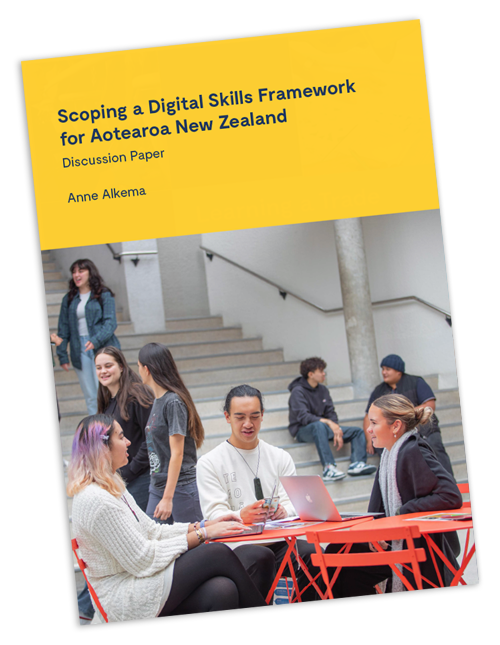
This report explores digital skills in Aotearoa New Zealand by examining existing frameworks and international policies, aiming to define digital literacy, justify the need for a framework, and propose key components for a tailored approach.
This discussion paper, created by Anne Alkema, is the result of research conducted in early 2023 to scope a digital skills framework for Aotearoa New Zealand. The research explored what is currently taking place in this country, with some international examples.
There is no denying that digital skills are now essential skills, just as the traditional forms of literacy and numeracy are. These skills are now required for full participation in life, community and work, yet studies show that in Aotearoa New Zealand there is still a considerable percentage of the population without the skills to do this.
This reports suggests some possible approaches to be considered in order to determine a feasible, practical and manageable way forward to progress a digital skills framework.
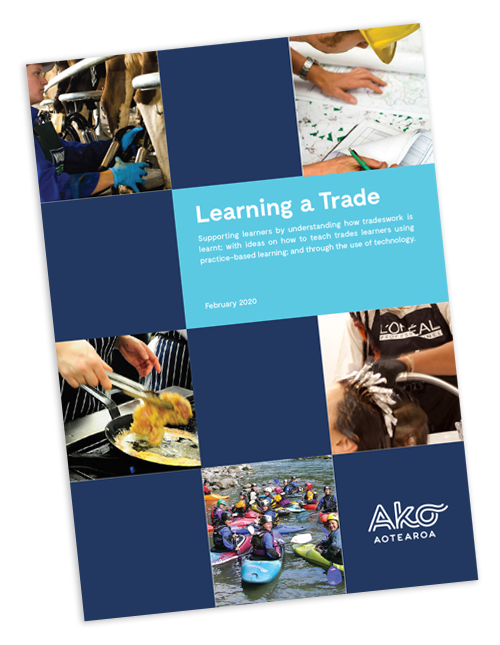
This report shares apprentices’ perspectives on how they went about learning a trade. It contains guidelines for apprentices and their workplace trainers to assist with workplace-based learning.
An updated guide – Learning a Trade: Becoming a trades person through apprenticeship – was produced in 2020.
An animated video made for use in the workplace to help apprentices learn a trade. Produced by Mohawk Media.
Background:
This report was completed in 2013. Led by Dr Selena Chan, the research was a collaboration of Christchurch Polytechnic Institute of Technology, Primary ITO, Building and Construction ITO, Hairdressing ITO, Competenz, Services IQ, Joinery ITO and NZ Marine ITO.
Co-funded by the Ako Aotearoa Regional Hub Project Fund (RHPF)
The report tells the story of the educational and life experiences of dyslexic learners in Aotearoa New Zealand as they have navigated compulsory school and tertiary studies. It sought to address a national and global research gap by emphasising the perspectives of dyslexic individuals and their families.
This report will help educators to know more about the experiences of those living with dyslexia, ensure educators are better informed about how to teach learners with dyslexia.
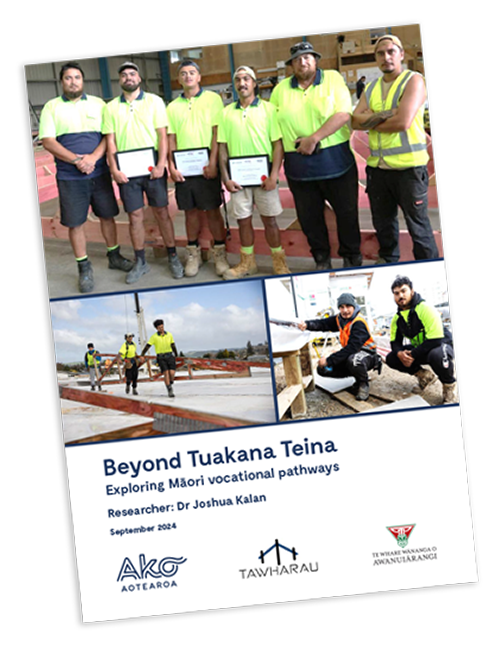
This report offers suggestions that prospective training providers and organisations may wish to consider as an aid and support in their own efforts with supporting Māori learners in trade training.
These insights will be of particular interest to industry training organisations who work with Māori learners and trainees with the potential for replicating aspects of Māori trade training in other vocational settings.
This research was completed in September 2025 by Dr Joshua Kalan – Te Whare Wananga o Awanuiārangi and Jayden Thompson – Director, Tāwharau Housing Trust.
The report uses a case study of Tāwharau Housing Trust, a small whānau-based construction company in Rotorua and their approach to vocational training and apprenticeships with Māori learners in the building industry.
Co-funded by the Ako Aotearoa Research and Innovation Agenda (AARIA)