Developing an electronic teaching resource: Using an interactive white board

This resource contains guidelines for the use of Interactive White Boards (IWB) as a tool to capture lesson structures. 

For anyone wishing to develop a resource using the Interactive White Board – the use-oriented document provides clear and encouraging directions, using everyday language.

Resource download:
Background:

A project, completed in 2012, to explore the use of Interactive White Boards (IWB) as a tool to capture the lesson structure of particularly skilled tutors and repackage it as a refined, coherent teaching resource that may be shared with other tutors to enhance students learning. The project was undertaken by Christchurch Polytechnic Institute of Technology with the assistance of Synapsys NZ Ltd.

Research report prepared by Barry Dowrick.


Co-funded by the Ako Aotearoa Regional Hub Project Fund (RHPF)
Posted in Curriculum | Leave a comment

Developing an authentic Samoan lens

This report seeks to investigate teacher education methods, aiming to improve professional practice courses and teaching processes that specifically address the assessment of learning among Samoan children.

While the research focusses on the Early Childhood sector, the findings will be of use to educators seeking to accommodate Samoan worldviews and cultural values and practices in their programmes.

Download the report:

Background:

A project, completed in 2011 at Te Tara Puna Ora o Aotearoa, New Zealand Childcare Association (NZCA), that aimed to enhance the educational performance of initial teacher education providers. It focused on assessment practices in two Samoan early childhood education (ECE) centres in Christchurch over a period of six months.

Report prepared by Pauline Luafutu-Simpson.


Co-funded by the Ako Aotearoa Regional Hub Project Fund (RHPF)
Posted in Pacific learner success | Leave a comment

Designing professional development for experienced teachers in tertiary vocational education

This report and accompanying resource highlight recommendations, guidelines and considerations for those responsible for planning Professional Development for experienced teachers.

Resource download:

Background:

This project, completed in 2016, aimed to identify how useful professional development is for experienced teachers in the tertiary vocational education sector in New Zealand and to improve the design of Professional Development programmes.

Resources prepared by Gerald Duignan, John Hitchcock, Scott Casley, Cath Fraser, Carmel Haggerty, Malcolm Hardy, Chris Lovegrove, Sue Sewell, Lynette Singh, Deb Stewart and Janet Walke. 


Co-funded by the Ako Aotearoa Regional Hub Project Fund (RHPF)
Posted in Professional learning | Leave a comment

Design and evaluation of a new web-based educational tool for systematic review authoring skills

This report documents the design, launch and evaluation of a web-based educational package for those in healthcare settings who wish to perform a systematic review of published literature.

Download the report:

Background:

Systematic reviews are a synthesis of the best available evidence for healthcare and assist clinical decision making and for developing health policy. The Cochrane Collaboration (CC) publishes systematic reviews in an electronic format that requires specific training. The CC has over 25,000 authors from over 80 countries and providing training and support to these authors presents a significant challenge.

The aim of this research was to assess the current Cochrane Protocol and Analysis course for authors of Cochrane systematic reviews and to compare with a newly developed electronic educational course.

Research report completed in 2011 by Jane Clarke, Jenny Weller and Cindy Farquhar from the the University of Auckland.


Co-funded by the Ako Aotearoa Regional Hub Project Fund (RHPF)
Posted in Online learning | Leave a comment

Critical thinking in initial teacher education

This report documents a programme to develop critical thinking skills in final year Early Childhood Education (ECE) student teachers through ‘learning circles’ and ‘sharing circles’.

The project led to the creation of a set of resources, including posters and cards, for teaching critical thinking.

Resource download:

Background:

A project, completed in 2016, to develop critical thinking skills in final year Early Childhood Education (ECE) student teachers. A collaboration of New Zealand College of Early Childhood Education (now New Zealand Tertiary College), Te Rito Maioha Early Childhood New Zealand and University of Canterbury.

Research report and resources prepared by Tui Summers and Rikke Betts.


Co-funded by the Ako Aotearoa Regional Hub Project Fund (RHPF)
Posted in Professional learning | Leave a comment

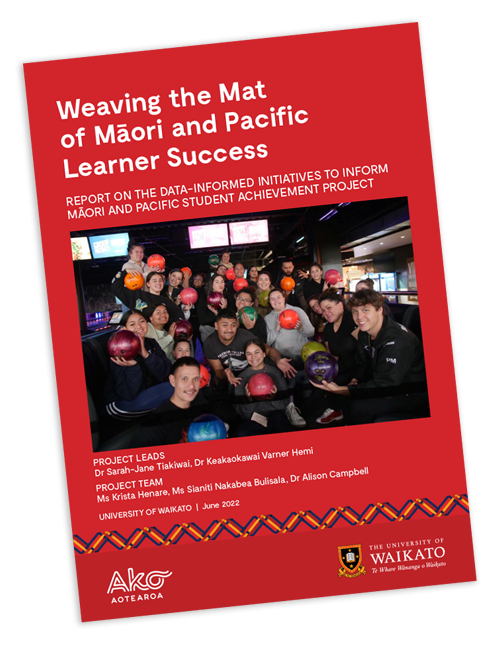
Weaving the mat | Data-informed initiatives to enhance Māori and Pacific student achievement

This report details the development of new teaching and learning initiatives for Māori and Pasifika students that are informed by a learner analytics system, combined with student voice data and cases studies of success.

It discusses how improved data and data analytic capability enhanced understanding of the literature on Māori and Pacific learner success and the experience of Māori and Pacific learners at University of Waikato. 

Download the report:

Supporting videos:

This series of teaching support videos, where students speak about their successes, was developed to help inform educators what Māori and Pacific student achievement can look like.


Weaving the Mat | Project presentation

A presentation by project leader Dr. Keakaokawai Hemi on the outcomes of the Weaving the mat project.

Background:

This project, completed in 2022 at the University of Waikato, aimed to develop new teaching and learning initiatives for Māori and Pacific students that were informed by a literature review, learner analytics, and student voice.

In the midst of COVID-19, the project team developed two learner initiatives: Te Kāhui Pīrere for Māori students and the Imua Learner Leader Initiative for Pacific students.

Research report prepared by Dr Sarah-Jane Tiakiwai, Dr Keakaokawai Varner Hemi, Ms Krista Henare, Ms Sianiti Nakabea Bulisala and Dr Alison Campbell.


Co-funded by the Ako Aotearoa National Project Fund (NPF)

Posted in Māori learner success | Leave a comment

Demystifying the code: Delivering a fail-safe bridge for live programming

Learning to write computer code is the most fundamental skill in software development. But before writing code, a student needs to understand the underlying programming concepts, and then apply those concepts using a particular programming language.

This report details the creation and evaluation of an interactive, online programming tool and its impact on students’ learning of object-oriented programming concepts.

Download the report:

Background:

This one-year project, completed in 2019 at the University of Auckland, aimed to create and trial an interactive website that is relevant and accessible to a wide range of students and teachers in introductory programming courses. 

Report prepared by Dr Nasser Giacaman, Elliot Varoy, Oliver Allen and Xavier Downs.


Co-funded by the Ako Aotearoa Regional Hub Project Fund (RHPF)
Posted in Online learning | Leave a comment

A project approach to teaching collision repair

This reports details a case study where embedding literacy and numeracy into the programme resulted in improved student retention and pass rates.

Download the report:

Background:

A project, completed in2009 at the Eastern Institute of Technology (EIT), to restructure the Collision Repair programme and embed literacy and numeracy into the programme.

A project approach was used in combination with changes to teaching, which could then be applied to other trades programmes at EIT.

Report prepared by Jillian Johnstone and Elly Govers.


Co-funded by the Ako Aotearoa Regional Hub Project Fund (RHPF)
Posted in Language, Literacy and Numeracy (LLN) | Leave a comment

Dedicated Education Unit: Enhancing clinical teaching and learning

This report documents the process of implementing and evaluating a a Dedicated Education Unit (DEU), and the model’s potential ability to support undergraduate nursing students within Counties Manukau District Health Board (CMDHB).

The accompanying guideline provide interested parties with a guide to setting up and
running a Dedicated Education Unit (DEU). The tips and suggestions in this summary are drawn from the Manukau Institute of Technology (MIT) experiences of setting up and evaluating their DEUs, and the broader literature on supporting nursing education.

Resource download:

Background:

An action-research project, completed in 2012, to examine the benefits to learners achieved by implementing a new approach to nursing placements, Dedicated Education Units (DEUs). A collaboration between Manukau Institute of Technology and Counties Manukau District Health Board.

Research report prepared by Willem Fourie and Beverley McClelland.

Guidelines developed by Sheona Watson, Berodice Flotman, Willem Fourie, Beverley McClelland, Denise Kivell, Lynette Cooper, Pam Williams, Sandra McDonald and Rose Whittle.


Co-funded by the Ako Aotearoa National Project Fund (NPF)

Posted in Industry specific resources | Leave a comment

Regional collaboration to develop a degree preparation programme

This report details the scoping of a unified qualification for learners preparing for degree level study that prepared them for study in different contexts at different providers.

Download the report:

Background:

A project, completed in 2011, to develop a new degree preparation programme to address the reduction of Level 4 bridging programmes in the Wellington region.

A joint initiative involving Weltec, Whitireia New Zealand and Victoria University of Wellington.

Research report prepared by Elizabeth M. Chinlund and Alistair Shaw of Victoria University of Wellington.


Co-funded by the Ako Aotearoa National Project Fund (NPF)

Posted in Educational transitions | Leave a comment

Defining a new model and developing a user guide for open education

The key outcome from the project was the development of an interactive user guide, using the wikibooks platform, for educational organisations interested in developing open education practices using popular social media.

Access the Wikibook:

https://en.wikibooks.org/wiki/Open_Education_Practices

Background:

A project completed in 2009, undertaken by Otago Polytechnic, to analyse the use of social media in polytechnic courses to identify benefits, shortfalls, opportunities and development needs.

Research undertaken by Leigh Blackall and Bronwyn Hegarty.


Co-funded by the Ako Aotearoa Regional Hub Project Fund (RHPF)
Posted in Online learning | Leave a comment

Cultural confluence and capacity in training providers intending to work cross-culturally within Māori and Pasifika contexts

This report explores pedagogical models and research methodologies specific to Māori and Pasifika contexts at Bethlehem Tertiary Institute (BTI).

The report concludes with recommendations that specific to BTI, but could be of value to other educational organisations seeking to work in the bi- and multi-cultural environment that is Aotearoa New Zealand.

Download the report:

Background:

A project completed in 2011, undertaken by Bethlehem Tertiary Institute (BTI), that aimed to explore areas of concern to Pasifika and Māori students and stakeholders.

Research report prepared by Andrew Smith and Tereora Crane.


Co-funded by the Ako Aotearoa Regional Hub Project Fund (RHPF)
Posted in Māori learner success | Leave a comment

Curriculum restructuring overnight

Teaching large first-year classes after a major earthquake

This report details the sudden curriculum and assessment overhaul that was needed to continue course implementation after the Canterbury earthquake.

Using two large, first-year introductory courses as case studies the report discusses the reasoning and justifications behind the changes, and draws conclusions based on student feedback and assessments.

Download the report:

Background:

A project completed in 2015, undertaken by University of Canterbury, to develop a good practice publication describing the sudden curriculum and assessment overhaul that was needed to continue course implementation after a devastating magnitude 6.2 earthquake struck Christchurch.

Research report prepared by Daniela Liggett, Kate Pedley and Erik Brogt.


Co-funded by the Ako Aotearoa Good Practice Publication Grants scheme (GPPG)

Posted in Curriculum | Leave a comment

Critical success factors in inter-Institutional project collaborations

This report and examines inter-institutional collaborations and what makes them reach, exceed, or fail their potential to deliver long term value and benefits to participants.

The accompanying guide has recommendations to assist inter-Institutional collaborative group to think about how to manage the collaborative experience, and shares common traits of successful project teams and sustainable communities of practice.

Resource download:

Background:

A one-year project, completed in 2015, to evaluate collaboration experiences within multi-organisation projects with the purpose of determining the factors that contribute to successful project teams and sustainable communities of practice. A collaboration of Bay of Plenty Polytechnic, Wellington Institute of Technology and Otago Polytechnic.

Resources prepared by Cath Fraser, Judith Honeyfield, Fiona Breen, Mervyn Protheroe and Victor Fester.


Co-funded by the Ako Aotearoa Regional Hub Project Fund (RHPF)
Posted in Research methodologies | Leave a comment

Recognising the impact on students of a crisis event in an educational setting

Developing response recommendations

This report collected data relating to the impact of the Canterbury earthquakes and aftershocks on healthcare students’ learning and wellbeing, and provides recommendations for responding to similar crisis events.

Download the report:

Background:

A project completed in 2012, aimed to identify and explore the impact of the Christchurch earthquake of February 22, 2011 on a range of medical and nursing students, and newly graduated nurses, involved in the Nurse Entry to Practice (NetP) programme.

Research report prepared by The Christchurch Earthquake Health Professionals Research Group.


Co-funded by the Ako Aotearoa Regional Hub Project Fund (RHPF)
Posted in Student engagement | Leave a comment

Coffee Break Guides on tertiary teaching

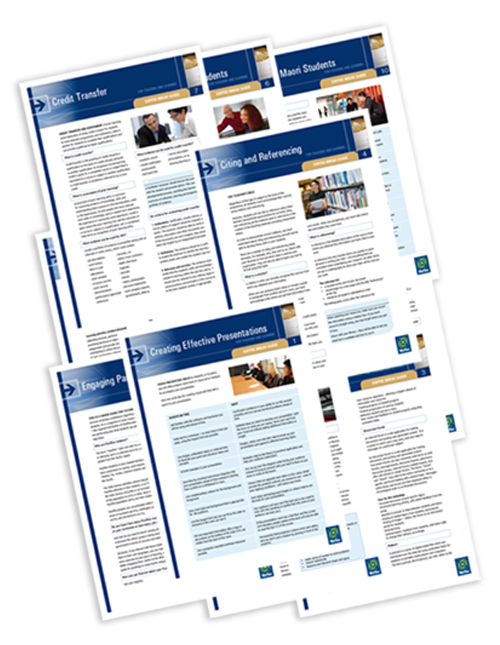
A series of resource booklets for recently-appointed lecturers and tutors that provide an overview of key topics, with bullet point advice on each topic and information on where to go to find out more.

Resource download:

Background:

A project, completed in 2012, to develop a series of short guides on tertiary teaching for new lecturers and tutors on topics such as education technology, embedding literacy and supporting Māori students. A Wellington Institute of Technology (Weltec) project.

Resources prepared by Paulene Crook.


Co-funded by the Ako Aotearoa Regional Hub Project Fund (RHPF)
Posted in Professional learning | Leave a comment

Creating team spirit and a culture of excellence among course participants

This report describes the practice of building team spirit and a creating a culture of excellence in a desire to close knowing–doing gaps among learners.

Download the report:

Background:

Across studies of leadership, innovation, creativity, and how to achieve success in life, the twin themes of team work and striving for excellence recur.

The practice of building team spirit and a culture of excellence had its starting point in a desire to close knowing–doing gaps among learners, and to reduce the tendency for people to acquire relevant information during training sessions but not apply it on the job.

Report prepared by Michael Mintrom, The University of Auckland.


Posted in Professional learning | Leave a comment

Creating sustainable change to improve outcomes for tertiary learners

This report details a framework for thinking about research projects in tertiary education. It aims to help readers reflect, gather evidence and use a project to support ongoing improvement and improved outcomes for learners.

Download the report:

Background:

This short publication is designed to help prospective project teams interested in improving teaching and learning scope out what this means in terms of project planning and implementation.

Project teams may also find useful the Ako Aotearoa Rubrics, which describe the characteristics of what were considered to be high-impact projects.

Report prepared for Ako Aotearoa by Anne Alkema, Heathrose Research.


Funded by the Ako Aotearoa National Project Fund (NPF)

Posted in Research methodologies | Leave a comment

Creating digital stories to enhance vocational learning

This report explores ways in which creating digital stories can support the development of vocational literacy skills. 

It highlights the potential of digital storytelling as a vocational learning and literacy development tool to engage learners more fully with course content.

Download the report:

Background:

A project completed in 2011, at Otago Polytechnic, to improve the vocational learning and literacy development of learners by engaging them more fully with course content through the creation of their own digital stories.

Research report prepared by Maxine Alterio and Adrian Woodhouse. 


Co-funded by the Ako Aotearoa Regional Hub Project Fund (RHPF)
Posted in Industry specific resources | Leave a comment

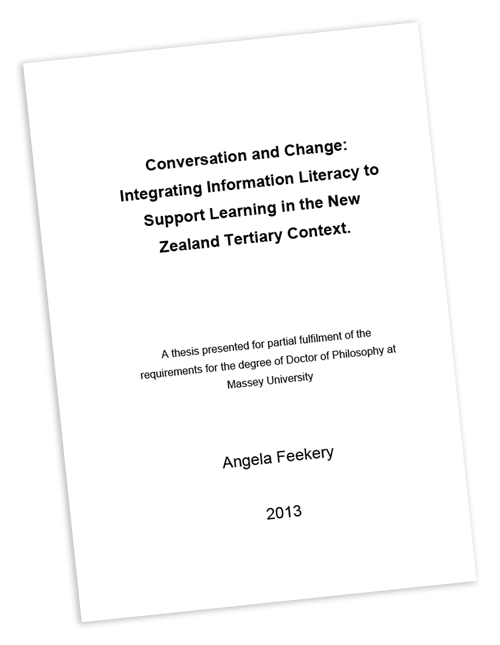
Conversation and change: Integrating information literacy to support learning in the New Zealand Tertiary context

This report explores ways university instructors can embed information literacy (IL) into their pedagogy and curricula to enhance student learning.

Download the report:

Background:

A doctoral thesis completed in 2013, undertaken by Dr Angela Feekery, Massey University.

It examines how students can develop their academic ‘voice’ as well as developing a longitudinal programme to improve students’ information literacy (IL) and pre-writing skills.


Co-funded by the Ako Aotearoa National Project Fund (NPF)

Posted in Curriculum | Leave a comment

Contextualising vocational programmes to match institutional and industry settings

This good practice guide and case study resource will assist vocational/trade education teaching staff understand ways in which they can tailor a programme to match their particular context, allowing them to create the best possible learning environment for their learners.

Resource download:

Background:

A project, completed in 2016, to identify barriers and solutions associated with delivering an automotive training programme package in different institutional and industry settings, in order to help tutors to tailor programmes to context and ensure consistency and relevant learning for students.

Report prepared by Sean Squires, Barry Dawe, Andy Kennedy, Tim Jagusch, Peter Sauer and Barry Patterson. 

A collaboration of Bay of Plenty Polytechnic, Eastern Institute of Technology, Christchurch Polytechnic Institute of Technology and Nelson Marlborough Institute of Technology.


Co-funded by the Ako Aotearoa Regional Hub Project Fund (RHPF)
Posted in Trades training | Leave a comment

Contemporary assessment practices in university

Impact on teachers and students

A project to examine the impact of high-stakes summative assessment on student learning and teaching at the University of Otago. The term high-stakes summative assessment refers to marking student work when this counts towards the award of a degree.

Download the report:

Background:

A project completed in 2014, undertaken by the University of Otago, that explored how students and academic staff experience a culture of frequent high-stakes summative assessment, with the aim of informing practice and policy to directly stimulate organisational change.

Research report prepared by Tony Harland, Angela McLean, Rob Wass, Ellen Miller and Kwong Nui Sim.


Co-funded by the Ako Aotearoa Regional Hub Project Fund (RHPF)
Posted in Assessment | Leave a comment

Using complex case studies to teach law and accounting

This report presents the findings of an investigation into use of case studies about local small and medium sized entities as a tool in the teaching and learning of accounting.

It considers both student and teacher experiences of using case studies to inform future case-study development and ongoing evaluation.  

The supporting resources include a course outline and student workbook for the University of Canterbury paper, Accounting and Taxation: An Introduction, which were developed as part of the project.

Resource download:

Background:

A two-year project, completed in 2019 at the University of Canterbury to investigate and develop complex teaching case studies used in law and accounting.

Research report prepared by Dr Julia Wu and Dr Erik Brogt.


Co-funded by the Ako Aotearoa Regional Hub Project Fund (RHPF)
Posted in Curriculum | Leave a comment

Community support for teacher learning in visual art

This report documents a study to enable provisionally registered primary school teachers to develop their confidence in the teaching of visual art by using visual art expertise found within community cultural centres.

Download the report:

Background:

A two-year project, completed in 2012, to investigate whether visual art education expertise found within cultural centres can effectively develop newly-trained primary school teachers’ confidence in teaching visual art. A collaboration of Victoria University of Wellington, Raroa Normal Intermediate School and Pātaka Art + Museum.

Research report prepared by Ian Bowell, Faculty of Education, Victoria University of Wellington.


Co-funded by the Ako Aotearoa National Project Fund (NPF)

Posted in Coaching & mentoring | Leave a comment

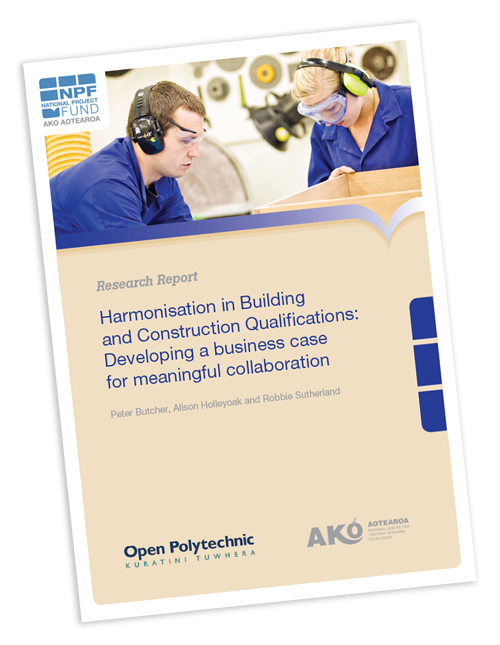
A collaborative approach for diplomas in building and construction

This report documents the development and creation of shared online resources that support the delivery of three Level 6 Building and Construction National Diplomas.

The outcomes of this project point to the importance of high-quality teaching and learning practice that is built upon collective knowledge and shared resources.

This resource may be of use to an organisations looking to collaborate on programme delivery or course materials.

Download the report:

Background:

A project, completed in 2012, to explore the development of a shared base of online teaching courseware to align with the revised standards for three national diplomas in the domain of building and construction.

A collaboration of The Open Polytechnic of New Zealand, Unitec, Wellington Institute of Technology, Christchurch Polytechnic Institute of Technology, Bay of Plenty Polytechnic and NorthTec.

Research report prepared by Peter Butcher, Alison Holleyoak and Robbie Sutherland.


Co-funded by the Ako Aotearoa National Project Fund (NPF)

Posted in Trades training | Leave a comment

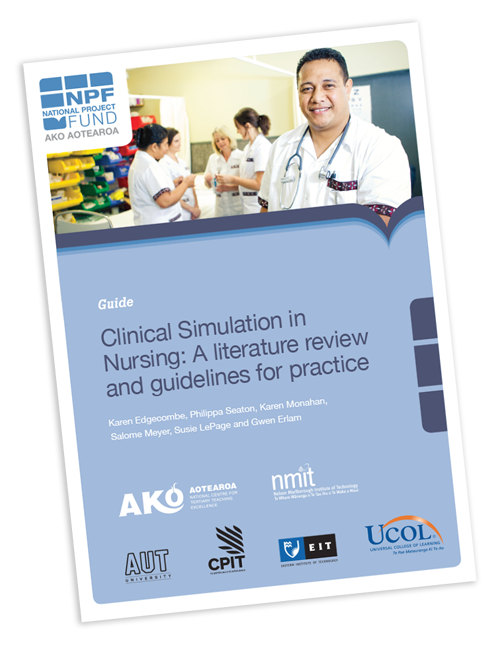
Collaboration in clinical simulation – Leading the way

Simulation is a teaching and learning strategy that is increasingly used in nursing education to prepare students for the clinical workplace.

This report and accompanying guidelines resource provide best-practice guidelines in using simulation as an effective teaching method for undergraduate nursing students.

Resource download:

Background:

An 18-month project, completed in 2013, to increase and support the collaboration of nurse educators involved in clinical simulation enabling them to join together and share ideas, news and resources and to also link together in a more cohesive and integrated way.

A collaboration of Christchurch Polytechnic Institute of Technology, Nelson Marlborough Institute of Technology, Universal College of Learning, Eastern Institute of Technology and Auckland University of Technology.

Research report prepared by Karen Edgecombe.

Guide prepared by Karen Edgecombe, Philippa Seaton, Karen Monahan, Salome Meyer, Susie LePage and Gwen Erlam. 


Co-funded by the Ako Aotearoa National Project Fund (NPF)

Posted in Curriculum | Leave a comment

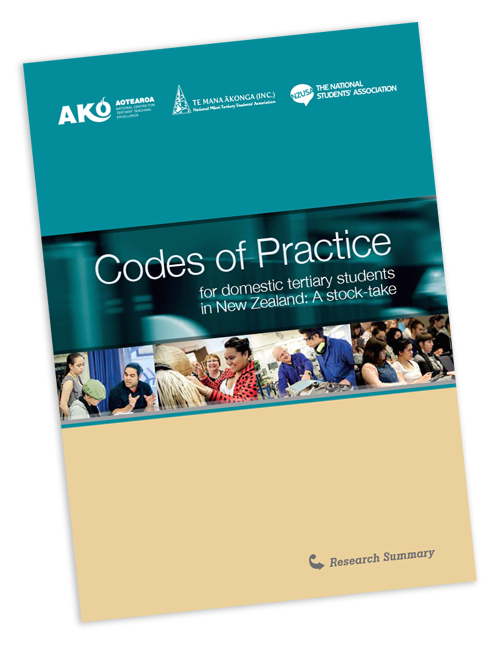
Codes of practice for domestic tertiary students in New Zealand: A stocktake

These reports assess the nature and effectiveness of codes of practice, contracts and learner agreements in the tertiary sector, and their implications for the relationships between tertiary organisations and learners.

Download the report:

Background:

When domestic students enrol with tertiary organisations, there is a significant contractual undertaking for both parties. This stocktake of agreements in place for domestic students in New Zealand’s tertiary education system gives an overview of how providers deal with the commitments and obligations (for both organisation and student) that come with enrolment.

The research was undertaken in 2012 by Network Research, in collaboration with the Tertiary Education Commission (TEC) Learner Advisory Committee. It was endorsed by the New Zealand Union of Students’ Association and Te Mana Ākonga (National Māori Tertiary Student Body).

Report prepared by Liz Gordon, Lesley MacGibbon, Sonya Midgway, Tina Mason and Tee Milroy.


Co-funded by the Ako Aotearoa National Project Fund (NPF)

Posted in Strategic leadership and change | Leave a comment

Strategies for co-constructing an initial teacher education curriculum

A school-university partnership

The report contains recommendations for effective strategies that facilitate the co-construction of an initial teacher education (ITE) curriculum in a school-university partnership.

Download the report:

Background:

A project completed in 2015, undertaken by Massey University, that investigated strategies to support the successful co-construction of an ITE curriculum. It aimed to make links between theories underpinning effective pedagogies taught at the university, with the day-to day practice of teaching and learning in three Normal Schools in the Manawatū.

Research report prepared by Alison Sewell, Tracey-Lynne Cody and Kama Weir. 


Co-funded by the Ako Aotearoa Regional Hub Project Fund (RHPF)
Posted in Curriculum | Leave a comment

Changing places: Exploring different conceptions of music education

This report documents a pilot study to explore and challenge ideas and assumptions about music teaching and learning processes through inter-contextual student workshops.

The idea to place an early childhood student with a university music student to work alongside each other in a centre to see how and if one could influence the other.

This project showed the advantage of a cross-disciplinary framework within a collaborative teaching and learning environment. The development of a cross-sector (i.e. private training enterprise and university collaboration) initiative was viewed as productive.

Download the report:

Background:

A project, completed in 2011, that sought to challenge pedagogical practice through introducing child-centred musical activities that presented new teaching and learning opportunities for the teacher and the child. A collaboration of New Zealand Tertiary College and University of Auckland.

Research report prepared by Chris Naughton and David Lines.


Co-funded by the Ako Aotearoa Regional Hub Project Fund (RHPF)
Posted in Curriculum | Leave a comment

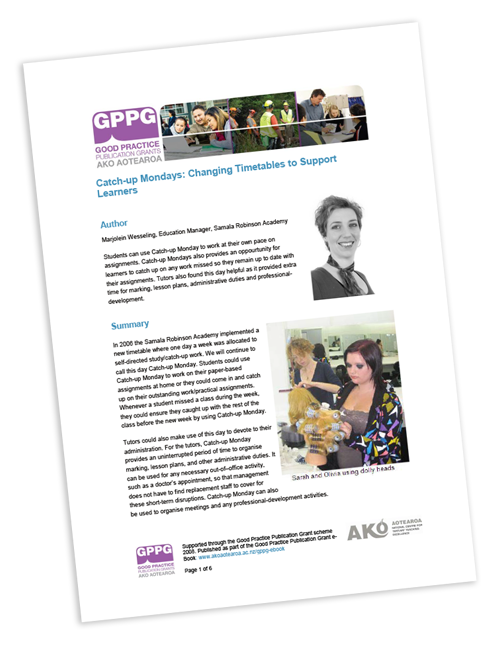
Catch-up Mondays: Changing timetables to support learners

This report describes how allocating one day a week – Catch-Up Monday – to self-directed study and catch-up work enhanced learner outcome at the Samala Robinson Academy (SRA).

Students can use Catch-up Monday to work at their own pace on assignments. Catch-up Mondays also provides an oppourtunity for learners to catch up on any work missed so they remain up to date with their assignments. Tutors also found this day helpful as it provided extra time for marking, lesson plans, administrative duties and professional development.

Download the report:

Background:

This report was completed in 2008, by Marjolein Wesseling.


Co-funded by the Ako Aotearoa Good Practice Publication Grants scheme (GPPG)

Posted in Curriculum | Leave a comment