Kaikaikaroro – Enhancing student success within Wānanga

Informed by the voices of students and staff from Wānanga organisations, this report
provides a rich tapestry of the outcomes of success that the Wānanga aspire to, and the actual experiences of the students themselves.

Kaikaikaroro is the metaphorical and visual conceptual framework for sharing the findings and presenting the opportunity for ongoing development.

The Kaikaikaroro framework provides reflective questions that can be used by all educators to ensure their practice and ongoing learning caters for the needs of Māori.

This focus on more responsive approaches will contribute to ensuring the future of Aotearoa is one that is underpinned by the knowledges and experiences of Māori and looks towards a potential-filled educational landscape for all our tamariki and mokopuna.

Download the report:
Background:

This project, completed in 20121, aimed to better understand what the unique features of the Wānanga experience are that contribute to student achievement and success. This project is a collaboration between Te Wānanga o Raukawa, Te Wānanga o Aotearoa, and Te Whare Wānanga o Awanuiārangi.

Research report prepared by By Hannah Simmonds.


Co-funded by the Ako Aotearoa Project Fund
Posted in Māori learner success | Leave a comment

Investigation of initial teacher education student views of engineers and engineering practice

This report contributes to understanding the gender imbalance in engineering by highlighting soon-to-be teachers’ views of the profession and the people who are working within it. 

There is a recognised lack of female, Māori and Pasifika participation in most engineering disciplines. Prior research infers that children aged 11-13 years reject careers in engineering due to the perceptions of key role-models such as teachers. ​

The research intended to highlight any false perceptions held by teachers in training, who in-turn heavily influence student career choices, and ultimately has the potential to improve diversity in the engineering workforce. 

Download the report:

Background:

This one-year collaborative project, completed in 2010 at the University of Canterbury and University of Waikato, sought to identify the attitudes and perceptions educators have regarding the typical character profile suited for engineering practice.

Research report prepared by Paul D. Docherty and Wendy Fox-Turnbull with contributions from Pinelopi Zaka and Tessa Impey.


Co-funded by the Ako Aotearoa Regional Hub Project Fund (RHPF)
Posted in Student engagement | Leave a comment

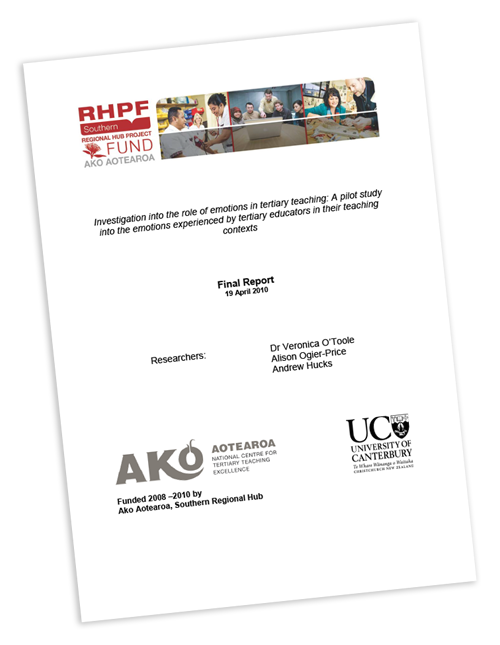
Investigation into the role of emotions in Tertiary Teaching

This report introduces ideas to help tertiary educators to understand and manage their emotions to enhance their effectiveness and promote an optimal emotional climate for teaching and learning.

Download the report:

Background:

A project completed in 2010 at the University of Canterbury, to investigate the role of emotions experienced by tertiary educators in their teaching contexts. 

Research report prepared by Veronica O’Toole, Alison Ogier-Price and Andrew Hucks.


Co-funded by the Ako Aotearoa Regional Hub Project Fund (RHPF)
Posted in Professional learning | Leave a comment

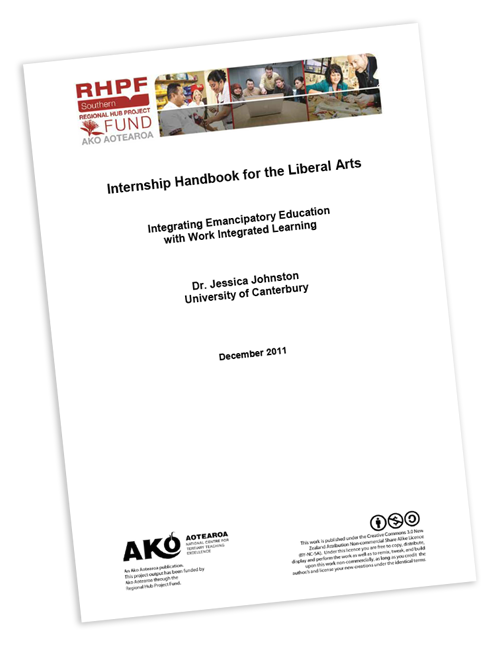
Internship handbook for the Liberal Arts

Integrating emancipatory education with Work-Integrated Learning

This report and accompanying videos will help academic staff incorporate Work-Integrated-Learning (WIL) in a way that promotes social transformation through the development of graduates as engaged and active citizens.

Download the report:

Supporting videos:

Background:

A project completed in 2011 at the University of Canterbury, to develop guidelines for the liberal arts that integrates emancipatory education with work-integrated-learning.

Research report prepared by Jessica Johnston


Co-funded by the Ako Aotearoa Regional Hub Project Fund (RHPF)
Posted in Curriculum | Leave a comment

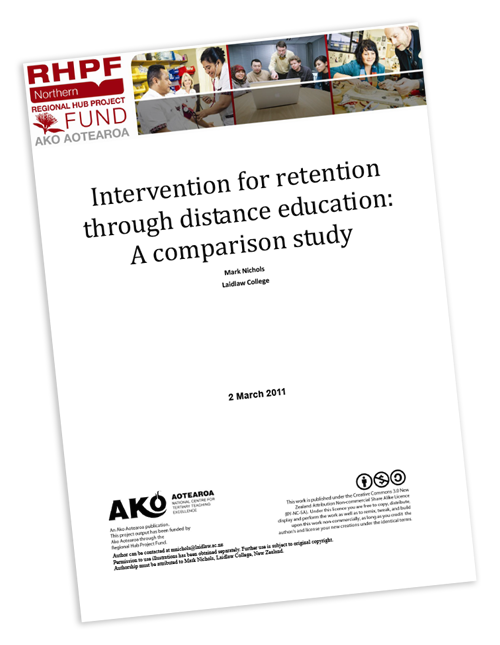
Intervention for retention through distance education: A comparison study

This report documents a trial of purposeful interventions to influence student retention in distance education, both for first time and returning students.

Download the report:

Background:

A project completed in 2011 at Laidlaw College, Auckland, that aimed to improve student retention.

Research report prepared by Mark Nichols.


Co-funded by the Ako Aotearoa Regional Hub Project Fund (RHPF)

Posted in Student engagement | Leave a comment

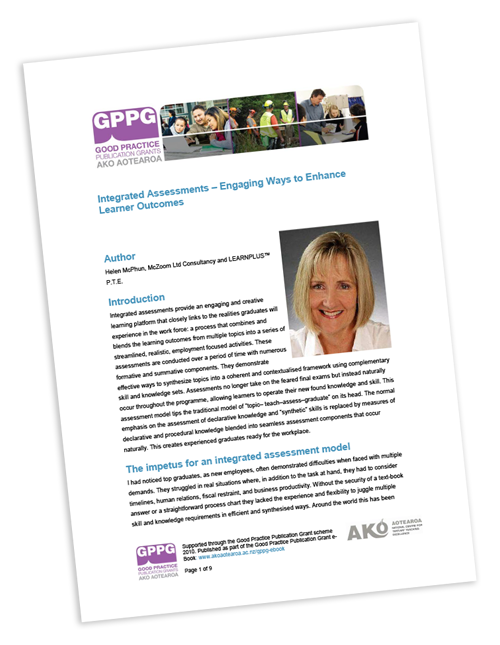
Integrated assessments – Engaging ways to enhance learner outcomes

This report describes integrated assessments as a process whereby learners have enhanced opportunities for relevance and engagement.

Download the report:

Background:

Integrated assessments provide an engaging and creative learning platform that closely links to the realities graduates will experience in the work force: a process that combines and blends the learning outcomes from multiple topics into a series of streamlined, realistic, employment focused activities.

This project was completed in 2010. Report prepared by Helen McPhun.


Co-funded by the Ako Aotearoa Good Practice Publication Grants scheme (GPPG)

Posted in Assessment | Leave a comment

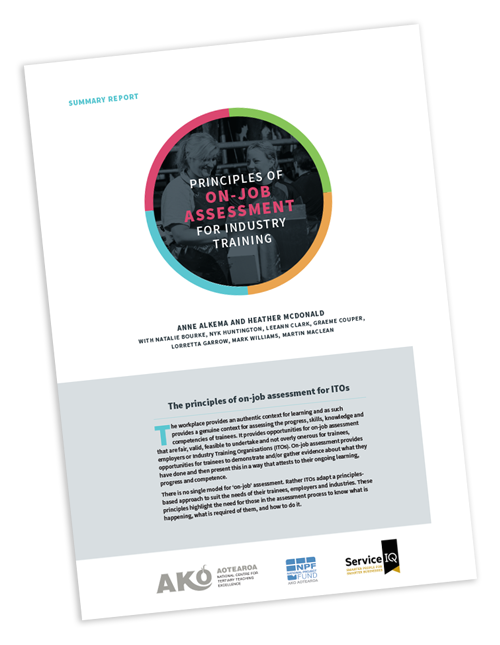
Review of good assessment practice in industry training

While there is no single model for ‘on-job’ assessment, these reports identify four key ‘Principles of on-job assessment for industry training’ that organisations can use to suit the needs of their trainees, employers and industries.

They also include reflective questions that organisations can use to guide professional conversations about on-job assessment.

The four organisational case studies provide specific examples of the assessment processes and practices that each organisation uses to meet the needs and demands of the specific industry, workplace and trainee involved.

Resource download:

Background:

A project, completed in 2016, that reviewed assessment practices used by industry training organisations (ITOs) to identify models of good practice. This guide builds on Vaughan and Cameron’s (2010) principles and practices for on-job assessment work in 2012.

A collaboration of five ITOs, including ServiceIQ, BCITO, Primary ITO, The Skills Organisation and Competenz.

Report prepared for ServiceIQ and Ako Aotearoa by Anne Alkema and Heather McDonald, Heathrose Research Ltd.


Co-funded by the Ako Aotearoa National Project Fund (NPF)

Posted in Industry specific resources | Leave a comment

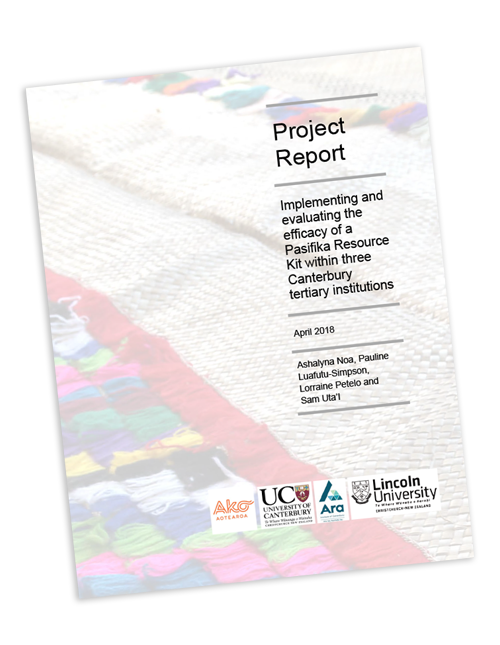
Implementing and evaluating the Pasifika success toolkit within Canterbury tertiary organisations

This report documents the implementation and evaluation of a Pasifika Success Toolkit at three Canterbury Tertiary institutions.

Success could be defined quite differently for Pasifika students compared to how institutions measure success; so the study began by establishing what ‘success’ meant to Pasifika students. Once they were able to identify and better understand what Pasifika students saw as success, then effective strategies that would enhance and support Pasifika success within tertiary institutions could be developed.

The five Pasifika Success Indicators in the downloadable tool demonstrate quality practice that students identified as having a significant influence on their perceived pathways to success.

Each indicator has a list of suggested approaches that staff can use to either continue to support an existing initiative or to establish an approach in their department or institution.

Resource download:

Supporting videos:

A group of Pacific students talk about what success means to them.

Three students share their experiences of being Pasifika students at University.

University staff talk about what they learnt from the Pasifika success workshops and how it has impacted their practice.

University staff reflect on difficulties with enhancing Pasifika student success within their institutions and what can be done to improve Pasifika success in their institutions.

Background:

This two-year project builds on the finding of the project Change strategies to enhance Pasifika student success at three Canterbury tertiary institutions. It is a continuing collaboration of the University of Canterbury, Ara Institute of Canterbury and Lincoln University, and focused on amplifying the Pasifika student perspective through the completion and implementation of a Pasifika Resource kit as identified and recommended by the previous project.

Report prepared by Ashalyna Noa, Pauline Luafutu-Simpson, Lorraine Petelo and Sam Uta’I.


Co-funded by the Ako Aotearoa National Project Fund (NPF)

Posted in Pacific learner success | Leave a comment

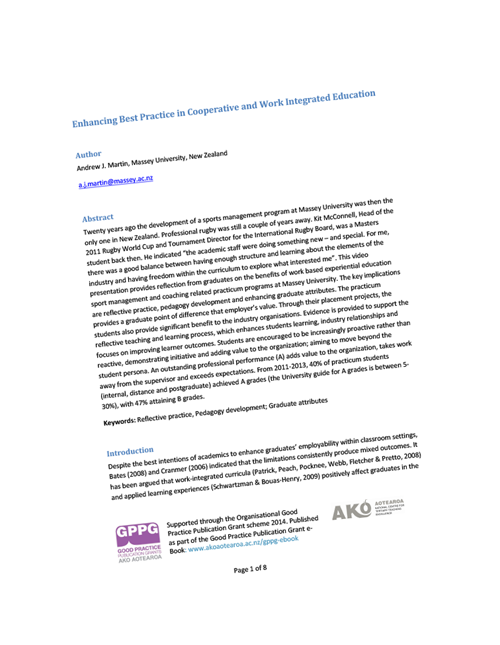
Enhancing best practice in cooperative and work-integrated education

This report details the benefits of work-based experiential education and coaching-related practicum programmes as a part of the sports management program at Massey University.

The supporting videos offer reflections from graduates.

Download the report:

Supporting videos:

Background:

A project completed in 2014 at Massey University, to develop a good practice guide on the benefits of work-based experiential education and coaching-related practicum programmes at Massey University.

Research report prepared by Andrew Martin.


Co-funded by the Ako Aotearoa Regional Hub Project Fund (RHPF)

Posted in Workplace learning | Leave a comment

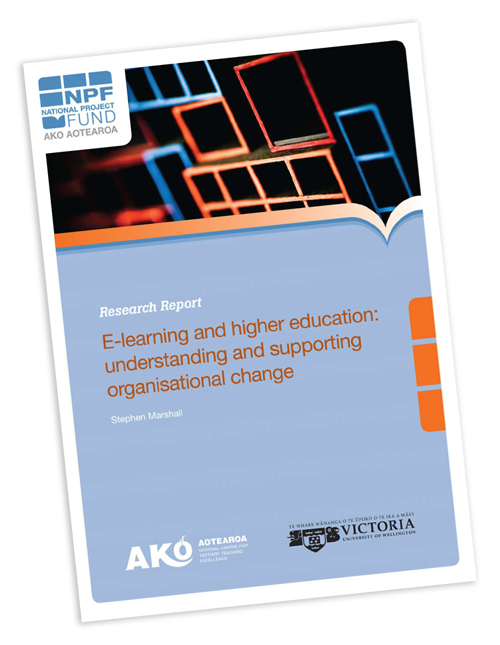
Understanding and supporting organisational change in e-learning

This report, and accompanying case studies, examine e-learning capabilities in the New Zealand tertiary sector.

Over an 18-month period four educational institutions − a New Zealand university, PTE (private training establishment), wānanga and ITP (institute of technology or polytechnic) − have engaged in a process of change influenced by technology. Their e-learning capability was benchmarked using the e-learning Maturity Model (eMM) and this information used to stimulate and support change activities.

The report identifies five factors as significant influences on the ability of organisations to change in response to technology in the educational landscape of the New Zealand tertiary sector.

Resource download:

Background:

A 2-year project, completed in 2012, to examine e-learning capabilities in the New Zealand tertiary sector and technology-driven institutional change management approaches, by applying the e-learning Maturity Model (eMM).

A collaboration of Victoria University, Massey University, AUT University, University of Auckland, University of Canterbury, Waikato Institute of Technology, New Zealand Tertiary College and Te Whare Wānanga o Awanuiārangi.

Reports prepared by Stephen Marshall.


Co-funded by the Ako Aotearoa National Project Fund (NPF)

Posted in Online learning | Leave a comment

Learners’ needs and practice-based learning informing tertiary teaching

This report shares information to assist educators to actively connect teaching with workplace learning. The parameters of the project were confined to learners’ needs regarding child and youth health as that is a high impact field of learning for practice nurses.

Though focussed on the healthcare sector, this report could provide a foundation from which to develop innovative teaching and learning materials to address the practice-based learning needs identified.

Download the report:

Background:

A project completed in 2010 at Christchurch Polytechnic Institute of Technology, to use a collaborative research process to gather information to assist educators to connect teaching with workplace learning for practice nurses.

Research report prepared by Philippa Seaton, Paul Watson, Jane Mountier and Deborah Sims.


Co-funded by the Ako Aotearoa Regional Hub Project Fund (RHPF)

Posted in Workplace learning | Leave a comment

Institutional programme-design strategies supporting forced change

The earthquake of February 22nd 2011 required Christchurch educational institutions to cope with the consequences of a natural disaster. CPIT re-developed or designed programmes of learning with a focus on student learning and flexible delivery.

In this report, case studies of six selected programmes were analysed to derive a set of guidelines, based on sustainable programme design related strategies, to assist NZ educational institutes to be better prepared for unforeseen disasters.

Download the report:

Background:

A project, completed in 2012 at Christchurch Polytechnic Institute of Technology (CPIT), to investigate the impact of forced change on CPIT courses and decisions made with regards to programme design and the accompanying effect on students.

Research report prepared by Selena Chan and Martin Jenkins.


Co-funded by the Ako Aotearoa Regional Hub Project Fund (RHPF)

Posted in Curriculum | Leave a comment

Integrated assessment for Māori youth learners entering tertiary education for the first time

Entering tertiary education for the first time can be a daunting experience for Māori youth who leave mainstream education with few or no qualifications and a history of truancy, or exclusion from mainstream education.

This report looks at the process of integrated assessment for learners who might struggle with traditional assessment. It offers recommendations for building organisational capability to ensure long-term sustainability of integrated assessment approaches.

Download the report:

Background:

A project completed in 2011, undertaken by Matapuna Training Centre, Gisborne, to investigate the use of integrated assessment with Māori youth learners entering tertiary education for the first time.

The project focus was to gather naturally occurring evidence towards achievement of units (including elective units) linked to the National Certificate in Employment Skills (NCES) Level 1 while students engaged in day to day course activities.

Research report prepared by Hannah Hohapata.


Co-funded by the Ako Aotearoa Regional Hub Project Fund (RHPF)

Posted in Māori learner success | Leave a comment

Information maps: Supporting students through Their research and writing processes

Information Maps (imaps) provide a visual description of the sources students have engaged with over the research stages of a project. An imap typically includes information about the sources themselves, where they were found, and how they relate to the topic of interest.

This report discusses ways that students benefited from the use of imaps during their studies, and offers recommendations for supporting the use of imaps to promote students’ research and writing process.

Download the report:

Background:

A project, completed in 2009 at Massey University, to explore how imaps can be used to enhance information literacy, reduce plagiarism and enhance feedback on students’ research and writing processes.

Report prepared by Lisa Emerson, Sharon Stevens and John Muirhead.


Co-funded by the Ako Aotearoa Good Practice Publication Grants scheme (GPPG)

Posted in Curriculum | Leave a comment

Industry oriented mathematics

This report documents pilot study of an industry-oriented maths approach within four Institutes of Technology and Polytechnics’ Bachelor of Engineering Technology (BEngTech) programmes. It aimed to discover support required by students to be able to apply the purely theoretical maths taught in the current course to industry related maths problems.

The finding could be transferable to other subject areas, for example, mathematics courses in finance, health and computing.

Download the report:

Background:

A project, completed in 2015, to identify and test an industry-oriented maths approach within four Institutes of Technology and Polytechnics’ Bachelor of Engineering Technology (BEngTech) programmes.

This is important to the learner as achievement in mathematics is integral to other aspects of the engineering programme. Understanding the mathematical underpinning of engineering processes is a basic building block of all engineering disciplines, although the ways these are applied to the different engineering specialties does differ.

A collaboration of Otago Polytechnic, Waikato Institute of Technology, Christchurch Polytechnic Institute of Technology and Wellington Institute of Technology.

Research report prepared by Ziming Tom Qi.


Co-funded by the Ako Aotearoa Regional Hub Project Fund (RHPF)

Posted in Industry specific resources | Leave a comment

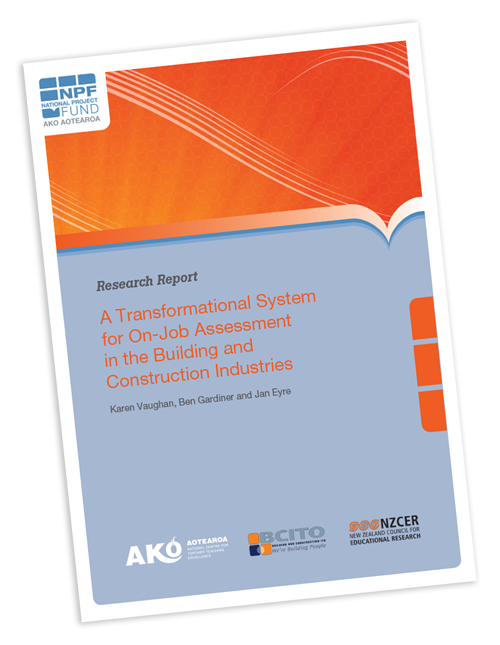
Transforming industry-led assessment of learning in the building and construction industries

This report introduces a set of four high-level principles for developing and maintaining good assessment systems for industry training organisations (ITOs) to ensure the right knowledge and skills are being assessed.

It also highlights the importance of good communication between ITOs and employers, and the need for ITOs to support employers so that employers and their workplaces can, in turn, support their apprentices.

While it is focussed on one ITO specifically—the BCITO— it will be of use for the assessment of on-job learning across all industry training organisations (ITOs).

The accompanying guide, Taking Charge of your Apprenticeship, was created to help learners manage their apprenticeship.

Resource download:

Background:

A project, completed in 2012, to highlight effective systems of on-job assessment and show how these systems can build organisational capability and improve outcomes for learners.

A collaboration of the New Zealand Council for Educational Research (NZCER) and the Building and Construction Industry Training Organisation (BCITO).

Research report prepared by Karen Vaughan, Ben Gardiner and Jan Eyre.


Co-funded by the Ako Aotearoa National Project Fund (NPF)

Posted in Trades training | Leave a comment

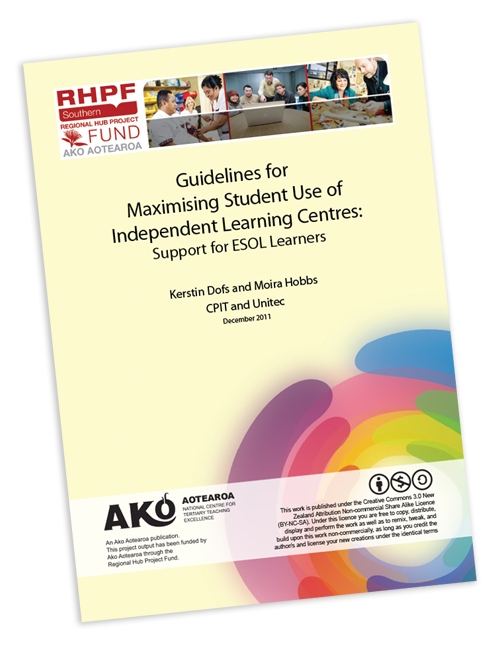
Guidelines for maximising student use of Independent Learning Centres

This report suggests good practice guidelines for the running of Independent Learning Centres (ILCs), and provision of autonomous learning support, with the aim of supporting learners and maximising student use of ILCs.

Download the report:

Background:

A project, completed in 2011, to add to a growing body of knowledge in the field of self-access and autonomous learning by investigating and presenting an up-to-date snapshot of current practices of student support in a range of ILCs throughout the country.

A collaboration of Christchurch Polytechnic Institute of Technology and Unitec Institute of Technology.

Research report prepared by Kerstin Dofs and Moira Hobbs.


Co-funded by the Ako Aotearoa Regional Hub Project Fund (RHPF)

Posted in Student engagement | Leave a comment

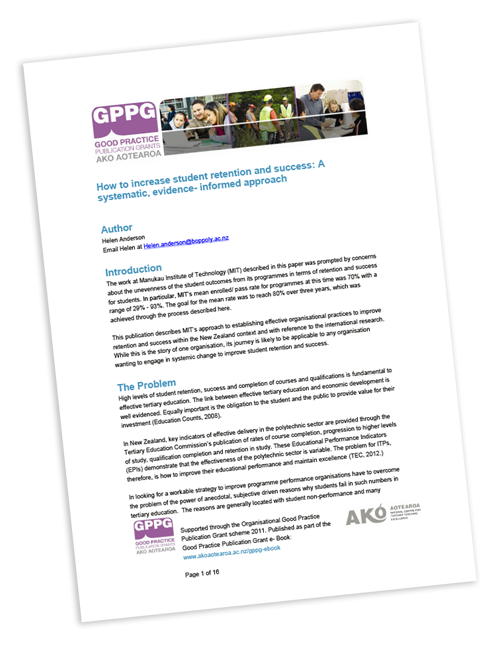
How to increase student retention and success

A systematic, evidence-informed approach

This report describes an organisational approach to establishing effective practices to improve retention and success within the New Zealand context and with reference to the international research.

While this is the story of one organisation, its journey is likely to be applicable to any organisation wanting to engage in systemic change to improve student retention and success.

Download the report:

Background:

A project, completed in 2012 at Manukau Institute of Technology, to establish effective organisational practices to improve retention and success.

Research report prepared by Helen Anderson.


Co-funded by the Ako Aotearoa Good Practice Publication Grants scheme (GPPG)

Posted in Student engagement | Leave a comment

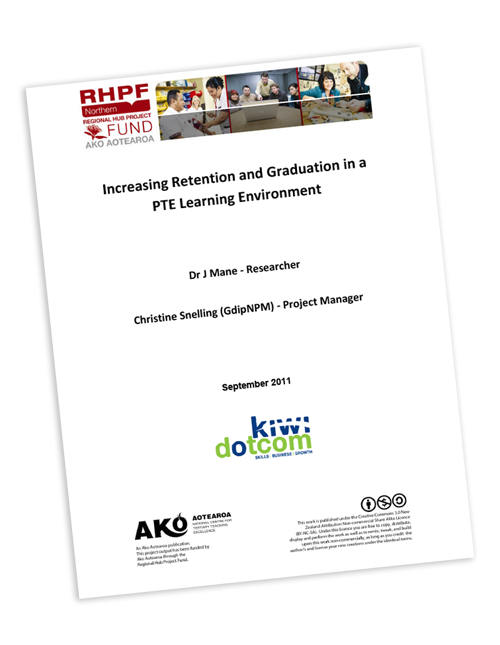
Increasing retention and graduation in a PTE learning environment

This report documents the causes of learners withdrawing or not completing courses of study in a Northland Private Training Establishment (PTE), and shares practices which are working effectively in keeping at least 60% of learners engaged to completion.

Download the report:

Background:

A project completed in 2011, undertaken by Northland PTE Kiwidotcom, to identify the main reasons for non-completion of chosen courses of study, and investigate strategies and initiatives that keep students involved to completion.

Research report prepared by Jo Mane and Christine Snelling.


Co-funded by the Ako Aotearoa Regional Hub Project Fund (RHPF)

Posted in Student engagement | Leave a comment

Inakitia Rawatia hei Kakano mō Āpōpō: Students encounter with bicultural commitment

This report documents an investigation to gain a deeper understanding of the importance of truly integrating a bicultural component in initial teacher education (ITE) programmes.

Resource download:

Background:

A project, completed in 2014, to better understand student encounters with biculturalism; their understanding of te ao Māori (the Māori world) from their past experiences; and the new learning that will occur during their study in an initial teacher education (ITE) programme.

A collaboration of the University of Canterbury and Rangi Ruru Early Childhood College.

Research report prepared by Diane Gordon-Burns and Leeanne Campbell.


Co-funded by the Ako Aotearoa Regional Hub Project Fund (RHPF)

Posted in Māori learner success | Leave a comment

Improving science communication skills through scenario-based role plays

Translating scientific results, conclusions and recommendations into language easily understood by non-experts is a critical skill for scientists and science learners.

These reports document the development and evaluation of a suite of scenarios that can be used as real-time role-plays that develop communication skills.

Through these role-plays, learners can gain experience in realistic and challenging situations where they need to rapidly respond in an uncertain environment, and effectively communicate with a range of stakeholders.

Resource download:

Background:

A project, completed in 2016, to help scientists and science learners learn how to translate scientific results, conclusions and recommendations into language easily understood by non-experts.

A collaboration involving the University of Canterbury, University of Otago, Nga Pae o te Maramatanga, Massey University Joint Centre for Disaster Research, Mercalli Consulting and GNS Science Joint Centre for Disaster Research.

Reports prepared by Jacqueline Dohaney, Erik Brogt, Thomas Wilson, Emma Hudson-Doyle, Ben Kennedy, Jan Lindsay, Brendon Bradley, David Johnston, Darren Gravley.


Co-funded by the Ako Aotearoa National Project Fund (NPF)

Posted in Curriculum | Leave a comment

Improving participation, retention and progression of Māori tertiary learners in the Whanganui region

This report details an investigation by two Private Training Establishments (PTEs) to develop co-joint and/or complementary programming to improve participation, retention and progression of Māori tertiary learners. 

It may be of use to other organisations looking to create a collaborative approach to learner success.

Download the report:

Background:

A project, completed in 2009, to investigate how two Private Training Establishments (PTEs) could improve the participation, retention and progression of Māori Tertiary Learners, and more specifically, Tangata Whenua, of the Whanganui region. A collaboration of Whanganui Learning Centre Trust and Tupoho Whanau Trust.

Research report prepared by Gail Harrison, George Marshall and Aroha Beckham. 


Co-funded by the Ako Aotearoa Regional Hub Project Fund (RHPF)

Posted in Māori learner success | Leave a comment

Improving the effectiveness of large-class teaching in law degrees

This report identifies effective methods for teaching large classes supported by limited hours of small group, face-to-face teaching.

Download the report:

Background:

A project completed in 2012 at the University of Canterbury, to identify effective methods for improving the effectiveness of large-class teaching in law degrees. 

Research report prepared by Lynne Taylor, Ursula Cheer, Neil Boister, Elizabeth Toomey, Sascha Mueller and Debra Wilson.


Co-funded by the Ako Aotearoa Regional Hub Project Fund (RHPF)

Posted in Curriculum | Leave a comment

Implementing a mentoring model for teachers in the tertiary education environment

This report offers recommendations to provide institutions or individuals with strategies to enhance the implementation and sustainability of an institute-wide mentoring programme.

Download the report:

Background:

A project, completed in 2012, to implement a model for mentoring that provides a contextualised framework for supporting learning and teaching practices across a tertiary education environment that contributes to the achievement of learner success. A collaboration of Universal College of Learning and Eastern Institute of Technology.

Research report prepared by Lesley Petersen and Janet Walke.


Co-funded by the Ako Aotearoa Regional Hub Project Fund (RHPF)

Posted in Coaching & mentoring | Leave a comment

Identification of tutor practices that achieve positive outcomes for Youth Guarantee students

This report shares case studies of good practices that influence the achievement of positive outcomes for Youth Guarantee (YG) students. It offers recommendations that private training establishments (PTE) could take to further develop their YG tutors’ pedagogical practice.

The accompanying guide offers suggestions for educators or organisations looking to develop a Communities of Practice as a pedagogy support mechanism for teaching teams in the New Zealand PTE environment.

Resource download:

Background:

This project, completed in 2016, aimed to identify and describe tutor good practices which influence the achievement of positive outcomes for YG students. A collaboration between Workforce Development Ltd and G&H Training Ltd.

Report prepared by Anne Greenhalgh, Erena Fussell and Dr Lesley Petersen.


Co-funded by the Ako Aotearoa Regional Hub Project Fund (RHPF)

Posted in Educational transitions | Leave a comment

Making the invisible visible: Illuminating undergraduate learning outcomes beyond content and skill

This report introduces a framework for unpacking the complex dimensions of graduate attributes that are often considered aspirational or ‘invisible’.

It provides a language by which ‘invisible’ attributes can be conceptualised in terms of their observable behaviours, which can then be actively developed rather than viewed as innate qualities of an individual.

The framework also provides a basis for conversation between students, lecturers and employers, so that expectations and evidence can be clarified within and across these groups.

Download the report:

Background:

Education is more than just content and skills acquisition. It enhances each student’s approach to learning, self-efficacy, professional readiness and disciplinary awareness. However, this learning is often invisible on academic transcripts – and to employers and students themselves.

Making the Invisible Visible was a two-year research project, completed in 2019, that aimed to identify and develop a framework to observe, analyse and report on ‘invisible’ graduate attributes, and to enable staff to identify and incorporate these ‘invisible’ graduate attributes into course design.

A collaboration between The University of Auckland and Victoria University of Wellington.

Report prepared by Dr Barbara Kensington-Miller, Dr Alys Longley, Dr Sean Sturm and Andrea Mead – University of Auckland, Dr Amanda Gilbert and Dr Bernadette Knewstubb – Victoria University of Wellington, and Alison Cleland – Auckland University of Technology.


Co-funded by the Ako Aotearoa National Project Fund (NPF)

Posted in Curriculum | Leave a comment

WBL – A new learning paradigm: The learner, employer and facilitator experience

This report documents the findings from a study into the effectiveness of degree level Work Based Learning (WBL). It It introduces of a set of guiding principles for WBL practice and delivery, that have been trialled and evaluated in undergraduate degree programmes offered by Otago Polytechnic.

The report also offers a set of recommendations as a means of improving the overall quality of the programme and the experience of learners, employers and facilitators.

Download the report:

Background:

A project, completed in 2014 at Otago Polytechnic, to investigate and evaluate the impact of degree level Work Based Learning (WBL) in the New Zealand context and whether or not there is real benefit and value from WBL focused inquiry projects for both learner and the employer.

Research report prepared by Keith Tyler-Smith.


Co-funded by the Ako Aotearoa Regional Hub Project Fund (RHPF)

Posted in Workplace learning | Leave a comment

How does mentoring training affect the quality of mentoring in two Industry Training Organisations?

This report explores the impact of mentoring training on the quality of mentoring engagement and provision in ITOs.

It includes recommendations for ITOs and other tertiary education providers to support future apprentice mentoring activities.

Download the report:

Background:

A project, completed in 2016, to determine the impact of mentoring training on the quality of the mentoring support provided by coordinators and supervisors and on apprentice learning outcomes such as retention, credit achievement, completion and progression, in the New Zealand ITO context.

A collaboration of the Building and Construction Industry Training Organisation and the Hairdressing Industry Training Organisation.

Research report prepared by Greg Durkin, Erica Cumming, Rex McGill and Lesley Petersen.


Co-funded by the Ako Aotearoa Regional Hub Project Fund (RHPF)

Posted in Trades training | Leave a comment

Hūtia Te Punga | Lift up the anchor

Relational based practices for strengthening cultural connectedness for Māori learners in trades training, agriculture and the polytechnic sector.

These reports detail a project to drive systems-level change to improve the educational experience and outcomes for Māori learners. It explores the impact of Culturally Responsive Professional Learning and Development (CRPLD) for educators on Māori learning success.

The Hūtia Te Punga reports provide research insights from three very different tertiary programmes. It highlights both challenges faced by educators and examples of best practice. If offers recommendations for education providers and workplaces as to how the learning environments and completion rates of Māori in vocational education could be improved.

The accompanying workshop guide helps educators think more deeply about their own work and experiences. What can you learn that will enable you to more effectively ensure the success of Māori tauira as Māori?

Resource download:

Supporting videos:

Four tutors talk about what Culturally Responsive Teaching looks like at Telford.

Janine from Otago Polytechnic talks about Māori student success from a leadership perspective and some of the strategies that they have implemented.

Background:

This project, completed in 2019, was a two year collaborative partnership with Ako Aotearoa, Te Tapuae o Rehua, Otago Polytechnic, the Building and Construction ITO and Taratahi Agricultural Training Centre.

The focus of the research project was to better understand the needs of the ITP and ITO sectors by scoping and probing different learning contexts, and making recommendations as to how outcomes for Māori learners in vocational education could be improved.

Research report prepared by Dr Porsha London, Dr Sonja Macfarlane, Sharon Armstrong, Dr Eruera Tarena, Dr Wayne Duncan, Claire McIntyre, Dr Joe Kuntz, Janine Kapa, Vai Punivai, Piripi Prendergast, Melany Tainui and Brett Fleming.


Co-funded by the Ako Aotearoa National Project Fund (NPF)

Posted in Māori learner success | Leave a comment

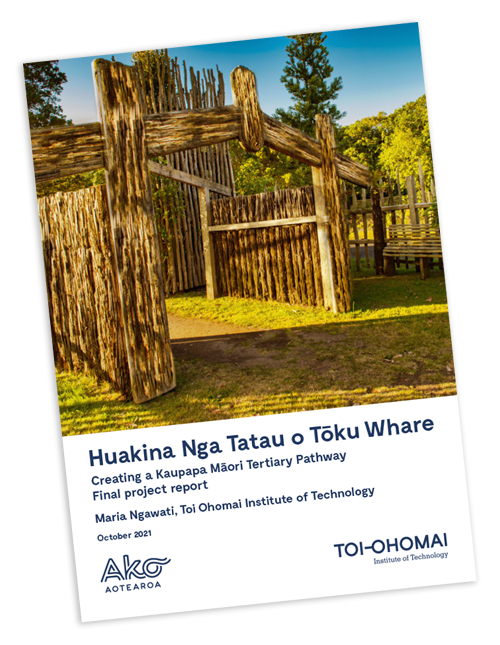
Huakina ngā tatau o tōku whare

Creating a Kaupapa Māori secondary tertiary pathway for Māori Medium students

This report documents the delivery and evaluation of Mātauranga Māori programme to Māori students, with content delivered in Te Reo Māori across the subject areas of Health, Education and Social Sciences in a tertiary setting. 

The report highlights institutional capabilities that develop Māori learner-centred systems, thereby increasing Māori student success.

Download the report:

Background:

This project, completed in 2021 at Toi Ohomai Institute of Technology, developed from the want to increase Kura Kaupapa Māori student participation in our local tertiary programmes, as a way of increasing the number of culturally and clinically qualified Māori health professionals.

It aimed to create a Kaupapa Māori secondary-tertiary pathway for Māori Medium students within the subject areas of Health, Education and Social Services. The programmes aimed to close the gap between Māori medium and Kura Kaupapa Māori learners and the tertiary sector by designing, delivering and evaluating a L2 and L3 programme that is written with University Entrance approved Te Marautanga o Aotearoa NCEA credits , in Te Reo Māori, to Kura Kaupapa Māori students.

Research report prepared by Maria Ngawati, Toi Ohomai Institute of Technology.


Co-funded by the Ako Aotearoa Regional Hub Project Fund (RHPF)

Posted in Māori learner success | Leave a comment